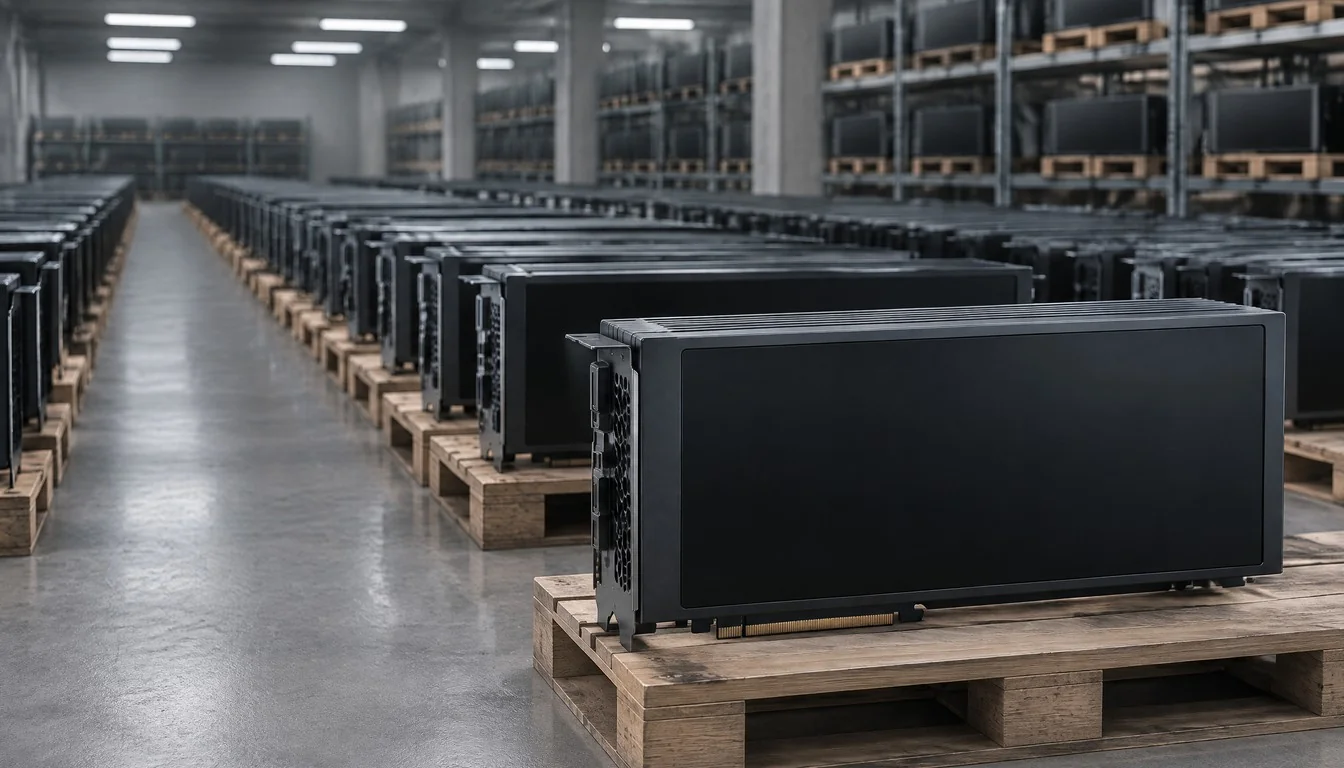
Nvidia’s AI chips are the one piece of hardware both Washington and Beijing want to control, and on November 10, 2026 the fight over them has three live fronts. Reuters reported on November 5 that about 600,000 of Nvidia’s advanced AI chips sit in Hong Kong while Beijing withholds approval for large-volume imports into mainland China. IDC data reported by Reuters puts Nvidia’s share of China’s data-center AI-chip market at 34% in the first half of 2026.
A third front opened inside Nvidia itself. Reports say the company now requires affected cloud customers to earn at least 51% of their revenue outside China, which caps Chinese customers at 49%. Washington gets a say in the H200 trade as well, since reports describe a 25% cut of approved sales going to the U.S. government. If you want the earlier thread, our report on the firm the U.S. cleared for H200 chips covers one corner of how licensing played out.
This analysis sorts what outlets have confirmed from what remains reported or unproven. We rely on Reuters, IDC figures reported by Reuters, AFP, and the other outlets named in the sections below. Where a claim lacks independent confirmation, we say so. We also place the story inside our AI and machine learning coverage, because the chip fight now shapes which models get trained, where, and at what cost.
Don't miss new tech stories on Google
Add Shattered once in the Google app and our stories show up in your news suggestions.
The Chips at the Center: H200, Blackwell and Rubin #
Three Nvidia product families define the dispute. The H200 is the older of the three and the only one with a path to China. Blackwell is the current flagship generation, and U.S. export controls bar its direct sale to China. Rubin, the generation after it, is also described in reporting as barred from export to China.
That tiering is the whole logic of Washington’s approach. China can buy last-generation silicon under conditions, but it cannot buy the newest chips that would speed up its frontier model training. Nvidia’s chief executive and co-founder, Jensen Huang, has to sell into that framework while his largest customers lobby for more access and his government lobbies for less.
| Chip family | Status for China (as reported) | Condition or caveat |
|---|---|---|
| H200 | Previously barred, later permitted for approved Chinese customers | Reported 25% cut to the U.S. government on approved sales |
| Blackwell (including B300) | Barred from direct sale to China | Servers still reported on gray markets at premium prices |
| Rubin | Described as barred from export to China | Newest generation, no approved route reported |
| Hong Kong stockpile | About 600,000 advanced chips awaiting shipment | Beijing has not approved large-volume H200 imports |
| Cloud-provider rule | At least 51% of revenue must come from outside China | Applies to new contracts, reportedly worldwide |
The table shows an unusual setup for an export-control regime. The U.S. permits one product, blocks two, and takes a payment on the permitted one. China, the supposed beneficiary of the opening, has not rushed to use it.
How U.S. Export Controls Reached This Point #
U.S. export controls have restricted China’s access to advanced Nvidia chips since 2022, according to the reporting this story draws on. That date matters because it frames every later move as a patch on the original rule. Each new Nvidia product designed for the Chinese market invited a new round of questions about whether it crossed the line.
Four years of tightening and loosening
The policy has not moved in one direction. Washington tightened controls to slow China’s AI progress, then eased them for the H200 when the cost to American suppliers became visible. The result is a regime that restricts the newest silicon and sells the previous generation with strings attached. Our reading is that the strings, including the reported 25% cut, tell you the U.S. treats this as a managed trade rather than a pure ban.
Why the 2022 date still shapes the market
Four years of restrictions pushed Chinese buyers to build habits around gray channels, stockpiles, and domestic alternatives. A chip ban rarely makes demand disappear. It reroutes demand, and the reroutes become the new story. That is why today’s headlines are about Hong Kong warehouses and cloud contracts rather than direct shipments from Santa Clara to Shanghai.
The H200 Compromise and Washington’s 25% Cut #
The H200 was barred from China before the U.S. permitted sales to approved Chinese customers under conditions. Reports say the U.S. government receives a 25% cut of approved H200 sales. Outlets describing the arrangement include the Straits Times and the Times Now coverage cited in our research.
Two points deserve care. First, reports that Alibaba, ByteDance, and DeepSeek could receive permission to buy limited quantities of H200 chips describe a possibility, not completed purchases. We treat that claim as unconfirmed. Second, a 25% cut is a reported figure and we have not seen the underlying terms published.
The compromise also shifts leverage. A permitted sale needs two approvals, one from Washington and one from Beijing. Washington’s yes means little if Beijing says no, and that is exactly the bind the Hong Kong stockpile shows. For Nvidia, a license on paper does not equal revenue in the ledger.
Beijing’s Brake: Why Chinese Approval Is the Bottleneck #
Beijing had not approved large-volume H200 imports into mainland China at the time of the Reuters report. That is the single most surprising fact in the story, because it flips the usual narrative. The common assumption holds that Washington blocks and Beijing begs. Here, Washington opened a door and Beijing held it shut.
Reports point to a mix of motives. Chinese officials appear wary of relying on American technology and eager to give domestic suppliers room to grow, with Huawei the most prominent rival. The reporting we reviewed describes this as reluctance, not a formal ban, so we do not claim a policy decision beyond what outlets confirmed.
Tech firms still want the chips. Reuters described demand from technology companies even as approval stalled. That gap between corporate appetite and state caution explains why inventory is piling up rather than moving. It also means the timing of any approval could swing Nvidia’s China numbers quickly in either direction.
600,000 Chips in Hong Kong: The Stockpile Problem #
About 600,000 of Nvidia’s advanced AI chips were reported stored in Hong Kong while they await approval for shipment to mainland China, according to Reuters, which cited two people familiar with the matter. Nobody has published an audited count, so treat the number as a sourced estimate. Even so, it is large enough to matter for Nvidia’s inventory, for its customers’ cash, and for the wider supply chain.
Think about what a pile that size means. Chips sitting in a warehouse earn no return for the buyer, tie up capital, and age as newer generations arrive. If approval comes late, some of that hardware may feel dated against what rivals can access. If approval never comes, the buyers must resell, reroute, or write the stock down.
The stockpile also gives regulators a visible target. A concentrated inventory in one city draws scrutiny that scattered shipments never would. Our coverage of the Megaspeed affiliates and their Nvidia gear shows how quickly questions about where chips end up become headline news.
The 51% Rule: Nvidia Polices Its Own Cloud Customers #
Nvidia’s reported new cloud-provider rule requires affected customers to generate at least 51% of revenue from customers outside China. That limits Chinese customers to 49%. Yahoo Finance and Business Insider both ran reports on the policy in the days before this article, and reports say it applies to new contracts and to Nvidia partners worldwide.
The target is the cloud backdoor. A Chinese company that cannot buy a Blackwell chip can still rent time on one in a third country. The 51% threshold tries to stop a data center abroad from becoming a Chinese compute farm in all but name. Whether it works depends on how Nvidia audits customer revenue, and no outlet has published those audit details.
There is a business cost as well. A hard cap on Chinese revenue forces cloud operators to turn away customers they might otherwise welcome. Smaller regional providers that built their model around Chinese tenants face the sharpest choice, because they cannot easily replace that demand. Nvidia accepts that friction to show Washington it is policing its own channel.
The Compliance White List Cuts Asian Buyers by More Than Half #
Nvidia reportedly more than halved the number of Asian companies authorized to purchase its AI chips after it introduced a stricter compliance white list. Exact counts were not in the sources we reviewed, so we can describe the direction but not the totals. The move fits the same pattern as the 51% rule, with Nvidia tightening its own gate before regulators force it to.
A white list changes who gets to be a middleman. Distributors and integrators that once handled orders across Asia now need to clear a higher bar to keep buying. Some will fall off the list entirely, and that shrinks the number of places where chips can leak. It also shrinks the number of legitimate resellers, which can raise prices for honest customers.
Compare this with the stockpile. The white list narrows supply on the Nvidia side while Beijing’s caution narrows demand on the Chinese side. Both squeezes hit the middle, which is where Hong Kong inventory and gray-market traders live.
Gray Markets: Blackwell Servers at More Than 20 Million Yuan #
Servers using newer Blackwell chips were reportedly offered for more than 20 million yuan each. A rack containing B300 processors was reportedly sold for about $2.8 million in China in October 2026. Both figures come from reporting that we could not tie to a documented transaction, so read them as price signals rather than audited sales.
Those prices say something even if the details stay fuzzy. Hardware that is barred from direct sale still commands a steep premium in China, which proves that demand is intense and supply is tight. High prices also give smugglers and intermediaries a strong incentive to find a route.
Claims that Chinese companies obtained restricted Nvidia chips through smuggling or third-country data centers stay unconfirmed. The available reporting presents them as possibilities, not established facts. We will not claim more than the sources do, and neither should readers who share the screenshots circulating on social media.
| Claim | Source type | Our status |
|---|---|---|
| About 600,000 chips stored in Hong Kong | Reuters, two people familiar | Reported, not independently audited |
| Nvidia holds 34% of China’s data-center AI-chip market in H1 2026 | IDC, via Reuters | Reported by a named research firm |
| 51% non-China revenue rule for cloud customers | Multiple outlets, including Yahoo Finance and Business Insider | Reported, applies to new contracts |
| B300 rack sold for about $2.8 million in October 2026 | Press reports | Reported, no transaction record seen |
| Blackwell servers offered above 20 million yuan | Press reports | Reported, price signal only |
| Chips obtained via smuggling or third-country data centers | Possibility raised in reporting | Unconfirmed |
| Alibaba, ByteDance, DeepSeek approved for limited H200 purchases | Report says they could receive permission | Unconfirmed, no completed purchases shown |
IDC’s 34% Figure: What Share Means in a Restricted Market #
IDC’s data, reported by Reuters on October 13, puts Nvidia’s share of China’s data-center AI-chip market at 34% in the first half of 2026. For a company that once treated China as a core growth region, that number reads as a retreat. A third of the market is still a large business, though, and no other foreign vendor sits near it.
Share figures in a restricted market need a caution label. They count what shipped, not what customers wanted. If Nvidia could sell freely, the number would almost surely differ, and if Beijing approved the Hong Kong stockpile, the second half of the year would look different from the first. IDC measures a constrained outcome, not a competitive one.
Domestic rivals led by Huawei have gained ground, according to the Reuters report, and that trend is the real risk for Nvidia. A customer who learns to run models on a domestic chip does not return easily. Each quarter of constrained supply gives Chinese software teams another quarter of practice on non-Nvidia hardware, and that habit can outlast any later policy loosening.
Competitive Comparison: Nvidia, Huawei, Google and Amazon #
Nvidia no longer fights only AMD for a place in the data center. Domestic Chinese silicon pushes from one side, and in-house chips from the big American clouds push from the other. Our earlier look at Google’s TPU sales ambitions explains why Nvidia’s grip on the global market feels less certain than its share suggests.
| Supplier | Position in the China story | What the sources support |
|---|---|---|
| Nvidia | Largest foreign supplier, constrained by U.S. rules and Beijing’s caution | 34% share in H1 2026 per IDC via Reuters |
| Huawei | Leading domestic rival, closing the gap | Reuters reports domestic rivals led by Huawei gained ground |
| Other domestic Chinese vendors | Beneficiaries of Beijing’s push for local supply | Described in general terms, no figures in our sources |
| Google TPU | Competes with Nvidia in the global market | Not described as sold into China in this reporting |
| Amazon Trainium and Microsoft Maia | In-house chips for their own clouds | Not described as sold into China in this reporting |
For a deeper look at how the American cloud giants build their own silicon, see our comparison of Trainium3 and Maia 300. Those chips matter here because they widen the set of buyers who could one day reduce their Nvidia dependence, which shrinks Nvidia’s bargaining power everywhere, not only in China.
What Chinese AI Labs Can Still Do With Nvidia Hardware #
Analyst Lian Jye Su told AFP that Chinese vendors are still using cutting-edge Nvidia chips to train their models. We paraphrase that statement here because we cannot independently confirm the exact wording beyond AFP’s report. We also cannot quantify how widespread the practice is, and the sources we reviewed do not either.
The statement is plausible given the other facts. Stockpiled hardware, gray-market servers, and overseas cloud rentals give Chinese teams several routes to restricted compute. The 51% rule and the white list exist because Nvidia and Washington suspect those routes carry real traffic. Still, suspicion differs from proof, and no outlet has named a specific model trained on a barred chip.
The next step in the story is evidence. If regulators or journalists trace a prominent Chinese model to restricted hardware, the political pressure for tighter rules will jump. If they cannot, the 51% rule may prove to be mostly a signal to Washington. Our report on the Nvidia case and the Chinese intelligence threat shows how thin the public record still is on that kind of attribution.
Market Impact: Investors, Suppliers and Cloud Customers #
Investors face two different China stories at once. One is a revenue story, where a 34% share and a pile of unshipped chips cloud the forecast. The other is a policy story, where any shift from Washington or Beijing can rewrite estimates overnight. Nvidia stock has already swung hard in recent sessions, as our coverage of the S&P 500 move as Nvidia fell shows, though other issues also drove that selloff.
Cloud operators outside China must now think about customer mix as a compliance item. A provider that leans too heavily on Chinese tenants risks losing access to new Nvidia supply. Component suppliers, meanwhile, watch whether the stockpile ever ships, since a release would trigger a burst of demand across servers and networking gear.
Chinese tech firms pay the highest price. They either wait in the approval queue, pay gray-market premiums, or pivot to domestic chips that may need software rework. Each option costs time, and in an AI race time is the scarcest input. We expect the next Nvidia earnings call, scheduled for Nov. 17 according to our earlier preview, to bring China commentary that analysts will parse line by line.
What Washington Wants and Cannot Give Up #
Washington wants two things that pull against each other. It wants China to lag in frontier AI, and it wants American companies to keep the revenue and the ecosystem lock-in that come from selling the world’s best accelerators. Selling the H200 with a 25% cut tries to split the difference. Blocking Blackwell and Rubin protects the lead where it matters most.
The political side is heated. Congressional Democrats have opened questions about Nvidia and its leadership, which our piece on Jeffries and the three chip bills explains in more detail. Pressure from both parties to look tough on China makes any further loosening hard to sell at home.
America will not give up this market because the chips are its leverage. Control over the supply of top accelerators gives Washington a tool it cannot easily replace, and any sale that weakens that tool needs a strong justification. That tension, more than any single rule, explains why policy keeps shifting in small, conditional steps.
Five Predictions for Nvidia and China #
These are our judgments, not reported facts, and we hold them loosely.
- Beijing approves a partial release. A limited approval of stockpiled chips looks more likely than a full one, because it relieves buyers without ending Beijing’s domestic push.
- The 51% rule gets tested. Expect at least one public dispute over how Nvidia measures a customer’s revenue mix.
- Blackwell and Rubin stay barred through the next policy cycle. The political cost of loosening them is too high right now.
- Domestic share keeps climbing. Constrained supply gives Huawei and other local vendors more time to improve, so Nvidia’s 34% looks like a ceiling for now rather than a floor.
- Evidence of misuse drives the next rule. A documented case of a restricted chip in a Chinese training run would move Washington faster than any lobbying campaign.
Each of these hinges on facts that could change within weeks. Watch Nvidia’s November 17 call, any Beijing statement on H200 imports, and the next IDC or Reuters data point for signs that the picture is shifting.
Frequently Asked Questions #
Can China buy Nvidia’s newest chips right now?
No. Blackwell chips are subject to U.S. export controls and are not permitted for direct sale to China. Rubin GPUs are also described as barred. The H200 is the exception, and only for approved customers under conditions.
What is Nvidia’s share of China’s AI-chip market?
IDC data reported by Reuters put it at 34% of China’s data-center AI-chip market in the first half of 2026. The figure reflects constrained supply, so it does not measure what Chinese buyers would purchase in an open market.
Why are 600,000 Nvidia chips sitting in Hong Kong?
Reuters reported on November 5 that the chips await shipment to mainland China while Beijing withholds approval for large-volume imports. The count comes from two people familiar with the matter and is not independently audited.
What is Nvidia’s 51% rule?
Reports say affected cloud customers must earn at least 51% of their revenue from customers outside China, which caps Chinese customers at 49%. It applies to new contracts and reportedly to Nvidia partners worldwide.
Does the U.S. government profit from H200 sales to China?
Reports say the U.S. government receives a 25% cut of approved H200 sales. We have not seen the underlying terms published, so the figure stays a reported one.
Are Chinese companies smuggling Nvidia chips?
That is unconfirmed. The available reporting presents smuggling and third-country data centers as possibilities, not established facts. Nvidia’s white list and the 51% rule exist partly to close those routes.
Did Alibaba, ByteDance and DeepSeek get approval to buy H200 chips?
The cited report says they could receive permission to buy limited quantities. It does not say purchases were completed, so we treat the claim as unconfirmed.
Why does Beijing hold back if Chinese firms want the chips?
Reports point to concern about reliance on U.S. technology and a wish to give domestic suppliers such as Huawei room to grow. No outlet has described a formal ban, only a on large-volume approvals.