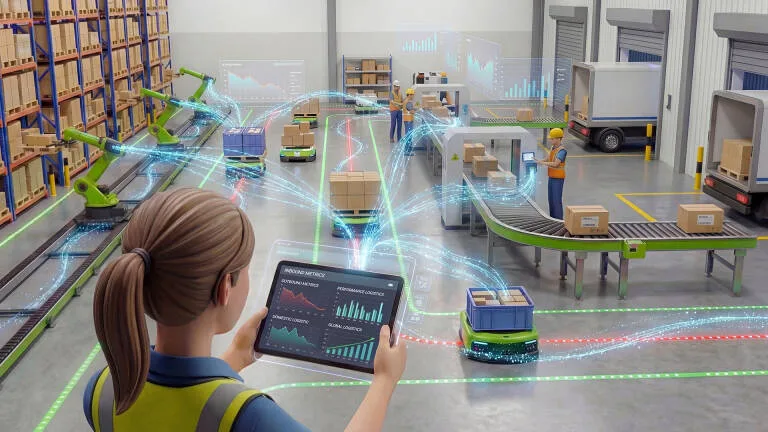
Moving a chip from the fabrication plant to a functioning data center rack is a logistical nightmare. NVIDIA measures this as "time-to-rack," while everything from power-on to the first generated token is "time-to-token." To stop these processes from becoming bottlenecks, they've integrated Nemotron LLMs directly into Palantir Foundry. This isn't just about having a chatbot; it's about codifying the messy, undocumented expertise of supply chain managers into a system that can actually predict delays.
Why standard RAG failed for their supply chain #
Most companies try to solve internal knowledge gaps with basic Retrieval-Augmented Generation (RAG). I've seen this fail repeatedly when the data is locked in fragmented PDFs or legacy spreadsheets. NVIDIA hit the same wall. Supply chain data is too volatile for static documents.
They shifted to a "digital twin" approach using Foundry. Instead of just searching for a document, the LLM queries a structured ontology. If a shipment of H100s is delayed at a port, the system doesn't just find a "shipping policy" PDF; it identifies the specific SKU, the affected data center, and the downstream impact on customer delivery dates.
Testing Nemotron against the supply chain data #
In my experience benchmarking these models, Nemotron handles technical, domain-specific jargon better than general-purpose models because it's tuned for NVIDIA's specific ecosystem. When they use it inside Foundry, the workflow looks like this:
-
Data ingestion from ERP systems into the Foundry ontology.
-
Natural language queries from managers (e.g., "Which clusters are at risk due to the power delivery delay in the North region?").
-
Nemotron processes the query against the structured data, not just raw text.
-
The output is a verified data point, not a hallucinated guess.
The cost of implementation and the risk of "black box" logic #
Implementing this isn't cheap. Palantir Foundry licenses are notoriously high-ticket, and the compute required to run Nemotron at scale across a global supply chain is significant. The biggest risk here is "model over-reliance." If the ontology is mapped incorrectly—for example, if a "wafer-out" date is mislabeled as a "ship-date"—the LLM will confidently give the wrong answer.
The only way to prevent this is a strict human-in-the-loop verification process. NVIDIA manages this by allowing users to click back to the source record in Foundry to verify the LLM's claim. If you can't trace a token back to a database row, the AI is useless for supply chain management.
When to use this architecture #
Don't build this if you have a simple inventory. This level of complexity is only necessary when:
- Your "lead time" involves multiple international hand-offs.
- You have a "time-to-token" style metric where hardware installation is the primary bottleneck for revenue.
- Your internal expertise is concentrated in a few veteran employees rather than a wiki.
If you're trying to replicate this on a smaller scale, start by building a clean ontology (a map of how your objects relate) before you even think about plugging in an LLM. Without the structured data layer, you're just chatting with a glorified search engine. Next NVIDIA BioNeMo Inference Runtime cuts structure prediction latency by using CUDA Graphs →
All Replies (3) #
I'm curious if this actually fixes the thermal throttling issues. I remember a 400W spike during my last rack deploy...
I want to try this tonight. Does Nemotron handle the telemetry via gRPC or is it just REST?
Finally! My last deployment took three weeks just to clear the BIOS errors. Wonder if Foundry handles the 404s on the NICs?