From acquiring competitors to investing billions in former rivals, Nvidia is redrawing the AI chip industry's battle lines Nvidia has spent over $27 billion on investments, acquisitions, and partnerships with companies that were, until very recently, its direct competitors. The strategy, orchestrated by CEO Jensen Huang, is turning the AI chip market from a zero-sum brawl into something closer to a solar system, with Nvidia firmly at the center.
The most recent move: a $2 billion investment in Marvell Technology, announced ahead of early July 2026. Before that, a $5 billion co-development deal with Intel. And before that, a $20 billion acquisition of AI inference chip startup Groq.
The AI factory playbook #
Huang’s overarching strategy has a name: the “AI factory.” The concept is deceptively simple. Nvidia wants to control the full stack of AI infrastructure, from chips to software to networking, while partnering with companies that have mastered the specific technologies Nvidia doesn’t want to build from scratch.
The Marvell investment is a textbook example. Marvell specializes in networking silicon and photonics, the kind of connectivity plumbing that becomes critical when you’re linking thousands of GPUs together in massive data center clusters. Rather than spending years developing that expertise internally, Nvidia wrote a $2 billion check to lock Marvell into its ecosystem.
The Intel deal, worth $5 billion and announced in September 2025, is arguably the more striking partnership. Intel was supposed to be the company that challenged Nvidia’s GPU dominance. Instead, it’s now a collaborator. The multi-year agreement covers co-development of chip technology, effectively transforming Intel from a would-be rival into a contract partner.
The Groq acquisition and what it signals #
The $20 billion acquisition of Groq in December 2025 was perhaps the boldest move in this entire sequence. Groq had carved out a niche in AI inference, the process of running trained AI models to generate outputs. Its custom-designed Language Processing Units (LPUs) were built specifically to make inference faster and cheaper than traditional GPU-based approaches.
Nvidia’s dominance has been built primarily on AI training, the computationally brutal process of teaching models to do their thing. Inference is a different beast, one that’s growing faster as companies move from building AI models to actually deploying them at scale. By absorbing Groq, Nvidia plugged a hole in its portfolio before it became a vulnerability.
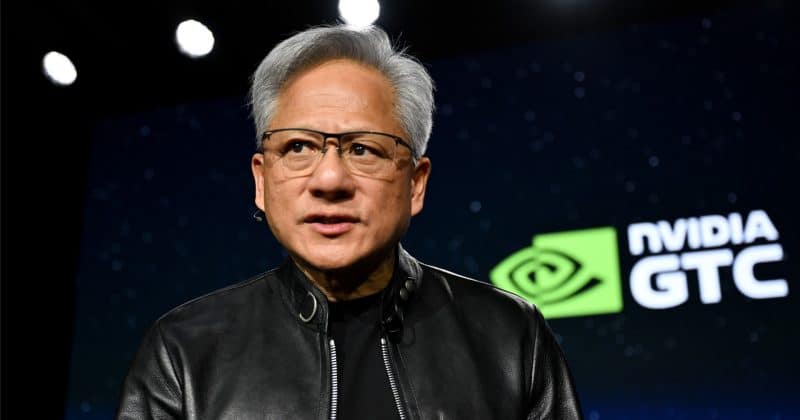
At GTC 2026, Nvidia unveiled ecosystem-wide support for its Rubin architecture, which is scheduled for production. The company also underscored its focus on AI token generation, referring to the outputs produced by large language models during inference.
Why crypto markets should pay attention #
Nvidia’s partnerships with hyperscalers like AWS and Meta to deploy large-scale AI factories mean that centralized AI compute is consolidating rapidly. Every dollar Nvidia pours into making its centralized stack more efficient and more integrated raises the bar for decentralized alternatives.
The “AI factory” model also creates interesting dynamics around tokenized compute. Nvidia’s repeated emphasis on “token” production, while referring to AI model outputs rather than blockchain tokens, highlights a conceptual overlap that decentralized AI projects have been trying to exploit. If AI inference output is increasingly measured and priced per token, the infrastructure for metering, trading, and financializing that output could eventually intersect with blockchain-based systems.
No specific crypto tokens have been directly tied to Nvidia’s initiatives. But the architecture Nvidia is building, one where AI compute is standardized, metered, and deployed through factory-like systems, creates exactly the kind of commoditized resource that tokenization models tend to target.
Nvidia’s $27 billion in combined investments and acquisitions represents a bet that the AI infrastructure market will consolidate around a few dominant platforms rather than fragmenting across dozens of competitors. Those outside its orbit, whether traditional chipmakers or decentralized compute networks, will need to find increasingly creative reasons to exist.
Disclosure: This article was edited by Editorial Team. For more information on how we create and review content, see our