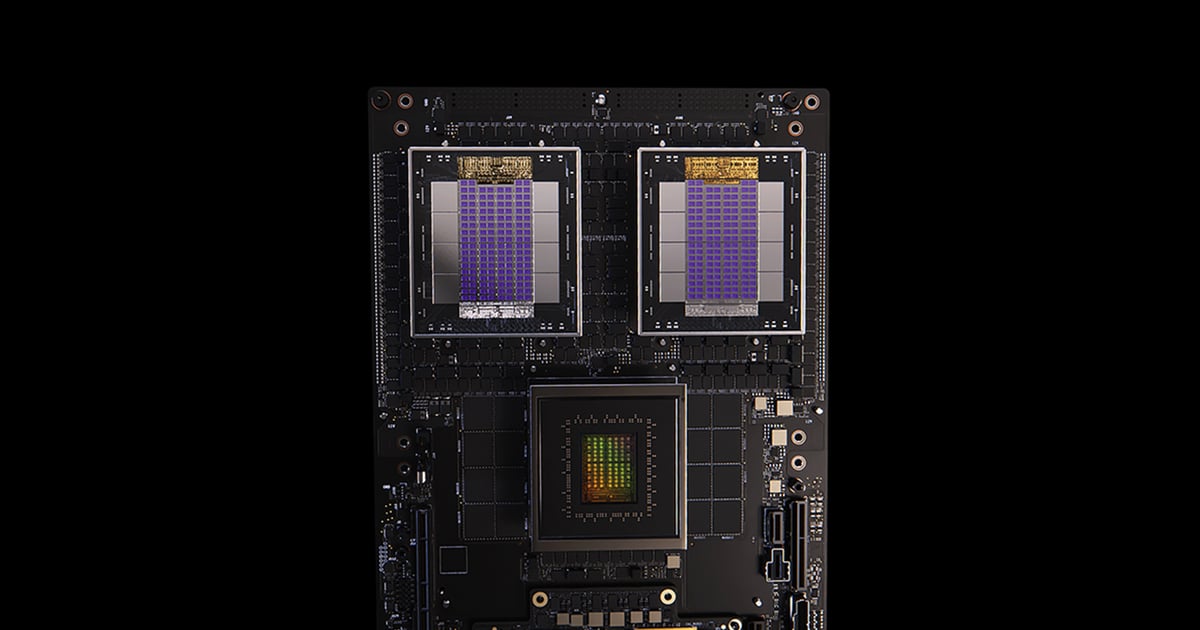
Nvidia is opening its rack-scale AI systems to custom chips, giving hyperscalers more flexibility as they seek alternatives to off-the-shelf GPUs.
Nvidia is opening its rack-scale AI infrastructure to custom accelerators from hyperscalers and other AI developers, expanding its NVLink technology beyond Nvidia's own processors.
The expanded partnership with MediaTek will let customers develop custom AI accelerators, or XPUs, using Nvidia's NVLink Fusion platform. MediaTek will offer the platform as a design foundation for its custom XPU customers.
Nvidia also invested $3.5 billion in convertible bonds issued by MediaTek.
“Ultimately, this gives customers more freedom to innovate without having to rebuild the entire AI factory around custom silicon,” said Dion Harris, senior director of HPC and AI hyperscale infrastructure solutions at Nvidia, during a media Q&A Monday.
The announcement comes as hyperscalers develop their own processors for AI workloads. AWS has Trainium and Inferentia, Google has TPU and Microsoft has developed Maia accelerators.
Custom Chips and AI Factories #
Nvidia says NVLink Fusion provides a prevalidated foundation for bringing custom XPUs into Nvidia-connected AI factories.
The platform combines NVLink Fusion connectivity with NVLink-C2C, NVHBM and chiplet technologies. Customers can use Nvidia intellectual property for elements of their systems while retaining control over their custom accelerator designs.
“Customers can focus on differentiated compute,” Harris said.
MediaTek will provide SoC design and packaging capabilities for customers developing the XPUs, while Nvidia provides connectivity and rack-scale infrastructure technologies.
“Production AI factories require packaging, HBM, I/O and networking,” Harris said. Customers also have to qualify and certify rack-scale systems at data center scale.
Nvidia's MGX ecosystem provides rack-scale infrastructure around the processors.
“We've built out this incredible ecosystem, which is what we call MGX, that now all these customers can tap into, and they don't have to go and reinvent the wheel,” Harris said.
The companies did not identify customers developing XPUs through the MediaTek relationship or announce a specific data center deployment.
Heterogeneous AI #
The partnership comes as AI infrastructure becomes more diverse.
Matt Kimball, vice president and principal analyst at Moor Insights & Strategy, said AI systems will use a broader mix of processors as inference workloads become a larger part of computing demand.
“Heterogeneity is the future of AI,” Kimball said.
That includes custom silicon developed by hyperscalers such as AWS and Google, as well as specialized accelerators being developed elsewhere in the market, Kimball said.
The processors need high-speed connections to communicate within large systems.
“There are effectively three options,” Kimball said. “Scale up Ethernet, NVLink Fusion and UALink.”
Ethernet is the established approach. NVLink Fusion is Nvidia's scale-up technology for connecting custom accelerators to Nvidia infrastructure. UALink is an open standard being developed by a group of chip and infrastructure companies, with AMD among its supporters.
“These fabrics are to make scale up easier and more performant,” Kimball said. “Both require broad ecosystem support to be meaningful.”
Nvidia Builds the NVLink Ecosystem #
Nvidia announced NVLink Fusion in May 2025 and has since expanded the number of companies supporting the technology.
MediaTek joins Astera Labs, Marvell, Samsung and AIchip in supporting NVLink Fusion for custom silicon, according to Kimball.
Arm, Intel, Qualcomm and SiFive have also announced support on the CPU side.
Harris said Nvidia's goal is to make the technology available to a broad range of customers.
“This will be available to all of MediaTek's custom XPU partners,” Harris said.
AWS is also adopting NVLink Fusion. Harris said AWS plans to use a mix of its own processors and Nvidia infrastructure, including NVLink-C2C and NVLink switch technology.
The licensing model for NVLink Fusion has not been disclosed.
“There will be some licensing elements in place,” Harris said.
UALink Challenges NVLink #
UALink provides an open-standard alternative to Nvidia's proprietary interconnect technology.
AMD is among the companies championing UALink and is incorporating it into its Helios rack-scale AI platform.
Helios combines 72 AMD MI455X accelerators with EPYC processors and Pensando networking. AMD is using UALink for scale-up connectivity and Ethernet-based networking for scale-out.
The competing approaches are part of a broader effort to connect increasing numbers of accelerators within AI systems.
Nvidia's strategy is to make NVLink available beyond Nvidia GPUs.
“Nvidia is an AI infrastructure company,” Harris said. “Customers need different architectures, for different workloads.”
Beyond the Accelerator #
Nvidia is also expanding NVLink beyond GPU-to-GPU connectivity.
Harris said NVLink-C2C can connect CPUs and GPUs at the chip level, while NVLink switch technology provides scale-up connectivity between processors.
Nvidia uses Spectrum-X Ethernet and InfiniBand for scale-out networking.
The company is positioning those technologies as complementary parts of its networking stack.
“It's not about ownership, per se,” Harris said when asked whether Nvidia's longer-term objective is to control AI infrastructure architecture regardless of which accelerator is inside the rack.
“It's really about being able to take all the technologies that we've built over the last several decades, and offering that to the ecosystem.”
The MediaTek partnership also extends beyond data center infrastructure.
The companies are continuing work on local AI computing, including future RTX Spark and DGX PC platforms, as well as automotive systems using MediaTek technology and Nvidia AI and graphics.
For the data center market, the immediate expansion is NVLink Fusion and its support for custom accelerators from MediaTek's customers.