TL;DR — Key Takeaways
- NVIDIA’s latest results sharply undercut speculation about a near-term default, with revenue, profits and margins all showing extraordinary financial strength.
- The bigger story is NVIDIA’s expanding role across the AI infrastructure stack, from GPUs and networking to financing, supply commitments and infrastructure support.
- NVIDIA’s reported $12.9 billion acquisition of Hugging Face would extend that reach into the open-model ecosystem and potentially give it a marketplace for directing workloads toward available compute.
A few days ago, I came across an Electronics Weekly article headlined “Could NVIDIA Default?”. It was not satire, but after NVIDIA’s latest earnings report, the headline belongs closer to The Onion than to a serious assessment of the company’s credit.
The article was not wrong about the size of NVIDIA’s financial commitments. NVIDIA has agreed to provide as much as $105 billion of residual-value support for an Ohio data center campus where OpenAI will be the tenant. Its commitments to suppliers have also exploded as it races to secure memory and other components.
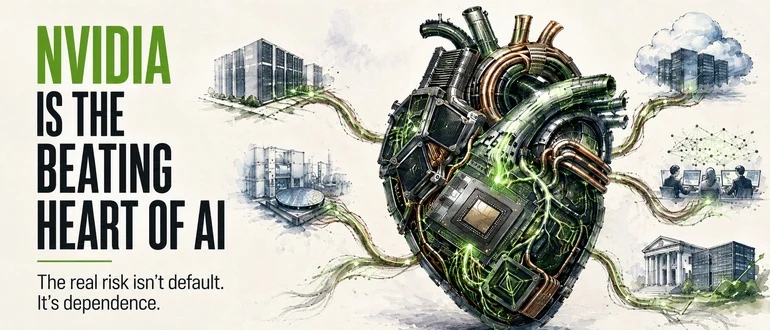
Those facts deserve attention. But moving from those facts to speculation about an NVIDIA default is like looking at the heart of a marathon runner, noticing how much blood it is pumping and concluding that the athlete must be on the verge of cardiac arrest. It mistakes evidence of extraordinary exertion for evidence of imminent failure.
NVIDIA’s fiscal second-quarter results provide the necessary reality check. The company generated $96.2 billion in revenue in three months, an increase of 106% from a year earlier. Net income reached $59.7 billion. Data center revenue was $89 billion, up 117%. Gross margin remained at 75%.
For the current quarter, NVIDIA expects revenue of approximately $108 billion without assuming any data center compute revenue from China. Management also forecasts revenue growth of roughly 70% in fiscal 2028, far above the approximately 45% growth Wall Street had expected. Jensen Huang says demand would support even faster growth; the constraint is how much product NVIDIA and its suppliers can produce. That is not the financial profile of a company approaching default. It is the profile of a company generating so much cash, and occupying such a powerful market position, that it can use its balance sheet as another competitive weapon.
Demand Is Being Locked In Years Ahead
The earnings report provides the snapshot of NVIDIA’s current strength. Two other developments show how much of the next wave of AI infrastructure is already being built around the company.
AWS and NVIDIA announced plans to deploy 2 million additional NVIDIA GPUs across AWS’s global infrastructure in 2027–2028. AWS says that capacity is additional to the more than 1 million NVIDIA GPUs it previously planned to add beginning in 2026. The expanded collaboration also calls for Vera CPU-based infrastructure and 100,000 GPUs on secure AWS infrastructure for federal and national-security workloads.
Separately, TechCrunch reported that Anthropic has signed a roughly $45 billion, six-year agreement to rent compute from Nscale. That capacity is expected to use NVIDIA Vera Rubin systems and begin serving Anthropic in late 2027.
These are not spot purchases made to satisfy a temporary rush. Hyperscalers and frontier labs are reserving NVIDIA-based capacity years in advance. No announcement guarantees that every forecast will be fulfilled, but these commitments reinforce both the durability of NVIDIA demand and the concentration risk at the center of this story. As more future capacity is built around NVIDIA, the question becomes how all that compute will be kept productively deployed.
And Then Came Hugging Face
As if the earnings were not enough to answer the default question, NVIDIA was also reported to have agreed to acquire Hugging Face for $12.9 billion. At the time of writing, neither company had officially confirmed the transaction, so the details may change or the deal may not be completed. But its strategic importance is already visible.
Hugging Face reportedly generates only about $150 million in annualized revenue. NVIDIA would therefore be paying roughly 86 times revenue, an extraordinary price if this were merely the acquisition of a software subscription business. The price makes more sense if NVIDIA sees Hugging Face as the demand and distribution layer for the open-model economy.
Hugging Face sits between millions of developers and an enormous collection of models, datasets, tools and deployment choices. It can see which models are attracting attention, which workloads are emerging and where developers want to run them. Under NVIDIA, that marketplace could direct more activity toward NVIDIA hardware and clouds filled with NVIDIA systems.
It could also help NVIDIA find customers for unused capacity. If an AI lab or neocloud provider cannot consume all the compute it committed to use, Hugging Face could provide a channel through which NVIDIA finds other developers and workloads. This is NVIDIA’s claim that its compute is fungible put into action. NVIDIA would possess not only the hardware but also a marketplace capable of moving demand toward capacity that might otherwise sit idle.
The juxtaposition of the earnings and Hugging Face news matters. The earnings show NVIDIA has the financial capacity to keep expanding its role in AI. Hugging Face shows the ambition behind that expansion. NVIDIA is not content to be the dominant supplier of AI compute. It wants to own or influence the places where demand for that compute is created, discovered and deployed.
More Than a Chip Company
For most of the AI boom, we have described NVIDIA as the company selling the picks and shovels. That analogy is badly out of date. NVIDIA is now helping finance the mines, secure the land and power, invest in the mining companies and build the marketplace through which the gold will be sold. NVIDIA designs the GPUs, CPUs, networking equipment and complete systems. It controls CUDA, the software platform on which much of modern AI development depends. It is locking up memory, advanced packaging and manufacturing capacity years in advance. It invests in model developers, neocloud providers, infrastructure companies and startups. It is working with Apollo, BlackRock, Blackstone, Brookfield, Goldman Sachs and KKR on platforms intended to mobilize more than $500 billion of third-party capital for AI infrastructure.
NVIDIA is also providing selective credit support, residual-value protection and revenue-sharing arrangements. In some structures, NVIDIA can be paid when the hardware is sold and again through a share of the rental revenue.
This is where accusations of circular financing enter the discussion. The simplified version goes something like this: NVIDIA helps finance a customer, the customer uses that financing to buy NVIDIA systems, and NVIDIA reports the sale as revenue.
The actual arrangements are more complicated. Independent investors still underwrite the transactions. The financing can involve private capital, special-purpose vehicles, infrastructure owners, leases, residual-value guarantees and revenue-sharing agreements. NVIDIA argues that it is being well compensated for accepting a limited and carefully structured portion of the risk. That defense has merit, but it does not mean there is no economic loop.
NVIDIA commits to buying enormous quantities of components. AI companies want the resulting systems but may not have the cash flow or credit to finance them. NVIDIA helps outside capital enter the transaction and may support a portion of the infrastructure’s future value or revenue. The customer deploys NVIDIA technology. NVIDIA recognizes the hardware revenue and may participate in future rental income. Those purchases then become further evidence of demand for NVIDIA products.
The demand is not fake. AI companies really do want more compute than the market can currently deliver. But demand, customer financing, supplier commitments and NVIDIA revenue are becoming increasingly interconnected.
The Balance Sheet Becomes a Moat
NVIDIA disclosed approximately $366 billion in future commitments at the end of the quarter. That includes $279 billion in supply and capacity commitments, up from $119 billion just three months earlier, primarily to secure memory. The remainder includes cloud service agreements, future data center leases, equity investments and capital expenditures.
These commitments should not simply be added to NVIDIA’s guarantees and labeled debt. They cover multiple years. Some support products NVIDIA expects to sell at a substantial profit. Others are investments or conditional obligations rather than bills that must immediately be paid. The maximum value of a guarantee is not the same as an expected loss.
Nevertheless, conventional debt increasingly understates NVIDIA’s real economic exposure. The company has commitments on both sides of its business. It is promising suppliers that it will take components while helping ensure that customers can finance the systems containing those components.
The most revealing statement during the earnings call was not the 70% growth forecast. NVIDIA said AI labs for which it expects to leverage its balance sheet could account for roughly one-quarter of its business next year. Its financial support for the AI ecosystem is not a small venture-investment program sitting at the edge of the company. It is becoming material to NVIDIA’s growth.
That does not necessarily make the strategy reckless. NVIDIA may be uniquely positioned to execute it. The company understands the technology, the supply chain, customer demand and the secondary market for compute better than the banks and private credit firms providing most of the capital. It can evaluate the assets and influence where they are deployed. Above all, NVIDIA believes its compute is fungible and durable. If one customer cannot use the capacity, the hardware can be reassigned to another.
That assertion is central to the strategy. It also helps explain why Hugging Face is not some unrelated software acquisition. Fungibility is not merely a property of the hardware; it requires a market capable of matching available capacity with new workloads. Hugging Face could become that market, making NVIDIA’s claim that GPU compute can be redeployed far more credible.
Put the pieces together and the scale of NVIDIA’s ambition becomes clearer. NVIDIA supplies the compute, secures the components, helps finance the infrastructure, supports portions of its residual value, participates in rental revenue and may soon own the marketplace through which developers find models and compute. That is more than vertical integration. NVIDIA is becoming the circulatory system of AI.
There is, however, a substantial risk in acquiring Hugging Face. The platform became important in part because it was perceived as neutral ground for the open AI community. It supports models and deployment options across NVIDIA hardware and competing systems from AMD, Intel, Google and others.
Would those alternatives receive equal visibility under NVIDIA ownership? Would benchmarks, search results and deployment recommendations remain neutral? Would developers and competing chipmakers be comfortable giving NVIDIA visibility into their activity?
NVIDIA would not need to deliberately disadvantage anyone for that perception of neutrality to disappear. The acquisition could prompt parts of the community to look for a new independent home.
The Risk Is Concentration, Not Default
There is a genuine risk story here, but it is not the one suggested by the default headline.
AI labs depend on NVIDIA for compute. Neoclouds depend on NVIDIA systems and increasingly on financing structures NVIDIA helps make possible. Infrastructure developers depend on its commitments. Memory and packaging suppliers are building capacity around its forecasts. Hyperscalers depend on NVIDIA to expand their AI services. Investors depend on the assumption that AI infrastructure spending will continue climbing. Developers may soon depend on an NVIDIA-owned marketplace to find and deploy open models.
NVIDIA has become the living, beating heart of AI because it pumps both compute and capital through nearly every part of the system. That position gives NVIDIA extraordinary power. It also creates extraordinary concentration. NVIDIA can almost certainly absorb the failure of an individual AI lab, a guarantee being triggered or a temporary inventory problem. The more serious scenario would involve several assumptions failing together: AI monetization disappoints, customers struggle to meet infrastructure obligations, GPU rental rates decline, new architectures shorten the economic life of existing hardware, memory prices remain elevated and outside capital becomes less willing to finance further construction.
That would not necessarily cause NVIDIA to default. But it would transmit losses and reduced spending through AI labs, neoclouds, private credit funds, data center developers, utilities, suppliers and the broader semiconductor industry.
This is a version of what I call the indispensability trap. Becoming indispensable is the ultimate competitive achievement. But indispensability also pulls responsibilities and risks toward you. Problems that once belonged to customers, suppliers and financiers become your problems because the market has come to depend on you to keep the system moving.
NVIDIA has moved up and across the stack so successfully that the boundary between NVIDIA and the AI infrastructure market is beginning to blur. Its balance sheet is now a moat alongside CUDA, GPUs, networking and systems engineering. Its willingness to finance and support the ecosystem makes NVIDIA harder to compete with and makes the ecosystem more dependent on NVIDIA.
So forget the clickbait about whether NVIDIA might default. The more consequential development is that NVIDIA has cemented itself as the indispensable infrastructure company of the AI era. NVIDIA is the heart pumping compute and capital through the entire system. The risk worth watching is not whether that heart suddenly stops. It is how much of the AI economy now depends on it never missing a beat.