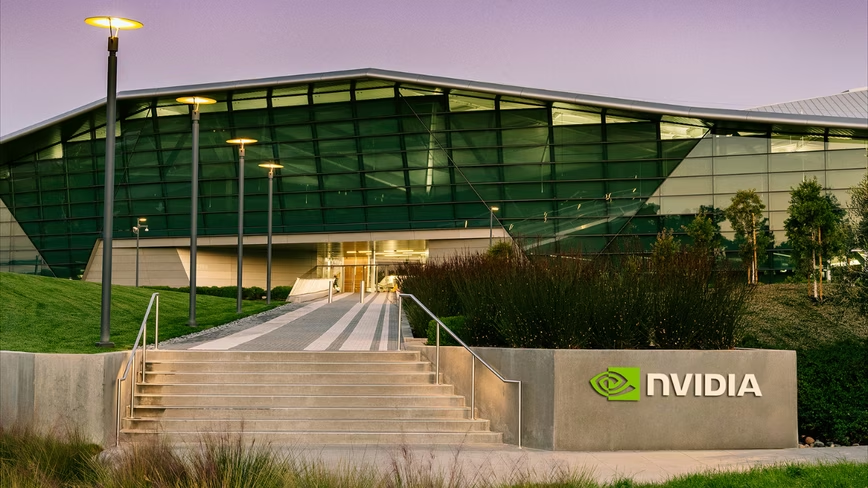
Nvidia is reportedly in talks to guarantee about $250bn of financing for OpenAI, a backstop that would let the ChatGPT maker fund a vast new data centre without the investment-grade credit rating such borrowing normally demands. The arrangement was described by the Wall Street Journal on July 26, and neither company has confirmed it.
The guarantee would not involve Nvidia handing over cash. It is a promise to cover the obligations if OpenAI or the project falls short, the sort of vendor support that has already drawn scrutiny as circular financing spreads through the AI economy. For a chipmaker that has spent the year making AI equity bets at a pace few rivals can match, it is another way of underwriting demand for its own hardware.
The money is tied to a 10-gigawatt campus in southern Ohio, developed by an energy subsidiary of SoftBank and leased by OpenAI, according to the Journal.
The $250bn would cover the data-centre lease and the construction debt behind it, with a further sum of up to $350bn discussed separately to fund chip purchases, potentially pushing the total project cost beyond $500bn.
The two tranches are being negotiated on different tracks, and none of the terms, including the fee Nvidia would charge for the guarantee, has been made public.
OpenAI does not carry an investment-grade rating, which makes borrowing on that scale expensive and, in places, impossible. Nvidia’s promise to stand behind the debt is what would make lenders comfortable, and it fits a wider shift in which OpenAI is trying to own more of its infrastructure rather than rent it from Microsoft, Amazon, and Oracle.
Nvidia, for its part, secures years of guaranteed demand for the chips at the centre of the build, which is the whole point of standing behind someone else’s debt.
The talks extend a relationship the two firms formalised last autumn. In September 2025 Nvidia said it would invest up to $100bn in OpenAI as part of a partnership to deploy 10 gigawatts of its systems, a deal both sides billed at the time as the largest AI infrastructure project yet attempted.
If the guarantee now under discussion goes ahead, it would dwarf that commitment, turning a headline equity stake into a far larger and more entangled bet on OpenAI’s ability to pay. The reception this weekend was sceptical. Michael Burry, the investor of The Big Short fame, wrote “around and around we go”, noting that Nvidia would be guaranteeing spending that ultimately flows back to Nvidia.
His post put the figure at $200bn, below the $250bn in the Journal’s account. The tech critic Ed Zitron called the structure “such an insane thing to do on so many levels”.
The unease is partly structural. A guarantee of this size behaves like a debt obligation on Nvidia’s balance sheet even if OpenAI never misses a payment, which could weigh on the company’s financial flexibility and invite questions from credit markets.
Nvidia has spent much of the cycle offering AI firms compute now, payment later, and a backstop of this kind is the same logic scaled up.
Capital may not even be the binding constraint. Power for the Ohio site is government-controlled, with allocation overseen by the US Commerce Secretary, Howard Lutnick, and part of the supply funded by Japan under a trade agreement, so the first phase is expected to bring only around 800 megawatts online in 2028.
OpenAI’s spending commitments now stretch well beyond what its revenue supports, from the Ohio hub to a separate $30bn data centre in Georgia. Nvidia shares closed on Friday down 0.92% at $206.84 and slipped further after hours.
We could not independently verify the report, no agreement has been signed, and neither company would comment, which leaves the largest number in the AI buildout so far resting on a single weekend report.
Get the TNW newsletter #
Get the most important tech news in your inbox each week.