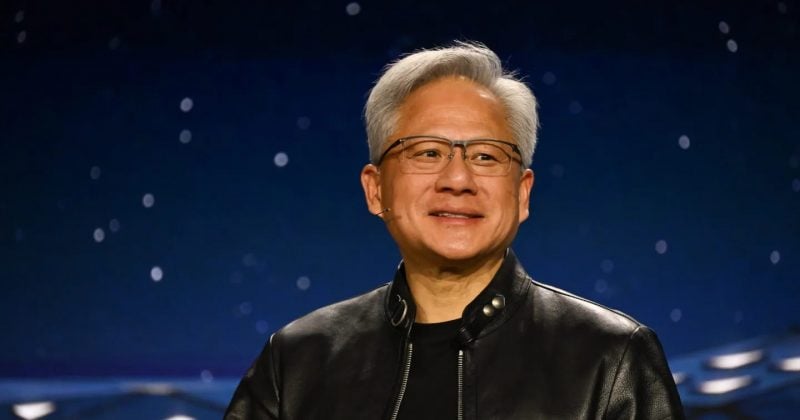
Huang pushes back against US efforts to ban Chinese AI models as semiconductor stocks reel from Moonshot AI's Kimi K3 release
Jensen Huang just did something most American tech CEOs wouldn’t dream of: he walked into a Chinese trade expo and told the world that China’s AI models are “world class.” And he did it while his own company’s stock was getting hammered by one of those very models.
The Nvidia chief, speaking at the China International Supply Chain Expo, argued that American companies should “absolutely” be allowed to use Chinese open-source AI models. That puts him squarely at odds with Trump administration officials and US AI labs that have been lobbying Washington to shut Chinese models out entirely.
The Kimi K3 shock and its market fallout #
Here’s what triggered all the hand-wringing. Moonshot AI, a Chinese startup, released Kimi K3 around mid-July 2026. The model packs 2.8 trillion parameters and a 1 million-token context window. It topped benchmarks in frontend coding tasks on the Frontend Code Arena leaderboard and scored highly on GDPval-AA v2 tests.
Wall Street’s reaction was swift and painful. Semiconductor stocks dropped more than 20% from their June 2026 peaks after the release. Nvidia briefly lost its crown as the world’s most valuable company.
Huang’s counterintuitive pitch #
Most executives watching their market cap evaporate would probably trash the competition. Huang went the other direction. He name-checked models from DeepSeek, Alibaba, Tencent, MiniMax, and Baidu as evidence that China’s open-source AI ecosystem is thriving and globally competitive.
His argument has a certain strategic elegance to it. Open-weight models, Huang contends, are actually better for safety and collaboration than the closed, proprietary systems that dominate the US landscape.
Huang isn’t naive about national security. He’s endorsed limiting exports of Nvidia’s most advanced chips, including the Blackwell and Rubin architectures, to China. His position is essentially: restrict the hardware if you must, but don’t ban the software.
What this means for crypto and AI-adjacent markets #
The Kimi K3 selloff isn’t just a semiconductor story. It ripples directly into crypto markets, where AI-related tokens and GPU-compute protocols have become a significant sector.
Decentralized compute networks like Render, Akash, and io.net have built their value propositions around the idea that GPU access is scarce and expensive. AI tokens broadly tend to correlate with Nvidia’s stock performance and the general narrative around AI infrastructure spending. A 20%-plus drawdown in semiconductor stocks creates headwinds for tokens in the AI sector, regardless of their individual fundamentals.
If Washington moves to restrict American companies from using Chinese open-source models, it could create a fragmented AI ecosystem. A world where certain models are banned in certain jurisdictions is a world where censorship-resistant infrastructure becomes more valuable. Disclosure: This article was edited by Editorial Team. For more information on how we create and review content, see our