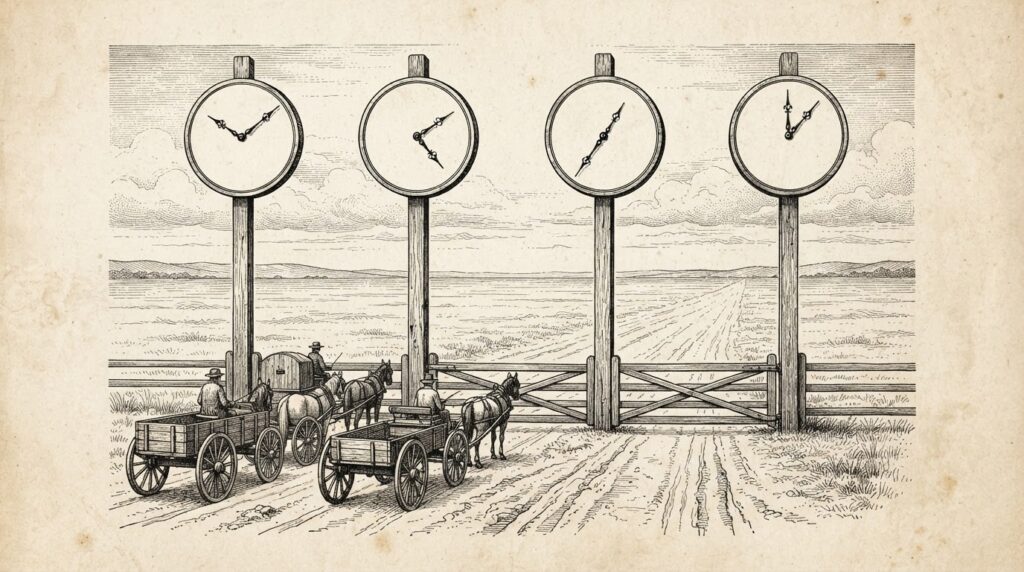
Four license files, three jurisdictions, one number. In eleven weeks, StepFun, Meta, Moonshot AI, and Mistral each began gating commercial deployment of open-weight models at $20 million in revenue. For agent builders that figure is not a price. It is a ceiling. Our 24-hour open-weight taxonomy sorted what “open” came to mean this month; these gates decide how far what you build on it may scale.
What the four gates actually say #
Three of the four licenses were read in full for this piece. Moonshot’s Kimi K3 license demands a separate agreement before any commercial use of the model or its derivatives if you run a Model-as-a-Service business and the aggregate revenue of you and your affiliates exceeds $20M over any consecutive 12 months. StepFun’s Model License 1.0, published October 15, sets the same trigger on combined revenue from all sources, then adds a second gate with no threshold at all: device makers embedding the model in phones, vehicles, smart glasses, wearables, or robots need a commercial license at any size, before any revenue question arises.
Mistral’s Modified MIT terms, documented since August, run differently: companies with monthly revenue exceeding $20M must obtain a commercial license or route through Mistral Studio, and the test applies to any use of those models. One strong month can move a company across the line. Meta’s Muse Model License, governing Muse Spark Open, requires the same pre-offer agreement from service operators above $20M in aggregate gross group revenue over any consecutive 12 months. Two disclosures: the license file sits behind a gated repository, so its wording is search-confirmed from the primary text, not read from the file; and one secondary account called the threshold $20M per month, which the primary text does not say. The agreement’s terms, like the others, are unpublished.
One correction to earlier shorthand belongs in the open. Kimi K3’s gate is not an annual MaaS revenue test. It counts rolling 12-month aggregate group revenue from all sources, so a large company’s small model-powered product is over the line on day one.
Eleven weeks, one number #
The gates surfaced in sequence: Moonshot with the K3 weights on July 27, Mistral’s documentation in August, StepFun and Meta in the same week of October. The spread is evidence. Coordinated drafting across US, Chinese, and European labs, two of them under active export-control tension, would more likely produce matched clocks and matched triggers. Instead the number matches and the machinery does not: monthly snapshot against rolling year, company revenue against group gross, service businesses against any commercial use. The pattern that fits is imitation around a market-clearing figure, $20M marking where a developer-scale user becomes a commercial inference business. Our earlier licensing analysis argued convergence; the timeline now shows it is behavioral, not coordinated.
What would change that read: a shared non-public contract template across labs, identical clocks in the next licenses, or documented contact. What would confirm ordinary market motion: the next gate at a different number. Alibaba’s Qwen3.8-Max license already sits at $50M with the same architecture of capture, pointing toward conventions spreading, not a cartel forming.
Why $20M is a ceiling #
The mechanism matters more than the number. These gates are stops, not tolls: the agreement must exist before the offering continues, and its terms stay private until you are in the room. The revenue test counts the licensee and affiliates at group scale, so no one shrinks out of scope by keeping model revenue small. The gate follows derivatives; fine-tunes, distills, merges, and quantizations stay inside the license. And the service definitions capture what agent platforms do: give third parties inference access with meaningful control over inputs and parameters.
The exclusion list is concrete. Mid-market builders running inference services or agent platforms sit inside these clauses. Teams at companies already past $20M in group revenue are gated on day one. Volatile-revenue businesses hit Mistral’s monthly clock fastest. The workarounds are real but partial: embed the model in your own features rather than exposing it as a service; relay instead of hosting; keep use internal; use certified partners or Mistral Studio; or move to unrestricted weights, DeepSeek V4 under MIT, GLM-5.3 Flash under Apache 2.0, NVIDIA’s Nemotron Bolt under OpenMDW-1.1, which carries no revenue gate. None of them lets a growing service business cross the line without a negotiation whose terms are not public.
The ground under the contracts is also splitting. The same $20M figure sits in US, Chinese, and EU paperwork in the weeks the DHS exclusion order (FR Doc 2026-21447, October 20) reached third-party products built on DeepSeek implementations and China’s Ministry of Commerce proposed export controls on 23 AI-stack technologies. As our three-regimes analysis mapped this week, the contract layer is converging while the trade layer diverges. The builder standing at the line plans for both.