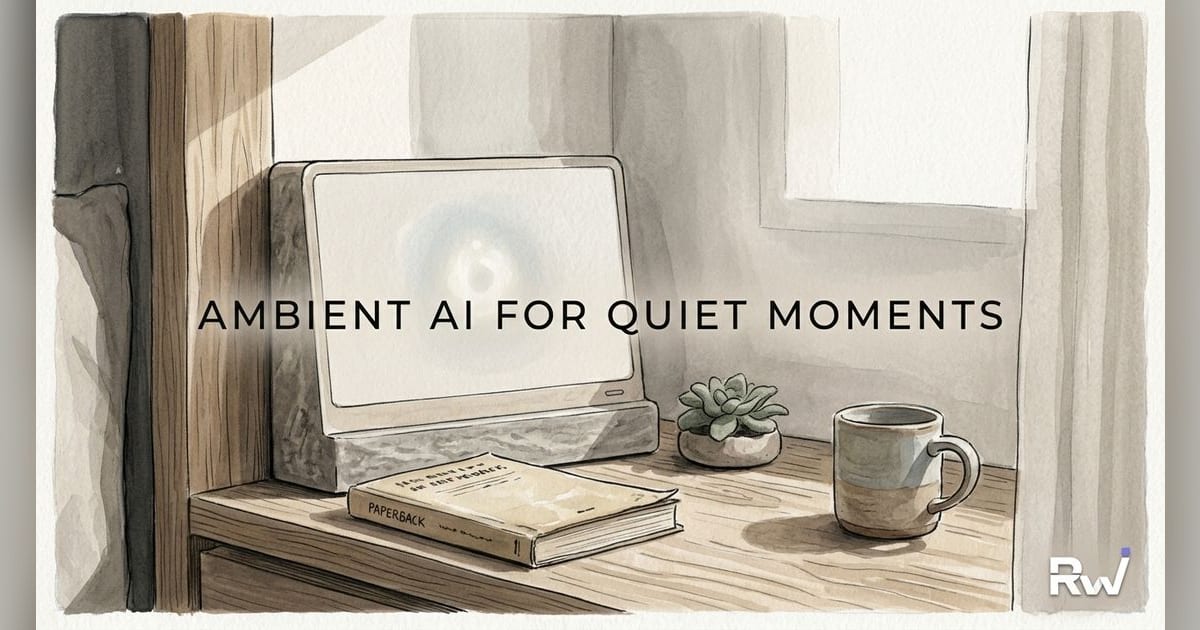
Raymond Zhao unveiled Nooklab's plan for a low-distraction AI screen on July 20th, pitching a physical assistant that captures voice and context, remembers commitments, and helps carry them through without sending users into another app.
Monday's announcement presents a product thesis rather than a finished device. Nooklab has not disclosed the screen's final name, industrial design, form factor, display technology, underlying AI models, price, or shipping date. The sole published image is labeled a concept visualization and explicitly does not show the final hardware.
Zhao brings a hardware operator's background to the idea. Nooklab says he previously held product leadership roles at OPPO, OnePlus, Anker, and ByteDance, working on foldable phones, AI glasses, and other emerging consumer electronics. Nooklab has not disclosed his titles, employment dates, or the specific products he shipped at those businesses.
That experience helps explain Zhao's decision to build another physical surface for AI at a time when much of the industry is trying to embed assistants into phones, computers, glasses, and earbuds. His bet is that an always-nearby screen can reduce the work required to use AI without demanding the attention of a smartphone.
"AI shouldn't ask you to become its operator," Zhao said in Nooklab's announcement. He said the technology should meet people where they are and help them follow through on existing priorities.
A product thesis before a product
Nooklab describes the proposed device as a screen that listens for voice input, understands surrounding context, and converts scattered ideas, information, and commitments into actions. The intended experience resembles an external memory that decides when to resurface an item and helps move it toward completion.
The hard engineering and product questions remain unanswered. Nooklab has not explained how the screen will distinguish a commitment from casual conversation, decide which information deserves attention, or act across calendars, messaging services, task managers, and other accounts. Nooklab also has not identified the AI providers or integrations that would let the hardware complete work outside its own interface.
Those omissions are important because Zhao's thesis depends on reducing setup and supervision. A device that needs extensive configuration, frequent corrections, or manual integration management would reproduce the labor Nooklab says it wants to remove.
Nooklab is entering a category where other builders are also experimenting with ambient context. AYO, for example, markets a desktop assistant that can read a user's screen with permission and answer voice requests. AYO describes its privacy model and says sensitive processing happens locally. Nooklab has not yet published comparable details about consent, on-device processing, cloud transmission, data storage, or retention.
Those controls will shape whether a nearby microphone and contextual memory feel useful or intrusive. Nooklab's product is built around collecting enough information to understand what matters, making privacy architecture part of the core experience rather than a secondary specification.
Nooklab's public footprint points to Shenzhen
Nooklab's release carried a New York dateline and described Nooklab as a global AI hardware business, without naming a headquarters. Public records connect the brand to Shenzhen.
A European trademark record lists Shenzhen Lu Ke Technology Co., Ltd. as the owner of the NOOKLAB mark. The application was filed on July 13th and published on July 16th, four days before Zhao disclosed the product vision. Its listed goods include display screens, microphones, audio recorders, electronic notepads, handheld computers, mobile applications, and project-management software.
A public Behance profile for industrial designer Xuanliang Chen identifies him as Nooklab's design director in Shenzhen. Chen previously worked as a senior industrial designer at Anker, according to the profile, and his portfolio includes chargers, MagGo accessories, smart glasses, and other consumer hardware. Nooklab has not formally named Chen in its announcement or identified him as a founder.
Shenzhen Lu Ke Technology also filed a US trademark application for SNAPNOTE on February 26th. The application covers task-management, scheduling, and voice-recording software as well as screens, microphones, audio recorders, electronic notepads, handheld computers, and tablet-like hardware. The filing claims first commercial use on October 26th, 2025.
The overlap makes SNAPNOTE a potentially related product or earlier identity, although Nooklab has not connected the mark to its planned screen. The claimed 2025 use date also predates Nooklab's stated 2026 founding. That timeline suggests product work may have begun before Zhao introduced the Nooklab brand, while the exact relationship between Nooklab and Shenzhen Lu Ke Technology remains unexplained.
A seed round with no disclosed backers
Nooklab says it recently closed a seed round and is preparing a pre-A financing. It has disclosed neither the seed amount nor its investors, valuation, closing date, or total funding.
The sequencing gives Zhao a public product thesis ahead of October, when Nooklab plans to open early-access sign-ups. Nooklab says the final name, design, form factor, display technology, and full feature set will arrive later in 2026. There is no preorder date, commercial launch date, or shipping window.
That leaves Zhao selling a direction before customers can assess the product. His direction is clear: AI hardware should fade into daily life, remember context without repeated prompting, and help people finish what they have already decided to do. The eventual device will have to prove that a new screen can reduce distraction while collecting enough context to be useful. Its design, privacy model, integrations, and reliability will decide whether Nooklab has built a calmer interface or another object that asks to be managed.