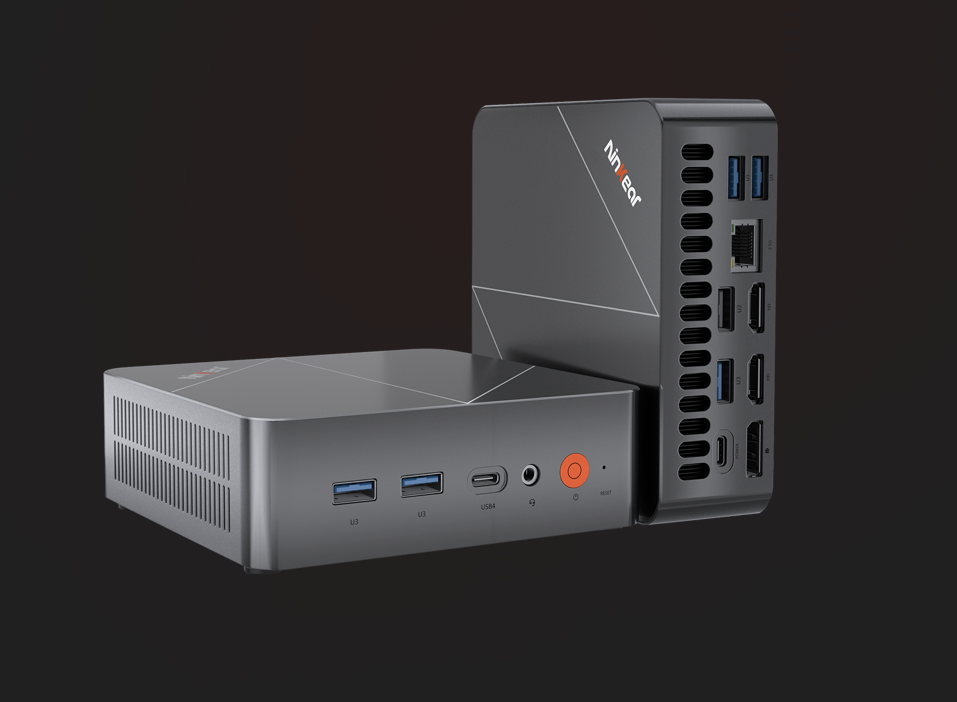
On August 17, 2026, Gizmochina reported that Ninkear had listed the L20 AI Mini PC, a 0.66-liter Windows 11 system built around Intel's Core Ultra 5 226V processor. Ninkear markets the device with up to 97 TOPS of total AI performance, 16GB of LPDDR5 memory, Intel Arc 130V graphics, and support for up to three 4K displays. Its store lists configurations beginning at EUR699.
Ninkear has listed the L20 AI Mini PC, a compact Windows 11 desktop built on Intel's Lunar Lake-based Core Ultra 5 226V processor. The manufacturer lists the system from EUR699 for a configuration with 16GB of memory and a 512GB SSD, with a 1TB option also available.
According to Ninkear's product listing, the 17W Core Ultra 5 226V has eight cores, eight threads, clock speeds of 2.1GHz to 4.5GHz, and an 8MB cache. The company promotes the L20 at up to 97 TOPS of total AI performance and identifies the processor's Intel AI Boost NPU as providing 40 TOPS. Ninkear also markets the device as supporting Copilot+ PC capabilities.
Compact hardware and connectivity
The L20 measures 129 x 129 x 43 mm, has a stated volume of 0.66 liters, and weighs about 625g, according to Ninkear. It supports VESA mounting, which can allow the system to be attached behind a compatible monitor or under a desk.
Graphics come from Intel's integrated Arc 130V GPU. Ninkear lists seven Xe cores and a 400MHz to 1.85GHz graphics clock range. The company describes the system as suitable for creative workloads, multimedia, and 1080p gaming, although it does not publish application-specific performance results or benchmark data on the product page.
Ninkear lists the following I/O and networking options:
- •One USB4 port, four USB 3.2 Gen 1 ports, one USB 3.2 Gen 2 port, and one USB 2.0 port
- •HDMI 2.1, HDMI 1.4, and DisplayPort 1.4 outputs, plus a USB-C port for power delivery
- •2.5GbE, Wi-Fi 6, and Bluetooth 5.3
- •Two M.2 2280 SSD slots, with 512GB or 1TB PCIe 3.0 storage configurations listed
Ninkear and Gizmochina describe the display setup as supporting up to three 4K monitors through HDMI, DisplayPort, and USB4. The product specification page rates the HDMI 2.1 port for 4K at 120Hz or 8K at 60Hz, while the HDMI 1.4 port is listed at 4K at 30Hz. Actual multi-display behavior can vary with display timing, USB4 display routing, and operating-system configuration.
What the AI rating does and does not establish
The 97 TOPS figure is a platform-level throughput claim rather than a benchmark for a particular model, quantization scheme, or local AI application. Ninkear's separate 40 TOPS NPU figure is the more relevant specification for workloads explicitly routed to the NPU, while some AI tasks can also use the CPU and integrated GPU.
For developers evaluating small local AI machines, published TOPS ratings alone do not establish inference latency, memory capacity for a chosen model, software-stack support, or sustained performance under thermal load. Comparable compact PCs are often most practical for NPU-enabled Windows features, lightweight vision or audio pipelines, and small quantized models, rather than large GPU-memory-intensive local inference workloads. The L20's 16GB soldered LPDDR5 memory configuration and integrated graphics make memory sharing an important consideration for such workloads. Ninkear has not published model-level AI benchmarks, sustained-power testing, or independent validation of its 97 TOPS marketing claim on the cited product pages.
Key Points #
- 1Ninkear's L20 combines Intel's Core Ultra 5 226V with a claimed 97 TOPS platform rating in a 0.66-liter desktop.
- 2The listed 40 TOPS NPU specification matters more than total platform TOPS when assessing workloads designed for dedicated neural acceleration.
- 3Compact PCs with integrated graphics commonly require workload-specific tests because shared memory, thermals, and software support determine practical local inference performance.
Scoring Rationale #
The L20 is a modest but relevant compact-PC release for practitioners interested in on-device Windows AI acceleration and multi-display workstations. Its claimed TOPS figures are useful hardware context, but the sources provide no model-specific benchmarks or independent performance testing.
Sources #
Primary source and supporting public references used for this report.
Practice interview problems based on real data
1,625 SQL & Python problems across 15 industry datasets — the exact type of data you work with.