Its innovation so far has been about engagement, but it could become a revenue source, the company says
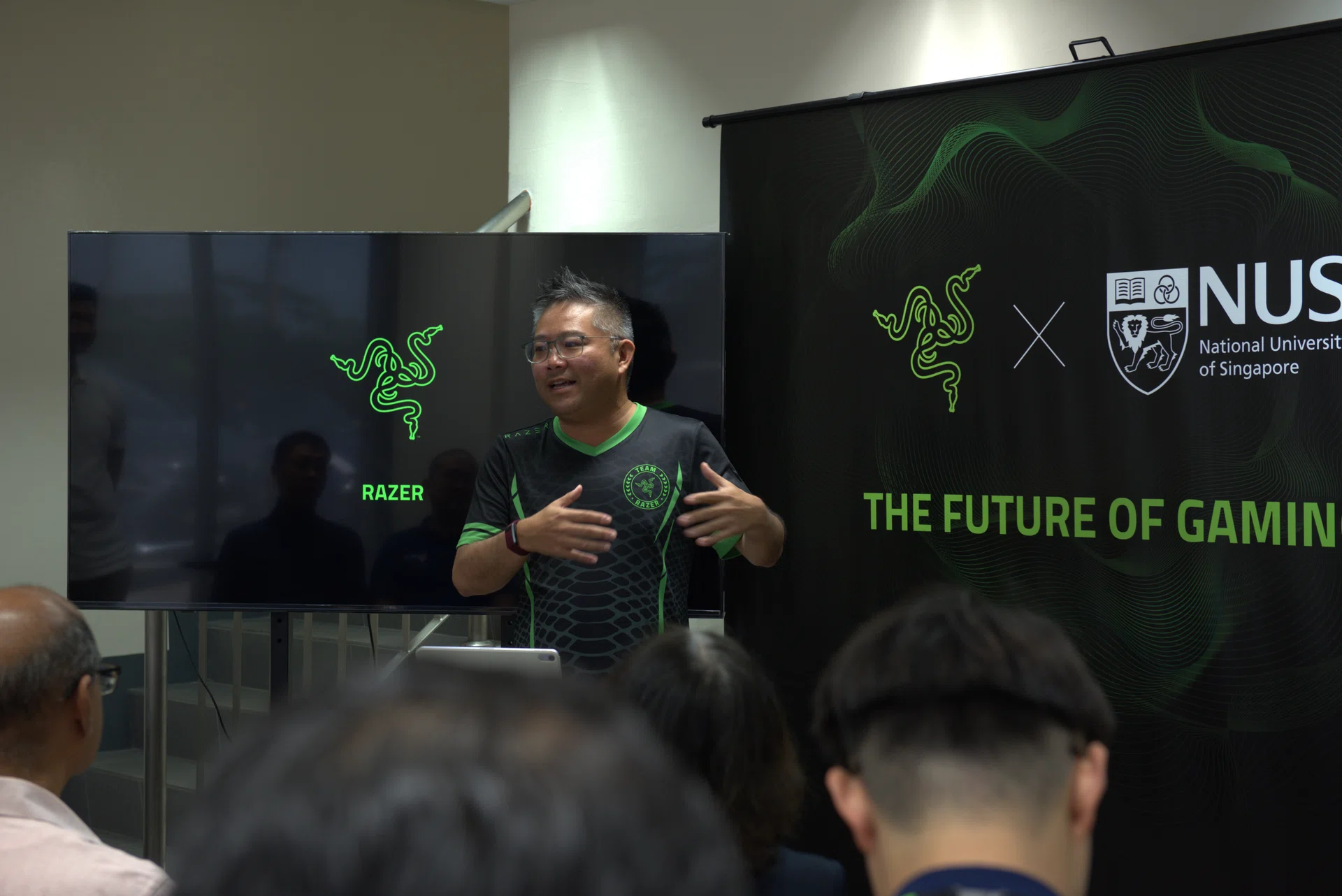
[SINGAPORE] Gaming company Razer and the National University of Singapore (NUS) on Wednesday (Aug 5) launched a joint research lab aimed at advancing artificial intelligence within the gaming industry.
The lab will tap NUS’ AI research capabilities and Razer’s expertise to explore a new domain called gaming artificial narrow intelligence (Gani).
The partnership is part of Razer’s push to develop a software and AI layer around its core hardware business, said chief strategy officer Lee Li Ming.
“The hardware, to us, is the simple thing,” he said, adding that the challenge is in the software layer that powers products across different form factors.
As AI continues to evolve, Razer has been pushing the boundaries of the technology through various software investments.
“We have been investing in software without making any money,” Lee said. “It’s never about making money in the first place. It is to make sure the gamers get closer to us.”
Razer will “probably look at making money” from AI eventually, he added, but did not disclose any plans on how it intends to monetise its AI products.
The new AI lab, located within NUS, will house 15 to 20 researchers from the university’s School of Computing. Razer staff will support the projects on an ad hoc basis.
The lab’s research focus has three main pillars: core model innovation, real-time content systems, and advanced personalisation capabilities.
Razer did not disclose the amount invested into the lab.
Gani centres on AI models that are specially designed for interactive digital environments, and will be used to adapt and enhance gameplay experience, said Lee.
For example, it could generate context-aware objectives and dialogue in real time, or adapt difficulty during live matches to enhance engagement and fairness. He noted that Razer would need to work with other gaming industry players as well to drive the research.
“We know we cannot do it alone,” he said, adding that the joint lab will work with PhD students to give them a chance to translate their research into physical and more tangible outcomes.
“NUS brings the smarts, the talent, the pipeline to help build what we are trying to envision here,” he said. “What Razer brings is real-world adoption of these use cases.”
The intellectual property arising from the research will be jointly owned by Razer and NUS, said Associate Professor Ooi Wei Tsang from the university’s computer science department. He is also director of the research lab.
AI in gaming #
The announcement of the joint AI research lab – which Razer and NUS described as the “first of its kind” – comes as the gaming industry adopts AI across hardware and software services.
The value of AI in gaming is projected to increase to US$66.8 billion by 2035 from US$4.2 billion in 2025, indicated market research firm InsightAce Analytic. This translates to a compound annual growth rate of 32 per cent.
The technology’s value will be derived from improving gameplay, fostering more immersive experiences, and facilitating more intelligent in-game settings, InsightAce Analytic said.
Beyond gaming, Razer has also been expanding its offerings to appeal to mass consumers.
For instance, it is developing Razer AVA, a holographic digital human model able to respond to verbal prompts. However, the company has not yet announced a price or launch date. Razer AVA is one of many products that the company’s AI Centre of Excellence in Singapore is contributing towards.
Established last August and set within Razer’s South-east Asia headquarters at one-north, the AI hub houses more than 100 AI-related talent, said Lee.
It works mainly on consumer-facing AI and hardware advances, while another Centre of Excellence in France concentrates on technologies such as quality assurance and haptics.
The new research lab will sit further upstream and focus more on research, “thinking about two steps ahead”, said Lee.
Decoding Asia newsletter: your guide to navigating Asia in a new global order. Sign up here to get Decoding Asia newsletter. Delivered to your inbox. Free.
Copyright SPH Media. All rights reserved.