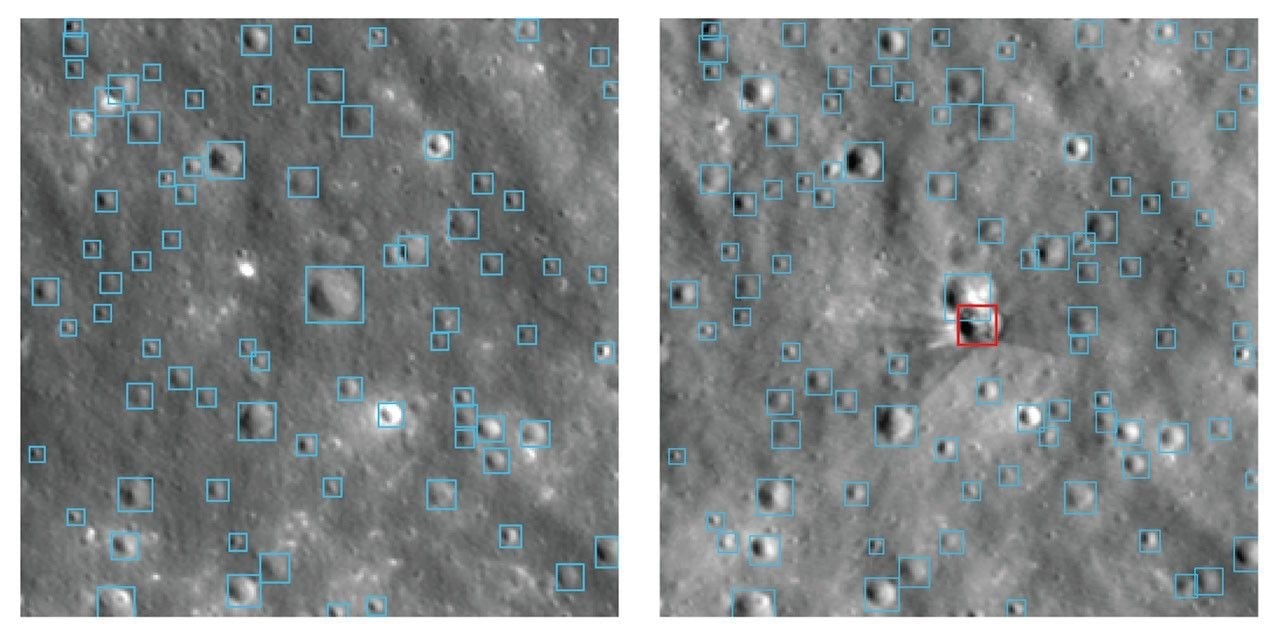
IBM and NASA have released the NASA-IBM Lunar Foundation Model as open source, one of the first publicly available foundation models built for scientific study of the Moon. The weights, a technical report, and the machine-learning-ready dataset it was trained on are up on Hugging Face under the Prithvi family, which already covers Earth observation, weather, and heliophysics. The pitch is that decades of multi-instrument lunar data have outgrown hand-sifted maps and narrow, task-specific models, and a single pretrained backbone can be adapted to crater mapping, volcanic-feature detection, and ice prospecting without starting over each time. In IBM and NASA’s own benchmarks, the model cut root-mean-square error in flagging likely ice deposits by up to 22% against a SwinV2-B baseline.
A TerraMind Backbone on 30 Layers From Nine Instruments #
The model is built on a version of TerraMind, the Earth-observation model IBM developed with the European Space Agency, chosen for how it handles mixed data types and resolutions and learns cross-modal correlations that can fill in missing or noisy values. Fine-tuning for each lunar task uses low-rank adapters that keep 90% of the base weights frozen, which is what keeps the adaptation cost low. The training corpus is the part NASA says didn’t exist before: a unified, spatially aligned dataset of more than 30 layers from nine instruments across four missions, on the order of 2 million image tiles, with more than 1 million 1-meter camera images and close to 964,000 multispectral images at 100-meter resolution. Sources include imagery from NASA’s Lunar Reconnaissance Orbiter, gravity-field maps from the GRAIL mission at 20 kilometers per pixel, Lunar Prospector data, and complementary observations from JAXA’s SELENE/Kaguya. The benchmark collection, called SOMBench, ships alongside the model.
Ice, Volcanic Patches, and Craters at Two Scales #
The 22% figure comes from the ice task, where the model combines multimodal, multi-resolution observations to predict where ice may sit below the surface of permanently shadowed regions, the places a future Moon base would mine for water, oxygen, and rocket propellant. For volcanic history, it maps Irregular Mare Patches with 3% better coverage than SwinV2-B while training on imperfect labels, which IBM frames as comparable accuracy at lower fine-tuning cost. Crater detection splits by scale: at meter-scale resolution the model matches SwinV2-B, and at roughly 100-meter context scale it outperforms it by nearly 19% with half the training data. Michael Barker, the NASA lunar topography expert who co-led the project, said the payoff is in features whose ages are still contested: “The ages of these features remain a matter of great debate, so the more we can understand their distribution and properties, the better chance we have of resolving this mystery.”
“NASA has spent decades building an extraordinary scientific record of the Moon, but collecting data is only part of the job. We also have to make data easier for scientists to explore and use,” said Kevin Murphy, chief science data officer and acting chief data and AI officer at NASA Headquarters. Juan Bernabe-Moreno, director of IBM Research Europe, UK and Ireland, said the model “gives scientists a foundation to explore the Moon at scale, connecting observations across instruments, revealing patterns that are difficult to see in isolation, and providing an open platform the global research community can build on.”
Everything is available now under an open-source license, and IBM’s research blog walks through the three initial NASA use cases in more depth. It’s the same open-weights playbook IBM has run on the enterprise side with Granite 4.0, applied here to a science domain where the scarce resource is labeled data and the compute to fine-tune against it, and the immediate consumers are landing-site hazard analysis and resource prospecting for a sustained lunar presence.