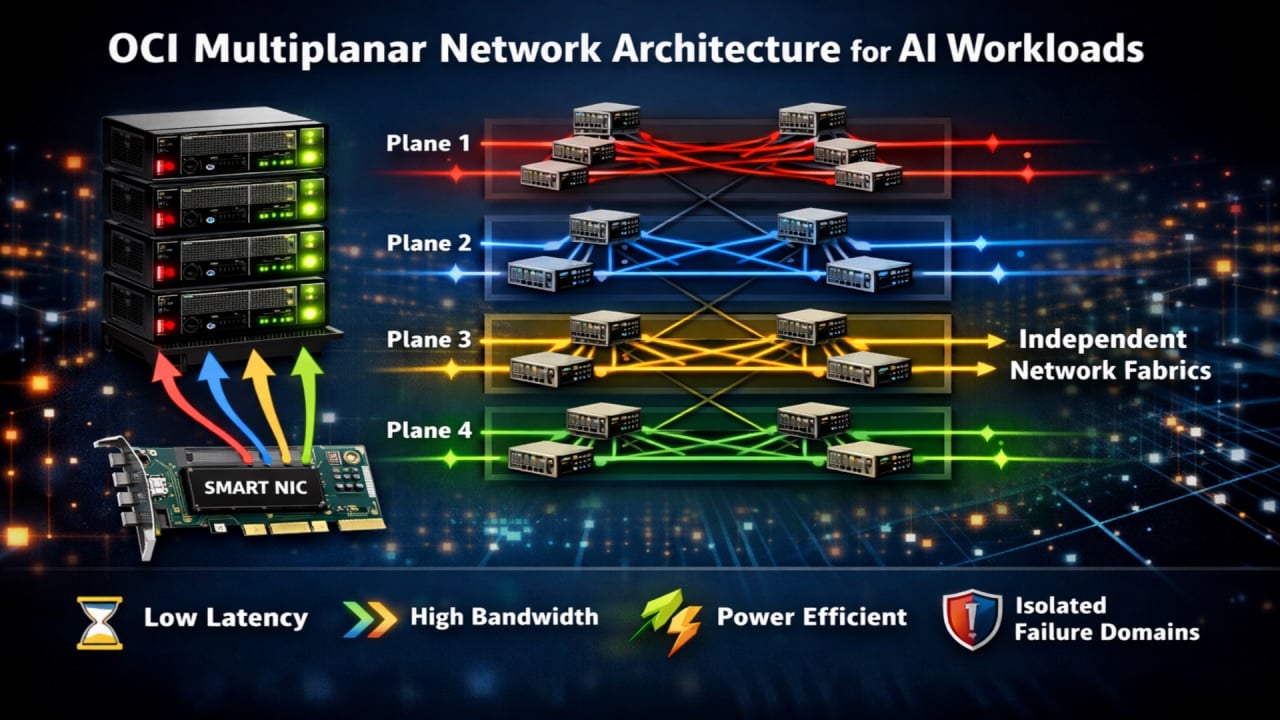
Oracle announced a second round of Oracle Acceleron capabilities at Oracle AI World in Las Vegas, a year after the networking suite first bundled dedicated fabrics, multiplanar networking, SmartNICs, and direct data paths for Oracle Cloud Infrastructure. The new pieces are RDMA on OCI’s shared front-end network, NVMe block storage attachments across Acceleron bare metal and VM shapes that Oracle rates at up to 3x the block performance, a collective communications plugin that moves failover and load balancing into the NCCL and RCCL layer, and multiplanar networking extended to front-end traffic.
“AI infrastructure can be unforgiving when it comes to network friction,” said Pradeep Vincent, executive vice president, Compute and AI Infrastructure, Oracle Cloud Infrastructure. “When thousands of accelerators are working together, one congested or failed path can have consequences far beyond a single connection. With Oracle Acceleron, we are building a network that can respond by rerouting traffic, recovering from failures, and helping customers scale securely.”
Front-End RDMA and the 3x NVMe Block Storage Claim #
OCI’s front-end network carries Oracle Database, customer compute, block and object storage, SaaS and OCI services, backbone links, internet access, and on-premises connectivity on the same fabric, which is why RDMA has historically stayed on dedicated back-end cluster networks. The Oracle Acceleron High-Performance Fabric puts RDMA on that shared front end for inference, storage, and HPC traffic, and Oracle says it supports every queue pair type and verb, so existing RDMA applications run without changes. The company also uses the front-end links to connect separate GPU clusters while the back-end fabrics handle training inside each cluster.
The storage half is the expanded NVMe block storage attachment options across the new Acceleron bare metal and VM shapes, which Oracle says improve NVMe block storage performance by up to 3x for AI, database, and other data-intensive workloads. Oracle has not published the baseline configuration, the workload, or whether the figure is throughput, IOPS, or latency, and we did not run or audit it. The release carries Oracle’s standard future product disclaimer and gives no availability dates for any of the new capabilities.
Sharing a front end between RDMA and TCP is a congestion-control problem, since RDMA transports typically use rate-based control and TCP uses window-based control, and one loop can starve the other. Oracle’s answer lives in the Acceleron SmartNIC. Hierarchical token buckets track bandwidth for RDMA and non-RDMA classes under a shared parent bucket, and as tokens run low the NIC probabilistically marks ECN-capable packets or drops the rest, which produces a gradual congestion signal and also heads off incast at the top-of-rack link. Either class can borrow unused bandwidth from the other.
For congestion inside the fabric, the SmartNIC runs One-Way-Delay Congestion Control, measuring forward-path delay so that a congested reverse path does not trigger a false signal. When it sees elevated delay on a flow, it probes three alternate paths and moves the flow if one is better; if none is, it falls back to ECN marking or drops. Oracle describes the design as needing minimal QoS support from the switches while keeping standard kernel and CPU bypass on the hosts.
| Capability | What Oracle Says It Does |
|---|---|
| Oracle Acceleron High-Performance Fabric | RDMA on OCI front-end compute for inference, storage, and HPC workloads, with all queue pair types and verbs supported |
| Expanded NVMe block storage attachments | NVMe block storage across Acceleron bare metal and VM shapes, up to 3x block storage performance (vendor figure) |
| Oracle Collective Communications Library plugin | NCCL and RCCL network plugin that spreads collective traffic across the back-end Multiplanar Network, load balances by congestion, and fails over around dead ports and NICs |
| Transparent Front-End Multiplanar Networking | Path selection, failover, and congestion control for front-end RDMA traffic, handled in the SmartNIC |
OCCL Moves Failover Into the Collective Layer #
OCI’s back-end Multiplanar Network connects multi-port NICs to several disjoint fabrics so a training job has n-way redundancy, but using those planes has required NIC-level functionality that is not always available. The Oracle Collective Communications Library plugin removes that dependency. It is a CCL network plugin that natively supports the NVIDIA NCCL and AMD RCCL plugin interfaces, the layer frameworks use to turn collective operations into NIC transfers, and it carries failover, recovery, and congestion-aware load balancing inside the plugin, independent of NIC firmware and topology.
In operation, OCCL distributes collective traffic across multiple standard Reliable Connection queue pairs, sends more over the pairs showing higher throughput, and moves traffic off congested paths at the message and chunk level. When a port or a whole NIC fails, it steers the collective to another port or NIC so the job continues without a restart. Oracle’s framing is that this is simpler than routing controllers that pick fabric paths and watch for changes, and it works on single-plane and multi-plane networks alike. The same multiplanar path selection and failover now reaches front-end RDMA traffic through what Oracle calls Transparent Front-End Multiplanar Networking.
The same networking update covered two items outside Acceleron. OCI Global CDN Connect provides direct connections between OCI Object Storage and Cloudflare, Fastly, Netskrt, and Mainstreaming, with zero OCI egress charges on eligible cache fetches in supported regions, and Oracle has signed a non-binding memorandum of understanding with F5 for a planned OCI App Defense web application and API protection service.