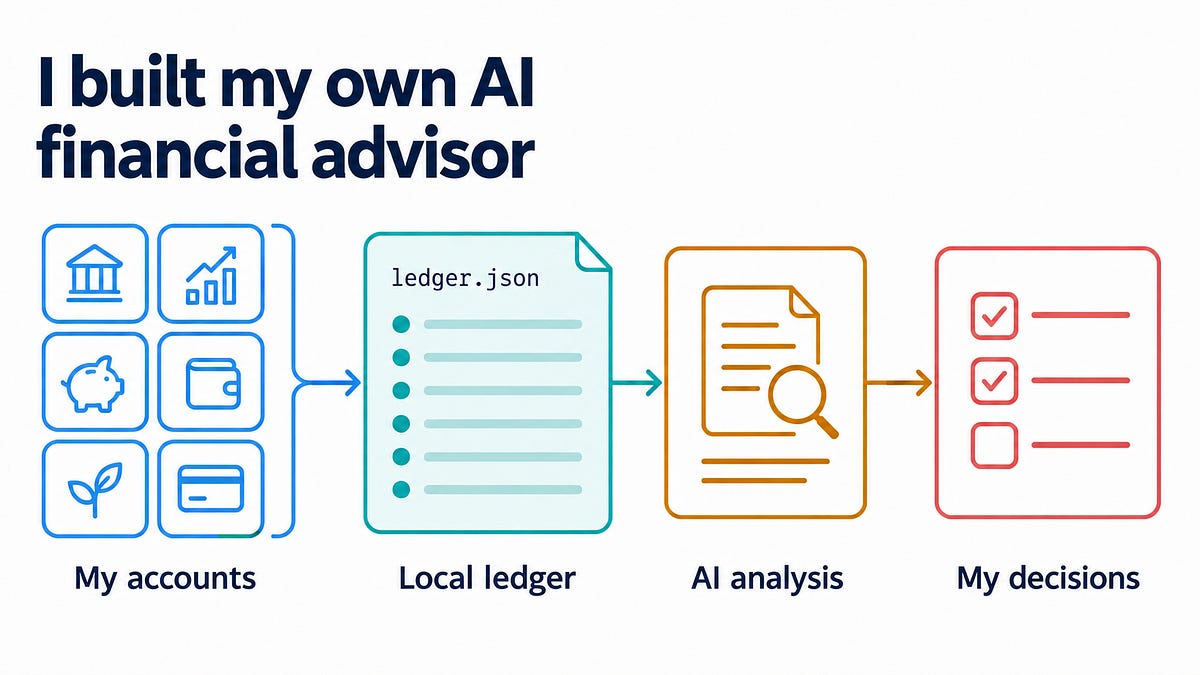
This year I left Google after nine years, and by August I owed more than half a million dollars on margin (not recommended), most of it riding on Micron and SK Hynix, a bet that memory chips are AI's bottleneck. My money sat across about a dozen institutions and services: multiple brokers, two stock-plan portals, a 401(k), an HSA, crypto, a few private-company stakes and various credit cards.
Getting it all in one place is mostly solved now. Rocket Money already tracked my spending, and apps like Monarch and Origin pull most accounts together with an AI assistant on top. What I needed was a second opinion that knew my whole situation before major decisions: how exposed I was on margin, which shares to sell first to pay it down, and what leaving the US would do to my taxes. None of the apps I looked at go that deep.
So I built that part myself, one system on my laptop that works as my personal finance advisor, tax planner, trading assistant and research analyst. It pulls every account into one balance sheet, including the ones the apps don't support, tracks leverage and debt, keeps a live tax tally, runs AI analyst debates on what I own and models big decisions like buying a house without a salary. I kept iterating on it, and it helped me cut my debt by about 70%. I've put seven of the pieces on GitHub as skills you can run yourself.
Why now #
A year ago I don't think this would have worked. On GDPval, where experts including financial advisors blind-grade AI work against their own, the best model matched or beat them on just under half the tasks in September 2025. By April 2026, GPT-5.5 was at 85%, by OpenAI's count. Tax math improved too, though on Column Tax's benchmark the best models still get two in five returns wrong. I use Claude Opus 5.5 and GPT-6 Astra, both released in September.
I started on Gemini 3.8 Flash to run simple scripts and tally numbers, then switched to Opus 5.5 to let the system work more on its own, and the difference was night and day. Flash made confident mistakes with my numbers that Opus fixed within a few prompts, even though Flash had topped Vals AI's finance agent benchmark. Test models on your own tasks, which is what the repo's behavior checks are for, and use a strong model to build the system and a fast one for quick summaries.
Why a folder on my laptop #
There are several ways to run a setup like this. From easiest to most capable:
- Paste everything into one ChatGPT chat. It's the quickest start, but long chats forget your portfolio.
- Make a project. ChatGPT, Claude and Gemini all save instructions, files and facts about you for every chat in it.
- Run a coding agent in a folder, which is my setup. Claude Code, Codex or Antigravity can write and rerun code, keep notes up to date and connect to APIs. PostHog's co-CEO James Hawkins had Codex build him a finance app in an afternoon .
- Run an always-on agent in the cloud, like a hosted OpenClaw, OpenAI's new dots or Grok Bot, whichadded a finance integration in September . It keeps working while your laptop is closed, but your account access and ledger have to live on an always-on machine, and I'm wary of that for financial data.
Hosted assistants now connect to your accounts too. ChatGPT links them through Plaid, Peter Yang uses it as a monthly tax advisor, and Anthropic is reportedly preparing a Claude Money feature. They're the easiest way in, but your data lives on their servers, and as with the apps, nothing I've seen from them covers margin, multi-year taxes or cross-border moves.
My laptop is almost always with me, or at home where I can control it remotely, so the third option covers what I need.
How it fits together #
The system does two jobs: getting all your data into a local ledger and analyzing it. The agents read the ledger along with a file of facts about me and a log of my decisions, and handle seven kinds of work, from everyday spending to taxes and financial planning. Jump to the list. A custom dashboard and email summaries are bonus extras.
Getting my data #
Pulling numbers out of a dozen institutions is tedious, and computer use makes it much easier. I logged into each site myself, and Codex opened the portals, found the transaction history and pulled years of it from each one.
Even a clean export needs a check against the source. Some of mine were missing data, and Rocket Money had a year of duplicate transactions, so Codex removed the duplicates and pulled the full history from Vanguard's website.
Where an account has an API, the agent uses it: Robinhood's official MCP server, Interactive Brokers' reporting API, Coinbase's regular API and the Ethereum network for a crypto wallet.
finance-gather packages this as a skill. It prefers read-only APIs and exports, never clicks anything that moves money or changes a setting, and hands control back to you for passwords and two-factor codes. Accounts get aliases, so account numbers stay out of the ledger.
Check your privacy settings before you try this. Whatever is on the screen goes to the model provider, and some consumer plans train on your chats unless you turn that off.
The local ledger
Everything lands in one file, ledger.json, with each account's positions, cost basis, cash and debts, plus where each number came from and when. It stays on your laptop, and the AI analysts see nothing from it until you allow it in rules.json.
Two smaller files sit next to it: facts.json for verified facts like your tax status and where you live, and rules.json for your limits, like your largest position and the most debt you'll carry. Before I had a facts file, the advisor kept giving advice that didn't fit my situation. Now every agent reads the same facts, so a correction only has to happen once.
Check the results before you trust them. My ledger had issues like missing cost basis and a wrong exchange rate, and an agent will build on numbers like that without noticing. Compare it against your broker statements and past tax returns before you ask it anything that matters.
Memory
On the small model, every chat produced a new plan that sounded final, and the recaps flattered me. I borrowed the fix, a memory skill, from the AI CFO Office newsletter. finance-memory saves the facts and decisions you confirm at the end of a session, with the date and source of each. It keeps ideas separate from decisions and from trades you placed, and records corrections as new entries. The agents read it before they recap anything.
What I use it for #
Once the data is in one place, you mostly just ask. Under the hood it's a mix of skills, open-source agents and small scripts. Where AI apps already do the job, I've named a few, though I haven't tried all of them. They're a decent, easy way to get started, but your own ChatGPT subscription can replace most of them.
1. Personal finance summaries
Ask for your net worth, leverage and debt, what changed this week, or where the cash could come from to pay something off. The AI answers with simple tool calls against the ledger, so a cheap, fast model like Gemini 3.8 Flash does great here. Monarch, where a lot of Mint users ended up, does this as an app, with an AI assistant that explains what changed and a weekly recap.
2. Everyday spending
My agent reads my spending from Rocket Money through computer use and saves a dated snapshot next to my ledger. That way planning questions start from my real spending. What I learned:
- Copying an app's numbers correctly doesn't make the accounting correct. An income spike in mine turned out to be investment distributions, not pay.
- Separate transfers, card payments and investment proceeds from real income and spending before you plan with the numbers. finance-plan has these checks built in.
- The files stay on your laptop, but the model reads every number, so it's local storage, not offline processing.
3. Technical and fundamental analysis
A committee of AI analysts from the open-source TradingAgents project covers fundamentals, news, sentiment and the chart, and a bull and a bear argue it out. A research skill writes deeper reports, like why SK Hynix fell 55% this summer while reporting record profits. Check the numbers they quote. On a small model, my analysts read a 6.33% debt-to-equity ratio as 6.33 times and called a company with almost no debt a "debt bomb." For quick research, Perplexity Finance is free and has financial statements, earnings highlights and bull and bear summaries for each stock.
4. Trading
Out of the box, the analysts didn't know I was on margin and kept suggesting starter positions of 2 or 3%. TradingAgents can now take your holdings, and portfolio-review checks any trade you're weighing against your holdings, cash and limits with plain code. People wiring fast models into trading bots landed on the same design: the model makes the call, code holds the limits and places any order, and they start with paper trading. The analysts' ratings are noisy (mine changed nine times in twelve weeks), so act on their risk advice instead. Go in stages, keep new positions small, and don't chase.
If you'd rather have an app run the rules, Public is rolling out agents that turn your instructions into fixed rules and wait for your approval before they run, and Composer, now part of SoFi, builds and backtests rule-based strategies. I haven't tried either, but both are getting a lot of buzz.
5. Investing
At the portfolio level, it tracks your leverage and how concentrated you are in each theme, and works out which sales would clear your debt and in what order. Vibe-Trading, another open-source project, backtests strategies you describe in plain English. I've asked Robinhood's AI assistant, Cortex, a few questions. It didn't tell me anything ChatGPT couldn't, but it's convenient because it's right there in the app.
6. Taxes
A live tax tally, checked against past returns, means no surprises in April. The system also runs harvest scenarios, flags wash sales and helps pick which lots to sell. For my move abroad, it modeled which year a sale should land in.
Other tax questions depend on your situation. A few it can work through:
- If you get stock at work, your employer probably withholds federal tax on each vest at a flat 22% , which can leave you owing in April if your bracket is higher.
- When you change jobs, it can compare offers after tax, including the equity, and walk you through a 401(k) rollover without triggering tax.
- It can rebuild crypto cost basis across exchanges and wallets.
- It can model 529 college savings plans and any state tax deduction. I skipped this since I'm leaving the US.
- Donating shares that have gone up, instead of cash, means you never pay capital gains tax on that growth.
- If you're a US person with foreign accounts that add up to more than $10,000 at any point in the year, you have to file an FBAR .
If you file with TurboTax, its Claude connector and ChatGPT app give estimates, refund projections and a checklist of the forms you'll need. Get a professional to sign off on anything cross-border.
7. Financial planning
It works out whether you can buy a house without a salary (lenders can qualify you on your assets), how long your cash lasts through a stretch without work or with a new kid, and which debts to pay down first. Plain code does the math and the model explains it, the same split Origin, an SEC-registered AI advisor, says it uses. I tried Origin, and despite the advisor label, it's a budgeting app much like Monarch.
It can also estimate how much life insurance you need, and Ethos's ChatGPT app can price a term policy from five questions. Ask it for an if-something-happens-to-me document too, listing every account, its beneficiaries and where the paperwork lives.
Retirement planning started with a question I hadn't thought to ask before leaving the US: had I worked long enough to qualify for Social Security? Codex checked my SSA account and my final Google paystub. I qualified, but SSA's estimate assumed I'd keep earning in the US, and setting future earnings to zero changed the numbers a lot. Then I asked whether I could collect while living in Singapore, whether to claim at 62 or 70, and how much my investments would need to cover. The agent wrote code to compare the options and saved a plan I can revisit. That's a good way to start with your own agent: give it a question, let it find the missing inputs, then have it save a plan.
You don't need a dashboard #
I built one anyway, like a lot of people have. It shows net worth, every account and loan, my largest exposures and my history against the S&P 500. My agent wrote all the code, and on Flash its first version copied a UX mockup, made-up numbers and all.
It was fun, but it isn't worth your time. Apps like Monarch already do this well, and for investments Monarch doesn't support, ChatGPT can use computer use to enter the balances for you. Where my own setup still helps is long conversations about my investments, with all my history and decisions in context.
What it can’t do #
It can't decide how much risk is right for you. My analysts told me to wait all summer before buying Micron as it dropped. I bought every dip anyway, maybe more aggressively than I should have, and it worked out only because the stock came back. The system can check trades against the limits you set in rules.json.
Check anything that moves money. OpenAI's own personal-finance benchmark tops out at 82.5 out of 100. And be skeptical of the AI trading bots all over X. Most of the gains are screenshots nobody can check, and scammers now post Claude trading-bot tutorials that get people to drain their own wallets.
I haven't let it place trades yet. Robinhood has a separate agentic trading account if you want to experiment.
Where this is headed #
Most of the talk about AI and money is about trading, which doesn't work yet for the average person. When nof1 had eight models trade US tech stocks, the combined portfolio lost about a third. On Kalshi, six frontier models trading real money each lost 16% to 31%, even though the best AI systems now roughly match superforecasters at predicting events.
Vanguard estimates that a good advisor adds up to about 3% a year, mostly from keeping clients on their plan and from tax moves, while picking investments adds between nothing and 1%. Behavior and taxes are where I expect AI to change personal finance.
That takes a fuller picture of you than any one app has. Plaid covers most US accounts, and the rest comes from four places:
- Portals with no API, like stock-plan sites and accounts abroad, which computer use can now read.
- Documents like tax returns and equity grants.
- What you tell it, like your plans and how much risk you can live with.
- What you actually do, including when you overrule its advice.
The last two matter most, since behavior is where most of Vanguard's 3% comes from. My facts file and decision journal are a rough version, and ChatGPT already keeps financial memories about you.
Big reasoning models like Opus 5.5 and GPT-6 Astra do the thinking, and a new kind of model handles the quick, repetitive calls. Jev, from TypeSafe, answers with typed choices instead of text, which makes it cheap enough to run on every transaction. James Long, who built Actual Budget, tried it on messy bank descriptions and got about 95% of the way to clean payee names.
Agents are starting to do the chores, too. Rocket Money's Rowan and Pine negotiate bills, and my girlfriend had Meta's Muse call her phone company's customer service to negotiate hers. Muse and OpenAI's dots each get their own cloud computer, so I expect errands like this to become routine.
Two things could slow it down. The US open-banking rewrite may let banks charge apps for your data. And the more an agent can do, the more a hacked account or a planted instruction can cost you. Check Point hid text in a company's reports and manipulated Jev into giving a low risk rating in every setup it tested.
Still, my guess is that you'll soon write a short mandate covering how much cash to keep, which debt to pay first and how big any one position can get. An agent will make the routine moves, ask before anything large, tally your taxes every month and model a move abroad or a house purchase on your real numbers, which most people could never pay an advisor to do.
Try it #
The skills are on GitHub at shashu10/personal-finance-skills, in the open Agent Skills format that Codex and Claude both read. To install them, paste this into Codex or Claude Code:
Install all seven personal finance skills globally from https://github.com/shashu10/personal-finance-skills
Or run npx skills add shashu10/personal-finance-skills --global. Then ask your agent to use finance-setup, or ask for a sample household to try it without your real accounts.
- finance-setup creates a private folder for your records and asks only for the facts it needs.
- finance-gather pulls in your accounts and reconciles them into
ledger.json. - investment-research researches stocks and IPOs and can run TradingAgents or Vibe-Trading.
- portfolio-review checks a trade you're weighing against your holdings, cash and limits.
- finance-plan reviews spending and works through budgets, cash runway, job changes, debt and taxes.
- finance-memory saves the facts and decisions you confirm.
- finance-dashboard checks a dashboard you already have for stale or missing data.
The dashboard app and email summaries aren't in the repo.
If you try it, tell me what breaks in the comments or by replying to this email. My co-host Mark and I also talk through builds like this on The Generative AI Meetup Podcast.
I own shares of Micron, SK Hynix and other stocks. None of this is financial advice.