Member-only story
MiniMax M3, GLM-5.2, and Kimi K3 compared on VRAM, license, and agent-loop latency: the real decision tree for self-hosting an open-weight coding model i #
A team I know spent an entire sprint provisioning an 8-GPU node. Turned out they could have run the same model at a quarter of the cost, on half the GPUs, with a different quantization format. Nobody had done the arithmetic. They’d done the leaderboard comparison instead: SWE-Bench Pro score, sorted descending, top result wins.
That’s the trap. A benchmark number tells you almost nothing about whether a model fits the hardware you actually have, what your agent loop feels like under real latency, or whether the license lets you ship it inside a product.
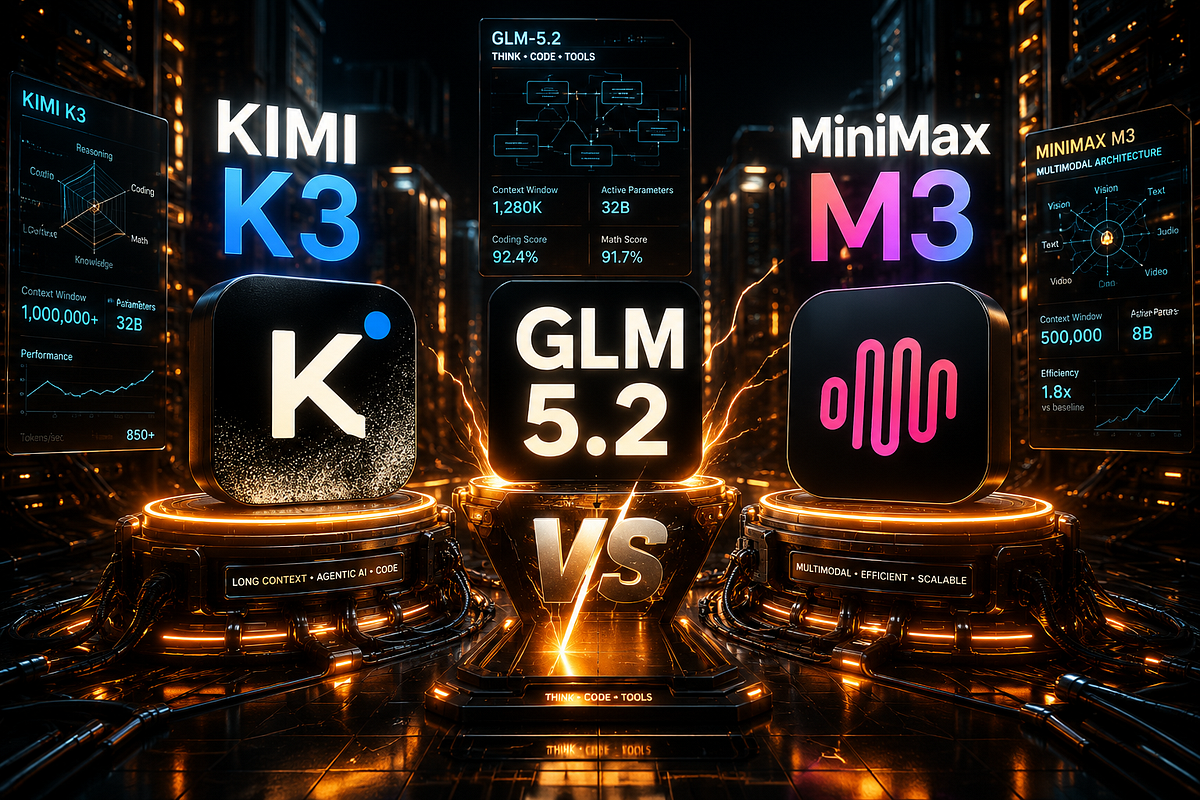
In a span of about six weeks in mid-2026, three labs released open-weight models that genuinely compete with closed frontier systems on agentic coding: MiniMax’s M3, Z.ai’s GLM-5.2, and Moonshot AI’s Kimi K3. Each took a different architectural bet. MiniMax went all in on sparse attention for cheap long-context decoding. Z.ai shipped a 744-billion-parameter MoE under a permissive MIT license. Moonshot went bigger…