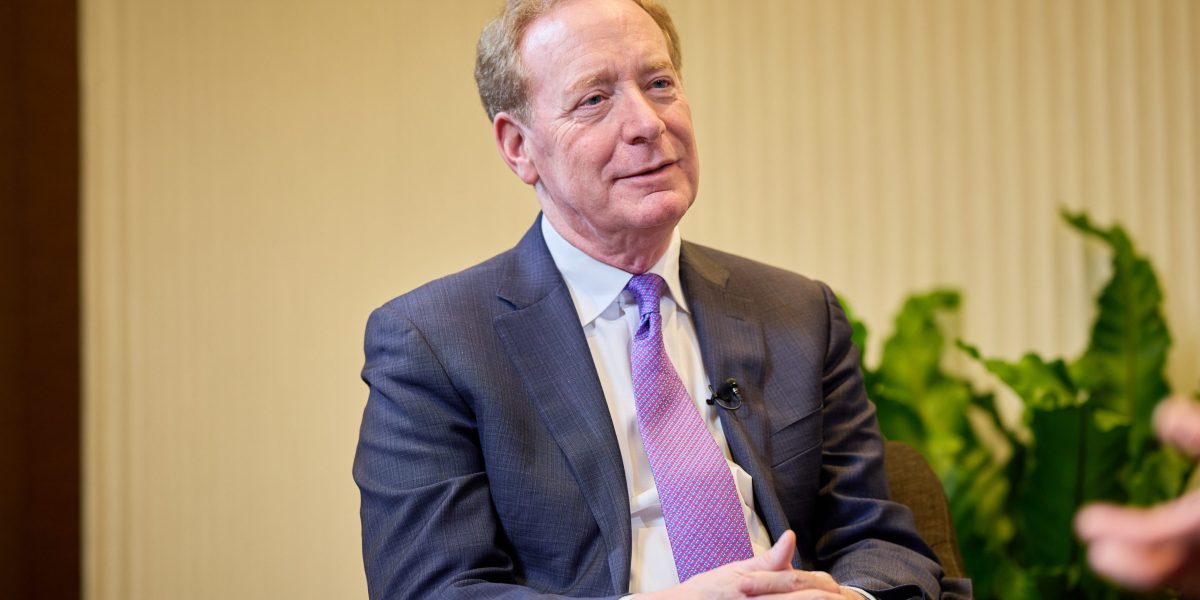
Microsoft President Brad Smith has weighed in on U.S. policy on AI, saying that the Trump administration’s current approach lacks transparency and does not provide the clear rules companies need.
Smith was speaking exclusively to Fortune on the sidelines of the AI for Good Global Summit.
“Everyone is reluctant to say there should be regulation, but what we really have right now is regulation without transparent or complete rules,” he said. “Without rules, businesses can’t plan.”
The Trump administration’s recent decisions to restrict access to two of the industry’s most advanced AI models has left even the labs building them guessing at what the government’s AI policy is.
Last month, the Commerce Department invoked export-control law to force Anthropic to pull its Fable 5 and Mythos 5 models from the market worldwide, citing a cybersecurity risk. Weeks later, officials pressed OpenAI to hold back the public rollout of its new GPT-5.6 model family, limiting early access to government-vetted partners. Both restrictions have since eased: Fable 5 came back online earlier this month, and OpenAI said this week GPT-5.6 will launch publicly on Thursday.
While Washington was right to act on a genuine security concern with Anthropic’s Fable, Smith said, and frontier models do need to be assessed before release, the administration is now effectively regulating frontier AI without the tools it needs to do so. “The U.S. government got information that led it to conclude that there was an urgent cybersecurity risk, and when the government gets that information, I think it’s right to act,” Smith said. “But, what the government found was that it only had one regulatory tool it could use: an export control tool.”
Legal experts have also noted that the export controls Washington reached for were never designed for widely accessible AI models delivered over an API, raising doubts about whether the government’s recent decision could have survived a legal challenge
“The government doesn’t have the tools it needs,” Smith said. “Ultimately, common sense says don’t be heavy-handed, but have enough of a touch that you can do what needs to be done. I hope we can move the conversation in that direction.”
So far, critics have said the administration’s policy looks something like a licensing regime built without formal legislation—or even any clearly delineated rules. A June executive order set up a voluntary pre-release review process but explicitly avoided a formal licensing system that would have forced developers to secure government approval before releasing new frontier models.
But, with Anthropic, officials have shown they are willing to reach for another mandatory tool—export controls—when a company declines to cooperate voluntarily or when it feels a company has done something it feels is too risky. OpenAI and Anthropic have also faced two different processes within weeks of each other, with no published standard for either. The government has not disclosed the criteria for who counts as a “trusted partner” or which models will be subject to vetting in the future.
A call for AI independence
The government’s use of export controls to block foreign access to Anthropic’s models has caused a political scramble for so-called sovereign AI—the push by governments to control both the models and the infrastructure that AI runs on.
In Europe in particular, politicians across the continent’s political spectrum said the move highlighted the dangers of relying too heavily on American technology and infrastructure. One French politician likened the shutdown to a blockade of the Strait of Hormuz, while a British lawmaker said that hospitals and researchers had lost access to crucial technology overnight.
Canadian Prime Minister Mark Carney made similar remarks around the G7 summit, calling it a lesson in over-reliance on a small number of providers.
But Smith thinks that the export control used against Anthropic has been misread as an effort to cut off foreign users specifically, when the government’s intent was to deprive everyone of access.
“They asked Anthropic to take Fable off the market,” he said. “Anthropic said it would not, so they used an export control lever in a way that caused Anthropic to take it off the market, both domestically and internationally.”
Foreign governments say the Anthropic episode shows how exposed they are to U.S. infrastructure, and according to Smith, the onus is now on Washington and American tech firms to prove that access to their systems will be reliable.
“We want to sell our services around the world, but people will not buy what we have to sell unless they’re confident that there will be certainty of supply, continuity of supply, and we need to address that,” he said. “There needs to be a level of technology assurance, both access to markets and access to supply. The two go together.”
Just hours earlier, Smith’s sentiment was echoed by Salesforce CEO Marc Benioff. He told the audience during a fireside chat that he felt “good” about the government’s decision to block foreign access to Anthropic’s Fable 5 model, adding that Europe had misread the government’s attempt to tackle a valid national security concern as a hostile attempt to cut off foreign access to American tech.
Subscribe to Fortune Gulf Brief. Every Tuesday, this new newsletter delivers clear-eyed, authoritative intelligence on the deals, decisions, policies, and power shifts shaping one of the world’s most consequential regions, written for the people who need to act on it.