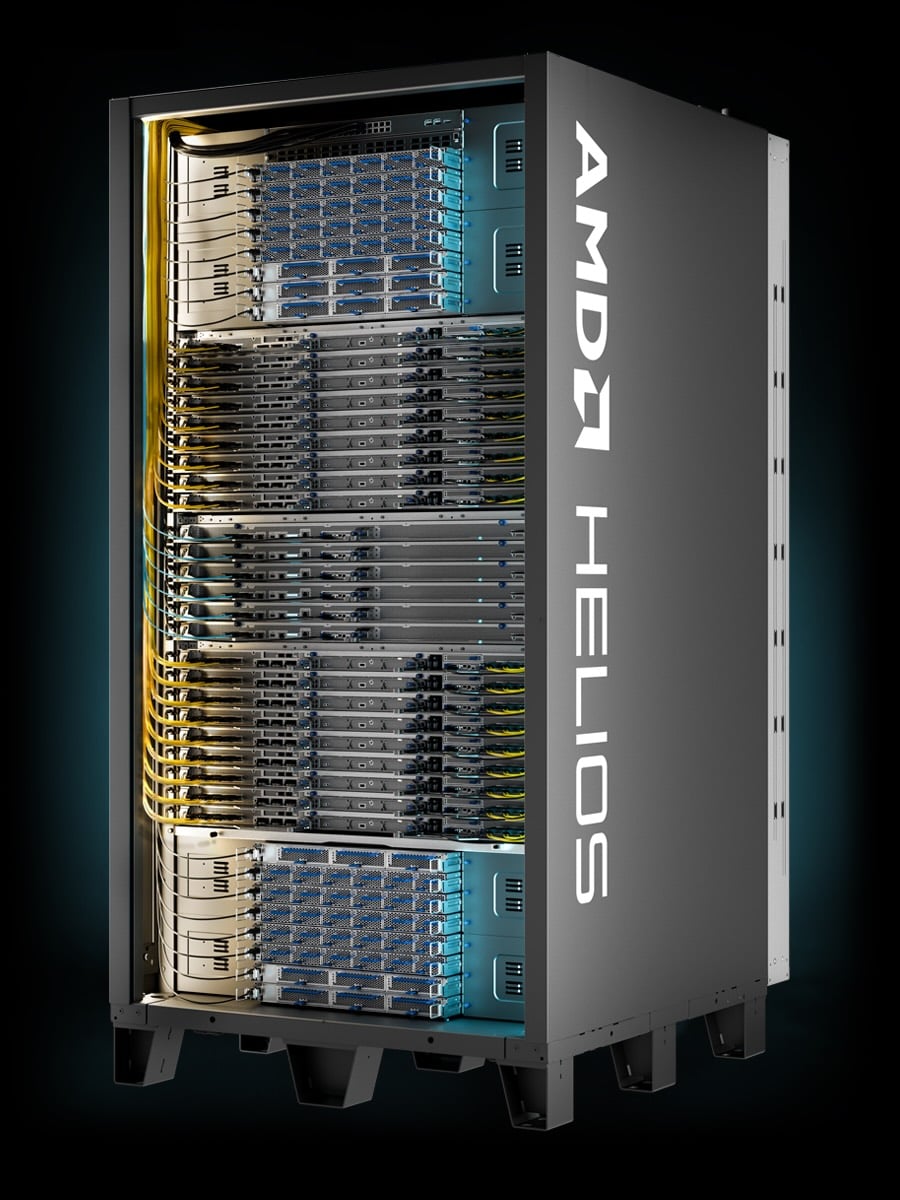
AMD has expanded its strategic partnership with Microsoft to cover GPUs, CPUs, networking, and software across Azure infrastructure. The collaboration includes Microsoft’s planned deployment of AMD’s Helios Rackscale Solution for AI inference workloads supporting frontier models, Azure AI services, and customer applications. The deployment makes Microsoft the first hyperscaler to publicly commit to Helios at scale, the clearest signal yet that AMD’s rack-scale platform is landing as a production alternative to NVIDIA’s rack-scale systems rather than a reference design.
Helios is AMD’s rack-scale AI platform, integrating Instinct MI455X GPUs, 6th Gen AMD EPYC Venice CPUs, Pensando networking technology, and the ROCm software stack. The platform is designed to provide an open architecture for large-scale AI training and inference, positioning AMD to offer an alternative infrastructure stack for cloud providers and organizations building large model environments.
AMD’s companion blog frames Helios as a system-level play rather than a component sale: a fully integrated platform designed around AMD compute, networking, software, power, and cooling, built to span training, inference, fine-tuning, and agentic workloads rather than optimizing for any single one. The division of labor is explicit: AMD supplies the silicon foundations, while Microsoft wraps them in Azure’s cloud operations, developer services, security, and AI platform services; the companies’ shared argument is that rack-scale infrastructure becomes more valuable when it arrives inside a complete cloud platform customers can consume at scale. The timing is no accident either: the announcement lands just ahead of AMD’s Advancing AI 2026 event, where Microsoft and AMD are co-presenting sessions on sovereign AI, AI economics, and production-scale infrastructure.
For Azure, the deployment targets inference workloads across Microsoft services and enterprise applications. Frontier model developers will be able to use AMD-powered Azure infrastructure for training and deployment, while enterprise customers can manage production AI workloads through Azure Foundry Managed Compute. The companies are also extending their CPU collaboration with two new Azure VM families based on 6th Gen AMD EPYC Venice processors. Azure HDv2 is intended for agentic AI and data pipeline workloads, while Azure HXv2 targets semiconductor design use cases. These instances expand Azure’s existing AMD EPYC footprint across AI, data-intensive, and engineering workloads.
Networking is another component of the partnership. Building on Microsoft’s existing broad deployment of AMD Pensando DPUs, Azure is extending them into AMD AI backend networking infrastructure and select Azure services, and the companies are integrating Azure Boost with AMD technologies to improve networking performance, efficiency, and connection processing at cloud scale. That matters most for AI clusters, where east-west traffic between GPUs grows faster than anything else in the data center.
AMD and Microsoft characterized the expanded arrangement as an effort to provide scalable AI infrastructure spanning model development, inference, data preparation, search, and reinforcement learning. For AMD, the agreement broadens the role of its GPU, CPU, DPU, and software portfolio within a major hyperscale cloud environment.
AMD expects to begin shipping Helios systems to customers, including Microsoft, during the second half of 2026.