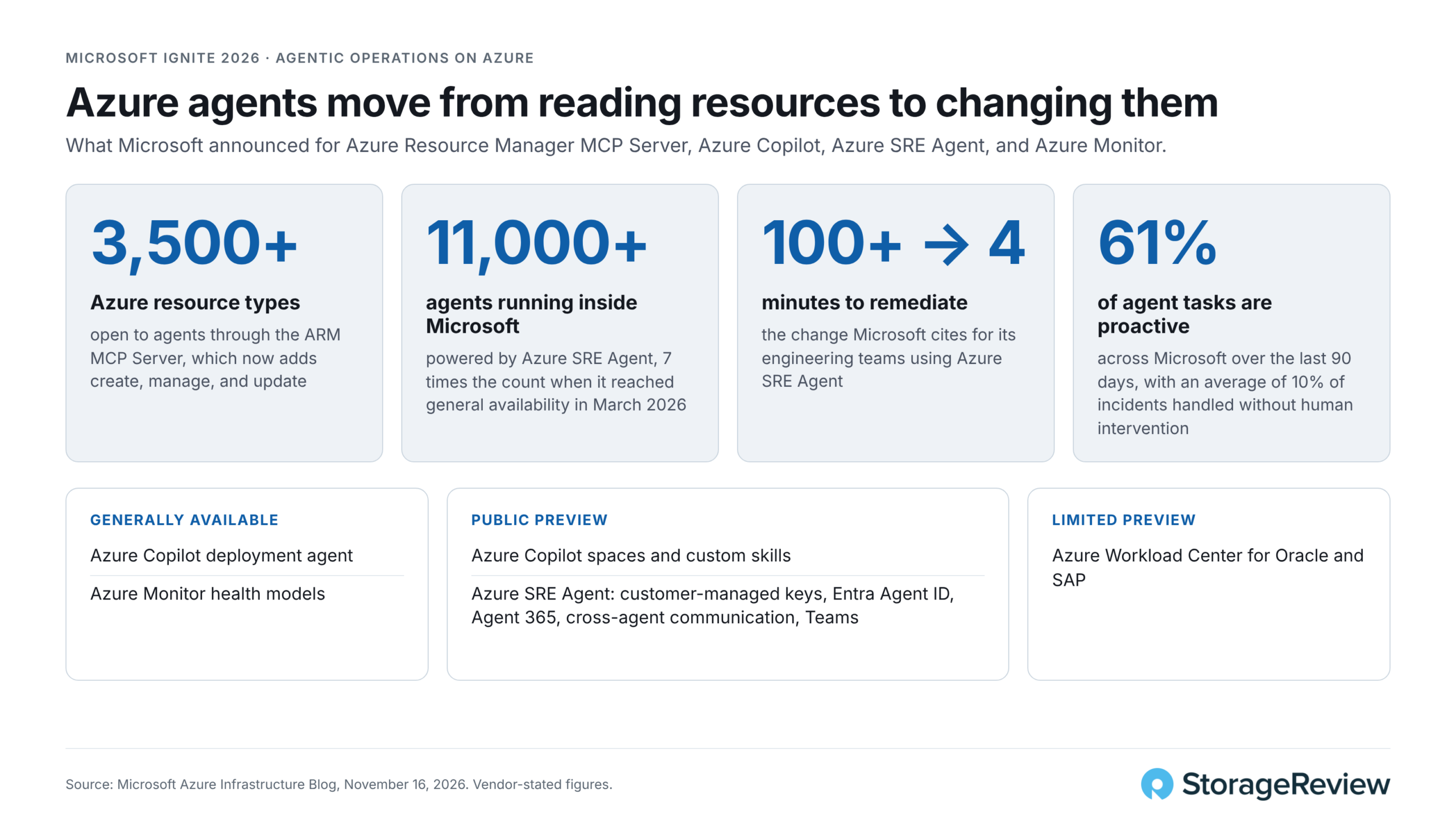
Microsoft used Ignite 2026 to move Azure’s AI agents from reading infrastructure to changing it. The Azure Resource Manager (ARM) MCP Server, which already gave agents read access to more than 3,500 resource types, now lets them create, manage, and update resources, with each request evaluated by Azure Policy. Microsoft’s agentic operations announcement pairs that change with updates to Azure Copilot, Azure SRE Agent, and Azure Monitor, and with a figure from its engineering teams: remediation that once took more than 100 minutes can now take four.
Most enterprise AI over the past couple of years went into email, meeting summaries, and code snippets, while the people keeping servers, storage, and data centers running were still digging through fragmented logs at 2 a.m. Microsoft names that fragmentation as one of three pressures behind the change, alongside agents that behave less predictably than traditional automation and expertise that sits in separate teams.
Context Matters More Than Raw Model Power #
Giving an agent a command line or a telemetry dashboard does not make it a competent administrator, and Microsoft makes the same point. Outages usually come from unexpected interactions among dependencies, configurations, and recent changes, so an alert that a service is failing says little about the cause. ARM and Azure Resource Graph (ARG) already hold an estate’s resources, their relationships, and their change history. Microsoft says it is building an intelligence engine on that foundation to turn operational data into context that people and agents can act on.
Brendan Burns, corporate vice president and technical fellow for Azure cloud native and management platform, writes that because the engine handles how resources fit together, people can “spend their time on what they want to accomplish.” An agent that already knows how the network, compute, and storage relate needs far less direction in the prompt, which leaves the administrator to describe the outcome the data center needs. That context is the difference between an operations agent and a chat window sitting on top of a dashboard.
Moving From Alerting to Actual Remediation #
Monitoring tools have long been better at reporting a failure than at helping fix it. The ARM MCP Server update addresses that for teams that bring their agents to Azure, since any agent compatible with the Model Context Protocol (MCP) can now make changes through the control plane administrators already use. Policies that block noncompliant deployments, require tags, or restrict regions and SKUs apply to an agent’s request the same way they apply to a change made in the portal.
Azure SRE Agent investigates incidents, identifies root causes, and automates operational tasks. Its additions, all in public preview, are customer-managed keys, Entra Agent ID, Agent 365 integration, cross-agent communication, and Microsoft Teams integration for investigations that span clouds. Microsoft says the first three give organizations more control and governance across the agent lifecycle, and the identity piece echoes what Nerdio’s Scott Manchester told us about treating an AI agent as an identity in Microsoft Entra.
The Azure Copilot deployment agent, which turns natural-language requirements into infrastructure and deployment code, is now generally available. Azure Monitor health models are generally available as well, turning telemetry into a real-time view of application health that connects architecture, dependencies, and business impact. Microsoft positions that view as context for agents too, since it shows how a failing resource affects an application before an agent recommends or automates a fix.
Microsoft says more than 11,000 agents powered by Azure SRE Agent now run across the company, seven times the count when the product became generally available in March 2026. Over the last 90 days, 61 percent of their tasks were proactive work, and an average of 10 percent of incidents were handled end to end without human intervention. Ecolab, the customer cited in the announcement, reports finding root causes 60 percent faster and reclaiming three to four hours per incident. These are vendor and customer figures, and we did not run or audit them.
We saw the same move from alerting to remediation in our lab evaluation of Tassient Aipex. In that review, the AI assistant repaired a WhatsApp client that was white-screening because of a corrupt cache and brought a system back after it lost DNS and network reachability, usually within seconds of the request. Beyond those support cases, we have used Aipex to provision KVM virtual machines, configure iSCSI and NFS shares on a compact NAS, and interpret storage benchmark results, all through plain-language prompts to its AI assistant.
Custom Skills Turn Generic Agents into Specialists #
Microsoft expects agents to pick up local knowledge through skills: Azure agents ship with skills for different areas of cloud operations, and organizations can write custom skills that capture their architectures, procedures, and requirements. Azure Copilot spaces and custom skills are in public preview, giving teams a place to keep persistent context for their environments. Azure Workload Center, in limited preview, extends the approach to Oracle and SAP workloads by monitoring workload health and validating configuration.
Microsoft’s model runs through the Azure control plane, and systems outside Azure typically reach it through Azure Arc. In mixed on-premises and edge environments, standalone tools such as Aipex have an advantage in reach, because the agent runs entirely in user mode and takes prompts and scripts for Windows, Linux, and macOS systems. In both cases, pairing a capable model with current context about the environment lets a lean IT team handle work that used to need a larger staff.
Where We Go From Here #
Microsoft putting agentic operations into the core Azure control plane lines up with what we have been testing on our lab benches. Other vendors are moving the same way, including Cisco, which has opened Cisco IQ’s telemetry and automation through an MCP server, though agentic IT is still emerging across most of the market. From small edge servers managed by a general-purpose agent to large cloud estates governed by Azure Copilot and Azure SRE Agent, natural-language intent is becoming a primary interface for infrastructure.
For IT practitioners, the job shifts from memorizing syntax and chasing logs toward defining guardrails, describing objectives, and verifying outcomes. Several of the Ignite additions are still in preview, so the near-term work is deciding which policies, approvals, and identities an agent will operate under before it is allowed to make changes.