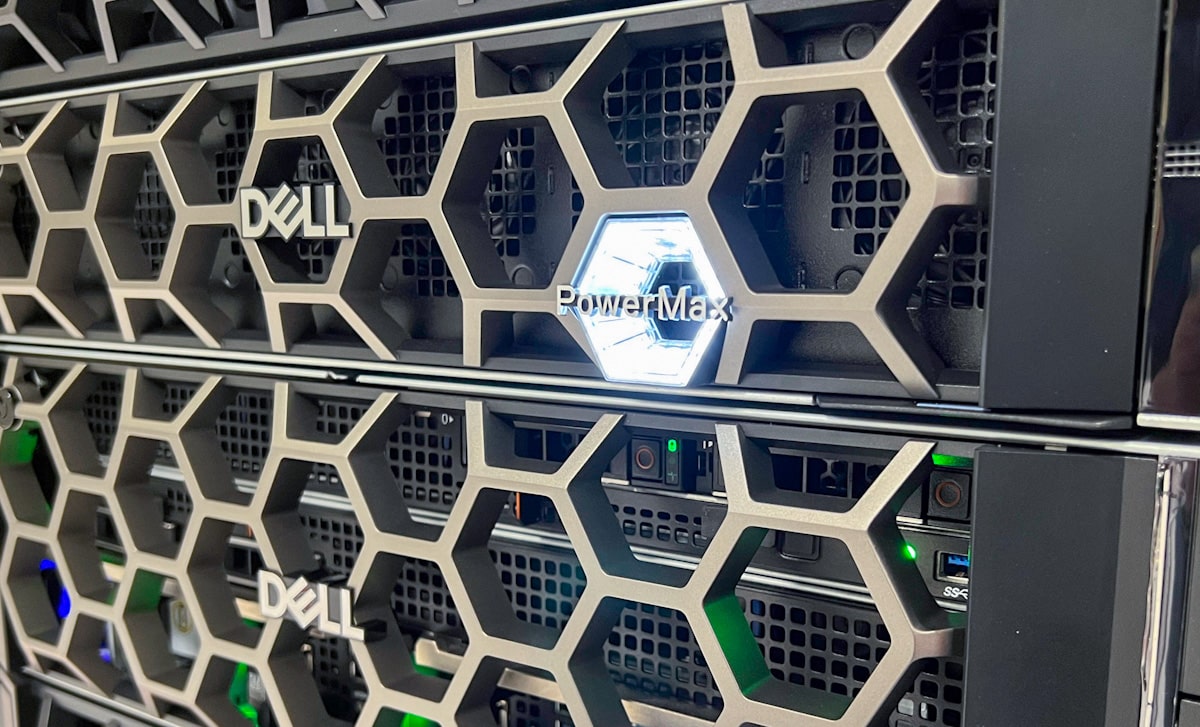
Dell announced PowerMaxOS 10.5 today, a software update for the PowerMax 2500 and 8500 that returns PowerPath multipathing to the platform, adds Dell Cyber Detect scanning of PowerMax snapshots, and opens array telemetry through OpenTelemetry and faster bulk REST APIs. Dell’s headline figure is up to 29 percent higher IOPS from cache-aware PowerPath against native round-robin multipathing on a PowerMax 8500. The update installs non-disruptively at no additional charge under an active Dell service contract. It is available now, with a Model Context Protocol (MCP) integration planned for later this year.
The release follows PowerMaxOS 10.4, which focused on SRDF read latency and ransomware detection, and it relies on software to get more from arrays customers already have installed. Dell frames that against constrained NAND supply, and it says PowerMax sales grew more than 60 percent in fiscal 2026. The company also cites IDC data giving it 42 percent of high-end storage, more than twice the share of its nearest competitor, a lead we covered when IDC’s first-quarter external storage figures came out.
Telemetry and Automation #
Dell says the enhanced bulk REST APIs return performance metrics up to 14x faster through a single filter-driven request. That figure comes from Dell’s comparison of one bulk call covering 10 instances in PowerMaxOS 10.5 with 14 standard API calls in PowerMaxOS 10.4. Native OpenTelemetry support streams performance data to Prometheus or any OpenTelemetry-compatible collector without custom polling code. Fabric Performance Impact Notification (FPIN) events from Broadcom Brocade SAN fabrics now appear in the REST API beside storage performance data, so fabric events and array metrics can be read from one source.
The MCP integration will let IT managers ask about capacity, performance, or response times in plain language from AI clients such as ChatGPT, Claude, or Gemini. Dell says storage administrators retain full control over configuration changes, which points to a query path for reporting while changes stay with the storage team. We noted in our PowerStoreOS 5.0 deep dive that Dell’s developer site lists more than 100 MCP tools across its storage lines, PowerMax included. The release also speeds up Red Hat OpenShift operations with streamlined provisioning and quicker cleanup for containerized workloads, though Dell gives no figures for those gains.
Cyber Detect for PowerMax #
PowerMax already takes immutable snapshots that can’t be altered or deleted, and Dell Cyber Detect now checks whether those snapshots are clean. Cyber Detect is Dell’s integration of Index Engines CyberSense, which reached PowerStore first, and it runs byte-level analysis trained on more than 7,500 ransomware variants. Dell cites up to 99.99 percent confidence in detecting corruption, a figure from an ESG report that Index Engines commissioned in June 2025. Cyber Detect requires a separate license and a supported Dell PowerEdge server, so it sits outside the no-charge PowerMaxOS upgrade.
Array-based snapshot scans can run several times a day, which helps teams catch an attack in progress and establish when data became at risk. Policy-based or on-demand scans identify the last clean copy, and the forensic output lists affected servers, corrupted files, the attack timeline, and the blast radius. Findings can be sent to SIEM and SOAR platforms such as Splunk, QRadar, and Microsoft Sentinel. Drew Schulke, vice president of product management for primary storage at Dell, wrote that the urgent question after an attack is whether a team “can trust that copy.”
PowerPath and NVMe over TCP #
PowerPath support covers the PowerMax 2000, 2500, 8000, and 8500, so the two previous-generation arrays get the multipathing software even though PowerMaxOS 10.5 targets the 2500 and 8500. Native round-robin multipathing (MPIO) sends reads down each path in turn, whether or not the data is waiting at the other end. PowerPath tracks which PowerMax node already holds the data in cache and sends the read there. Dell measured up to 29 percent higher IOPS than round-robin in internal testing on a PowerMax 8500 with an 8K random read hit workload, so the figure describes reads served from cache.
End-to-end NVMe over TCP gains external Unisphere and Solutions Enabler management, simplified provisioning, and support for 100GbE single-mode optics. Dell says the additions let administrators operate and manage a PowerMax entirely over standard IP networks. NVMe/TCP has been part of the platform since PowerMaxOS 10 arrived with the 2500 and 8500, and Dell describes the past year of PowerMax releases as focused on security, ease of use, hypervisor flexibility, and maturing that protocol.
PowerMaxOS 10.5 at a Glance #
| Feature | PowerMaxOS 10.5 |
|---|---|
| Release | PowerMaxOS 10.5 |
| Platforms | Dell PowerMax 2500 and 8500 |
| Upgrade | Non-disruptive No additional charge with an active Dell service contract |
| Bulk REST APIs | Up to 14x faster access to performance metrics (Dell) One bulk call for 10 instances vs. 14 standard calls in PowerMaxOS 10.4 |
| Telemetry | Native OpenTelemetry streaming to Prometheus or any compatible collector FPIN events from Broadcom Brocade SAN fabrics through the REST API |
| Dell PowerPath | PowerMax 2000, 2500, 8000, and 8500 Up to 29% higher IOPS than round-robin MPIO (Dell internal test, PowerMax 8500, 8K random read hit) |
| NVMe over TCP | External Unisphere and Solutions Enabler management Simplified provisioning 100GbE single-mode optics |
| Dell Cyber Detect | Index Engines CyberSense, trained on more than 7,500 ransomware variants Byte-level snapshot analysis, up to 99.99% confidence (ESG report commissioned by Index Engines) Findings to Splunk, QRadar, and Microsoft Sentinel Separate license and a supported Dell PowerEdge server required |
| Red Hat OpenShift | Streamlined storage provisioning and faster cleanup |
| MCP integration | Planned for later this year |
| Availability | Available now |