Has Independence Day come to Microsoft Corp. a few weeks after the national holiday?
In a bold assertion of technological independence, Microsoft AI has launched two new in-house artificial intelligence (AI) models into public preview while detailing extensive production data aimed at proving it no longer needs to rely exclusively on OpenAI’s frontier models to power its massive software ecosystem.
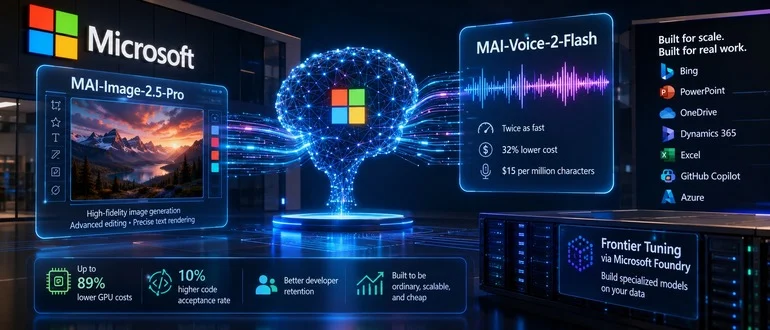
The twin releases — MAI-Image-2.5-Pro, a high-fidelity image generator, and MAI-Voice-2-Flash, a high-speed speech model for enterprise workloads — culminate a yearlong effort by Microsoft’s Superintelligence team to build purpose-built internal models.
Beyond research projects, the homegrown models now directly serve millions of users across flagship platforms that include Bing, PowerPoint, OneDrive, Dynamics 365, Excel, GitHub Copilot, and Azure.
“Microsoft didn’t just launch two models. It’s already running its own image and voice models across Bing, PowerPoint, OneDrive, and Dynamics 365, citing GPU cost cuts up to 89%. That’s the number buyers will test against their own bills,” said Mitch Ashley, vice president and practice lead for Software Lifecycle Engineering and AI-Native Software Engineering at The Futurum Group. “This is about vendor concentration risk, not model quality. Enterprises betting their roadmap on one frontier provider now have proof that alternative model layers run at production scale. Plan for multiple providers before a pricing or capacity shock forces the decision.”
The new models target opposite ends of the deployment spectrum.
MAI-Image-2.5-Pro is for premium creative work, advanced editing, and precise in-image text rendering, a historic weakness for generative media. Its base variant recently achieved the No. 2 spot for image editing on the Arena community leaderboard.
MAI-Voice-2-Flash is designed for unglamorous, high-volume operations like call centers and voice agents, Flash runs twice as fast as its predecessor and cuts costs by 32% (priced at $15 per million characters).
Together, the releases reflect Microsoft’s strategy to offer specialized model families rather than relying on a single, expensive flagship.
Seven years after investing over $13 billion in OpenAI, Microsoft’s latest move underlines a pragmatic shift: while third-party partners may push the boundaries of frontier research, the ultimate profits belong to the platform that makes AI ordinary, scalable, and cheap.
The release was accompanied by aggressive internal deployment metrics showing dramatic cost efficiencies. Microsoft reported that running its own models reduced GPU costs by up to 89% in certain applications.
In software engineering, Microsoft highlighted MAI-Code-1-Flash in GitHub Copilot, which achieved a 10% higher code acceptance rate and better developer retention than competing lightweight models. Further, by training that checkpoint inside an Excel reinforcement environment, Microsoft created a compact model performing on par with GPT-5.6 for standard spreadsheet tasks capable of running on legacy NVIDIA H100 and A100 GPUs rather than scarce, cutting-edge silicon.
Microsoft CEO Satya Nadella framed the shift in a strategic post on X titled “Frontier Diffusion & Control.” Nadella explained that Microsoft is actively routing product traffic to its own models whenever they match or outperform third-party options, reserving expensive frontier models only for hyper-complex needs.
Nadella said OpenAI and Anthropic remain critical partners within Microsoft’s broader orchestration system, but industry observers note the shifting dynamic. By keeping product memory, context, and harness systems external to the models, Microsoft retains full control, treating third-party models as interchangeable components while its own infrastructure handles routine traffic.
Microsoft is now commercializing this strategy through Azure, offering Frontier Tuning via Microsoft Foundry so enterprise clients can build specialized, cost-effective models on their own proprietary data.