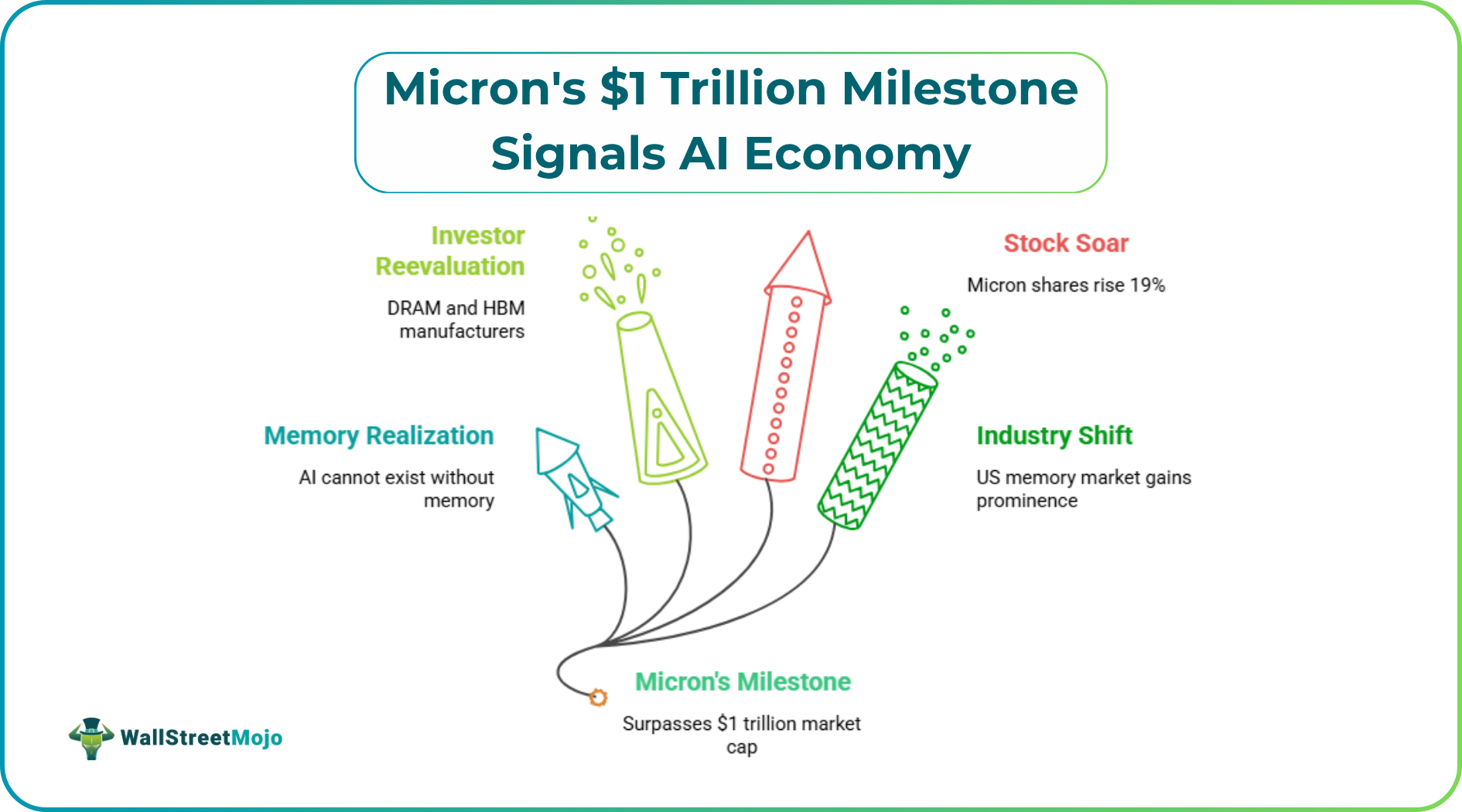
Micron Technology briefly surpassed a $1 trillion market capitalization in late May 2026 after a jump in its share price, driven by investor expectations about accelerating AI demand for memory, according to Reuters and CNBC. UBS raised its price target on Micron to $1,625 from $535, a move CNBC and Reuters cite as a catalyst for the rally. Reporting by TheStreet and WallStreetMojo notes sellers of high-bandwidth memory (HBM) are oversubscribed, with those outlets reporting that Micron has sold out HBM supply for 2026 and is developing next-generation HBM4. Reuters quoted B. Riley Wealth strategist Art Hogan describing Micron as central to rapidly rising memory demand. Industry coverage frames the milestone as part of a broader rerating of memory and infrastructure suppliers as AI spending grows.
What happened
According to Reuters and CNBC, Micron Technology briefly topped a $1 trillion market capitalization in late May 2026 after its shares rose roughly 19% in a single session. CNBC and Reuters attribute the jump in part to UBS increasing its price target on Micron to $1,625 from $535, the largest upward revision among brokerages covering the stock. Reuters quoted Art Hogan of B. Riley Wealth saying, "Today's crossing of the $1 trillion mark for Micron is just an exclamation point on the story of the massive amount of demand needed to run data centers in this AI revolution." Reporting by TheStreet and WallStreetMojo states that high-bandwidth memory orders are heavily oversubscribed, and those outlets report that Micron has sold out its HBM supply for 2026 while working on next-generation HBM4 development.
Technical details
Editorial analysis - technical context: Memory types most frequently cited across coverage are DRAM and high-bandwidth memory (HBM), which are used to store and move the large intermediate datasets that modern AI training and inference workloads produce. Industry coverage highlights that HBM, in particular, is capacity- and packaging-constrained because it combines stacked dies, through-silicon vias, and interposer/interconnect work. Observers frequently link tighter HBM supply and higher ASPs (average selling prices) to the need for larger model context windows and agentic workloads, which increase per-server memory demand relative to prior generations.
Industry context
Editorial analysis: Multiple outlets frame Micron's valuation milestone as part of a broader rerating that shifts investor attention from accelerators to full AI infrastructure. Reuters and CNBC place Micron alongside Samsung and SK Hynix as primary beneficiaries of rising memory demand. Industry-pattern observations point out that memory markets have historically been cyclical and prone to oversupply; analysts cited by Investopedia and TheStreet are watching whether current demand is structural or cyclical. TheStreet and WallStreetMojo report that large cloud and hyperscaler customers are signing long-term purchase commitments and reserving supply years in advance, which market coverage identifies as a key factor tightening short-term availability.
What to watch
For practitioners and market observers: monitor the following indicators reported or recommended across coverage:
- •capacity and ASP guidance in Micron's quarterly earnings and guidance (reported by Investopedia and Reuters),
- •announcements of long-term supply agreements between memory suppliers and hyperscalers (mentioned in CNBC coverage),
- •production ramp details for HBM4 and other next-generation HBM products as reported by industry outlets such as TheStreet and WallStreetMojo.
Editorial analysis: Observers should also track broader memory supply signals such as wafer starts, packaging lead times, and pricing trends for both DRAM and HBM, since these affect infrastructure cost and deployment timing for large AI clusters.
Bottom line
What was reported is a market revaluation: financial coverage documents a sharp rerating of Micron tied to AI-driven memory demand, anchored by a large UBS price-target increase and by press reports of tight HBM supply. Industry analysis frames this as a test case for whether elevated AI-driven memory consumption produces a lasting structural cycle or a temporary tightness that will normalize as suppliers expand capacity.
Scoring Rationale #
Micron hitting a $1 trillion valuation signals a notable market rerating of memory suppliers driven by AI infrastructure demand. This matters to practitioners because memory availability and pricing directly affect AI cluster economics and deployment timelines.
Practice interview problems based on real data
1,500+ SQL & Python problems across 15 industry datasets — the exact type of data you work with.