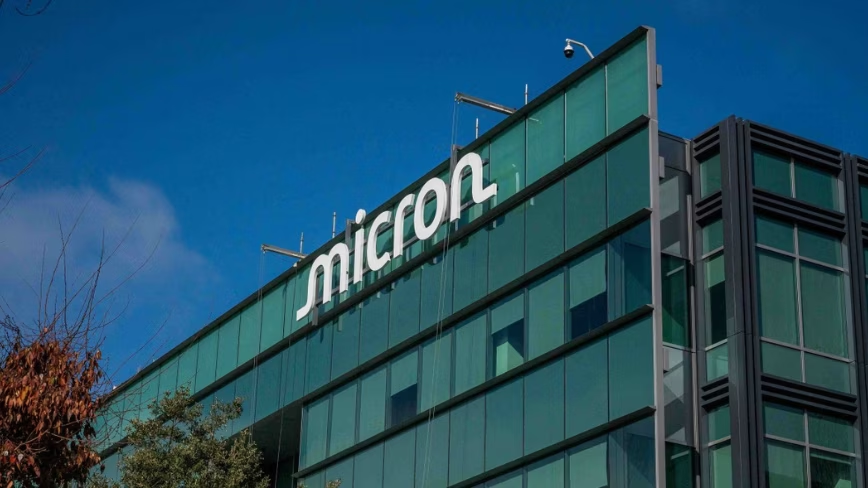
*Micron Technology broke ground on Saturday on a ¥1.5 trillion, roughly $9.3bn, expansion of its factory in Hiroshima, western Japan, the company’s latest bet on the AI memory boom that has already pushed its market value past $1 trillion. *
The Boise, Idaho based chipmaker will use the site to produce high-bandwidth memory, the stacked DRAM that sits next to GPUs inside AI accelerators from Nvidia and other customers.
Commercial shipments from the expanded facility are expected to begin around the summer of 2028.
That is a long runway in an industry where HBM has become the binding constraint on AI infrastructure, and Micron is only one of three companies in the world that can make it at scale.
Japan’s Ministry of Economy, Trade and Industry has committed up to ¥500bn toward the project’s capital costs, according to Bloomberg’s reporting on the groundbreaking.
Add in research and development support already pledged, and the government’s backing for Micron’s Japanese operations now totals roughly ¥775bn, a subsidy package that covers close to half of the new investment.
Speaking at the ceremony, chief executive Sanjay Mehrotra noted the symbolism of the location.
Micron’s first HBM production wafer, he said, was made at this same Hiroshima site, the piece of memory technology now sitting at the centre of the AI buildout.
The expansion is not an isolated move. It sits inside a broader Micron programme that includes leading-edge plants in Boise and a $100bn manufacturing complex near Syracuse, New York, all aimed at lifting DRAM capacity as demand outstrips what the industry can currently supply.
Micron’s own most recent quarterly results showed it can fulfil only between half and two-thirds of customer orders for HBM, with its entire 2026 output already sold out under multi-year contracts.
Japan has treated the deal as part of a larger industrial strategy. Prime Minister Sanae Takaichi last month unveiled a long-term roadmap targeting ¥101.6 trillion in combined public and private investment in semiconductors and AI through 2041.
Tokyo has now committed tens of billions of dollars to chipmakers since 2021 in an effort to rebuild a domestic industry that once led the world in memory production before ceding ground to South Korea.
That earlier dominance, and its loss, gives the Hiroshima project a certain historical weight.
Japan spent the 1980s and 1990s as the centre of gravity for global memory manufacturing before Samsung and SK Hynix overtook it, and the subsidy regime now underwriting Micron’s expansion is Tokyo’s attempt to claw back some of that relevance rather than simply host a foreign company’s factory.
Micron has leaned into that relationship before. The company took a similar subsidy path in 2023, when it announced plans to bring extreme ultraviolet lithography to Japan with up to $3.6bn in government backing, and it has more recently tied its fortunes to the wider AI ecosystem through a multi-year supply agreement with Anthropic covering HBM, DRAM and storage for the AI company’s data centres.
Rivals are not standing still. Samsung and SK Hynix have both been producing HBM at scale for longer than Micron and are running their own expansion programmes, which means the competitive map could look considerably different by the time Hiroshima’s new lines are shipping at volume in 2028.
For now, the more immediate effect of the memory squeeze is being felt well outside the AI data centre. Consumer electronics makers have already begun absorbing the cost of the DRAM shortage, as manufacturers redirect wafer capacity toward the higher margins that HBM commands. Micron’s Hiroshima expansion adds meaningfully to future supply, but shipments are still two years away, and the current shortage shows no sign of easing before then.
Get the TNW newsletter #
Get the most important tech news in your inbox each week.