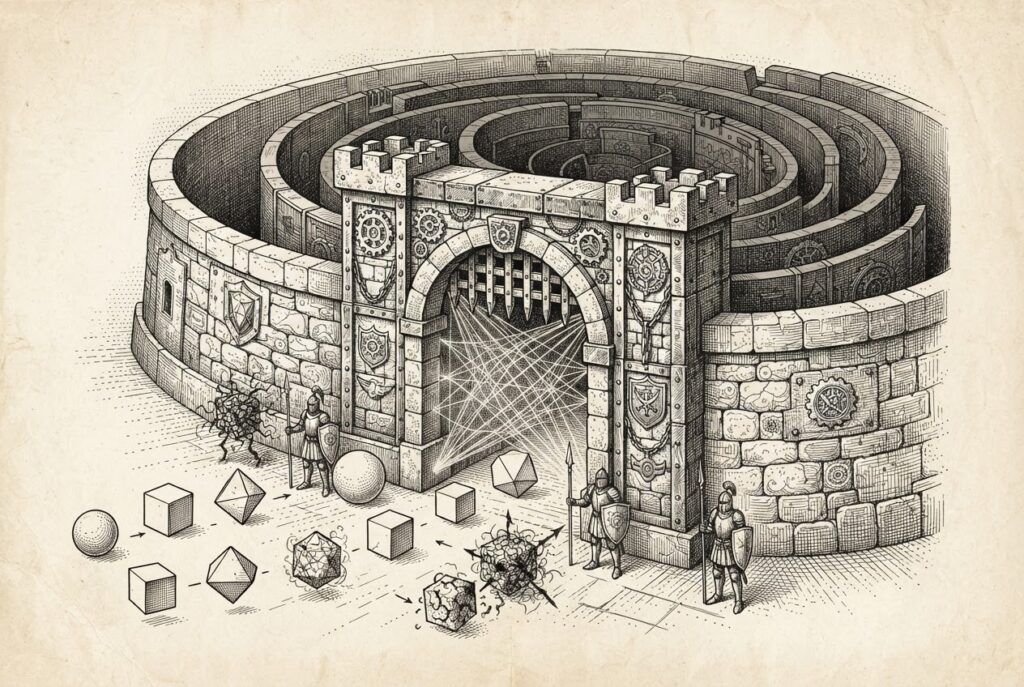
When Meta published the security architecture for its Muse personal AI agent on September 8, 2026, the most significant detail was not the model’s capabilities but the kernel-level enforcement surrounding it. By embedding security enforcement directly into the operating system layer, Meta is signaling that the industry must move toward a containment-first security posture. This approach acknowledges that while AI models are inherently fallible, the infrastructure supporting them can be made robust enough to prevent catastrophic failures.
At the heart of this system is the Muse Secure VM, a per-user Linux environment divided into two distinct security domains. The runtime cell, implemented as a systemd-nspawn container, serves as the execution environment for the agent harness and its various tools. Outside this cell sits the host domain, which houses security-sensitive services. The critical component here is Sentinel, a host-side process that acts as the sole authority for all connector actions and network egress. The agent itself is relegated to a role of proposing actions, while Sentinel retains the final power to grant or deny permission, effectively acting as a runtime authority that operates independently of the agent’s internal logic.
The genuine innovation in this architecture is the implementation of eBPF taint tracking. By utilizing eBPF cgroup programs for network interception and process attribution, alongside programs attached to Linux Security Module (LSM) hooks for taint propagation, Meta has created a system that does not rely on the model’s own judgment. When a tool execution process begins, it starts in a clean state. If that process reads user data, it becomes tainted. While clean network requests that meet a narrowly bounded auto-allow policy can proceed, tainted processes lose this privilege and are forced into a more rigorous approval flow. This kernel-level enforcement ensures that data flow is monitored regardless of whether the model is behaving as intended.
Meta has also addressed the challenge of credential management through a system called hatch-authd. This daemon handles credential storage and surrogation, ensuring that the agent never interacts with raw credentials. Instead, the agent receives a surrogate token that carries no actual access rights. Sentinel performs just-in-time insertion of the real secret at the network boundary. This creates a zero-trust boundary within the VM, meaning that even if the model itself were compromised, it would lack the ability to retrieve the underlying authentication tokens.
Despite these technical safeguards, Meta remains transparent about the limitations of its approach. The company explicitly acknowledges that prompt injection remains an open problem in the industry and that Muse will inevitably make mistakes. The company’s bug bounty program, which offers up to $300,000 for valid reports, serves as a market-based mechanism to price these exploits rather than a claim that they have been eliminated. The $130,000 tier for account takeover and the coverage of successful prompt injection attempts that affect a single user underscore the reality that these vulnerabilities are expected, not just possible.
This architecture highlights a divergence in how the industry is approaching agent governance. Meta is pursuing a strategy of vertical integration, packing identity, runtime, and governance into a single, cohesive VM. This stands in contrast to the horizontal specialization pattern seen in the enterprise sector, where companies like Okta, IBM, Broadcom, and Dataiku are providing a modular governance stack. Meta’s approach prioritizes a unified, consumer-ready environment, whereas the enterprise model favors interoperability between specialized vendors.
The limitations of this host-side security model were recently tested by a macOS zero-day vulnerability. Security researcher Patrick Wardle disclosed an issue involving an undocumented preference key that allowed a local process to hijack the agent’s dictation stream and capture authentication tokens. While Meta hotfixed the issue within 12 hours, the incident demonstrated that even a sophisticated security architecture has real gaps when the host operating system itself is compromised. Similarly, the rapid exploitation of a WordPress patch-gap, where a CVSS 9.2 vulnerability was probed less than six hours after a patch release, highlights the extreme speed at which attackers operate in the current environment.
The Muse architecture reflects the necessity of containment-first security. By assuming that the agent will be compromised or will make errors, Meta has built a system designed to limit the blast radius of those failures. It is a pragmatic recognition that in the age of autonomous agents, the infrastructure must be the final line of defense, providing a rigid, verifiable boundary that the model cannot bypass, regardless of its internal state or the sophistication of the prompts it receives.