Meta is teaching robots to play technician, and the experiment could change who keeps its sprawling AI data centers running.
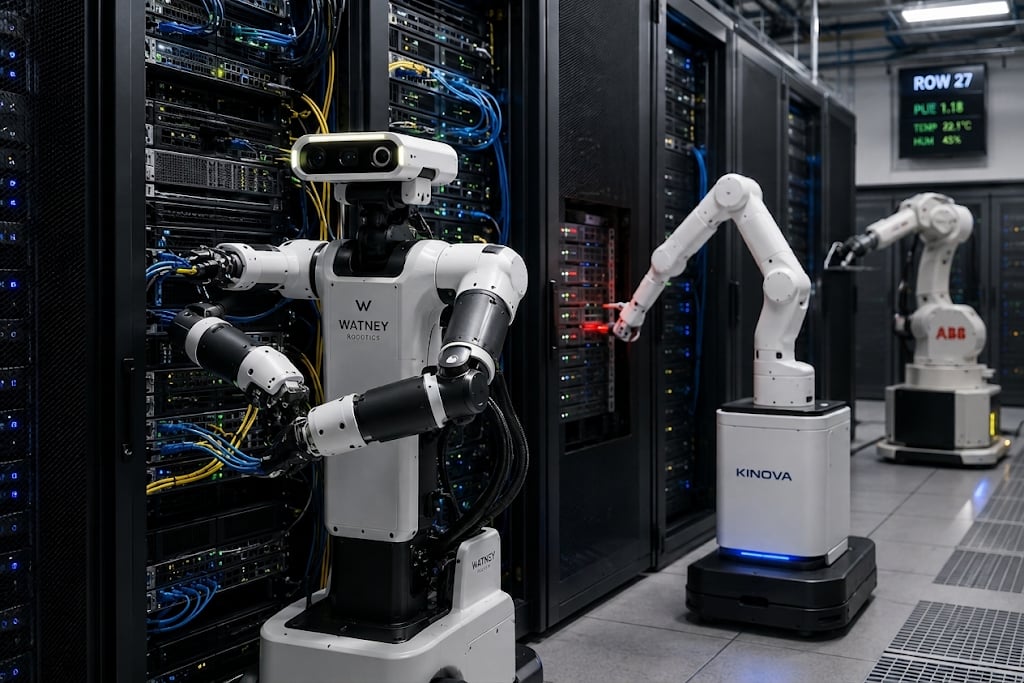
Meta is testing robots from Watney Robotics, Kinova and ABB for jobs including swapping network cables, restarting servers, reseating hardware and cutting power to equipment, according to WIRED reporting based on interviews with current and former Meta workers.
The trials are taking place at facilities including Meta’s Altoona, Iowa, campus and its Prometheus data center in New Albany, Ohio.
At Altoona, Meta has been testing two dual-armed Watney robots on cabling work since June 2025. The machines remain slower than human technicians and operate under supervision. A Meta worker told WIRED that a successful cable-swapping system could eventually eliminate up to 80% of the workload in some roles.
“We thought those of us performing the physical tasks were safe for a while, but not anymore. It’s coming for us all, unfortunately,” the worker told WIRED.
Meta is also testing a Kinova Gen3 robotic arm for server power-cycling, while ABB machines at the Ohio facility are being used to reseat components.
From simple automation to physical work #
Robots are not entirely new inside Meta’s data centers. The company previously demonstrated autonomous machines that move heavy server racks and track inventory. Those systems are now operating at multiple sites, according to people familiar with the projects.
But the newer experiments push automation closer to actual maintenance. One simple device can remotely press the power button on a Mac Mini or similar equipment to restart it.
Meta’s robotics ambitions are also not new. Eric Xu, a senior robotics manager at Meta, said at a conference last year, per WIRED, that putting robots in data centers was among the company’s long-term goals, including for incident response, environmental monitoring and preventive maintenance.
Why this matters: The technology still has plenty to prove #
The technology has clear limits. Meta’s inventory robots can struggle with corners and cables, while their grayscale cameras cannot distinguish green from red equipment indicators. Workers also report battery-recharging downtime and the need to manually move some machines between buildings.
More demanding work remains difficult, too. Meta has acknowledged internally that robots are not equipped for the intensive cabling required by Nvidia GB300 systems.
Helen Oleynikova, CEO of Exclaim Robotics, told WIRED that there have been “a lot of pilots and demos, but no provable working solution.”
That matters because replacing technicians is not simply a matter of giving a robot an arm. Data centers contain tightly packed equipment, cables, and components where a small mistake can disrupt expensive computing infrastructure.
A bigger question for data centers #
The stakes are rising because Meta is building data center capacity at enormous scale to support its AI ambitions. If robots eventually become reliable enough to perform routine physical maintenance, the company could expand facilities without increasing technician staffing at the same rate.
That does not necessarily mean mass job cuts are imminent. Robots remain slower, limited and dependent on people. Meta also says it needs more skilled workers and has launched training programs aimed at producing thousands of electrical, mechanical and plumbing workers each year.
The more interesting shift is that automation is moving beyond software tasks. Meta’s experiments suggest the next productivity gains from AI may come not only from automating decisions on a screen, but from machines physically maintaining the infrastructure that powers AI itself.
Also read: TechRepublic recently examined how Meta could turn its massive AI infrastructure investment into a cloud business by selling excess compute capacity to other companies.