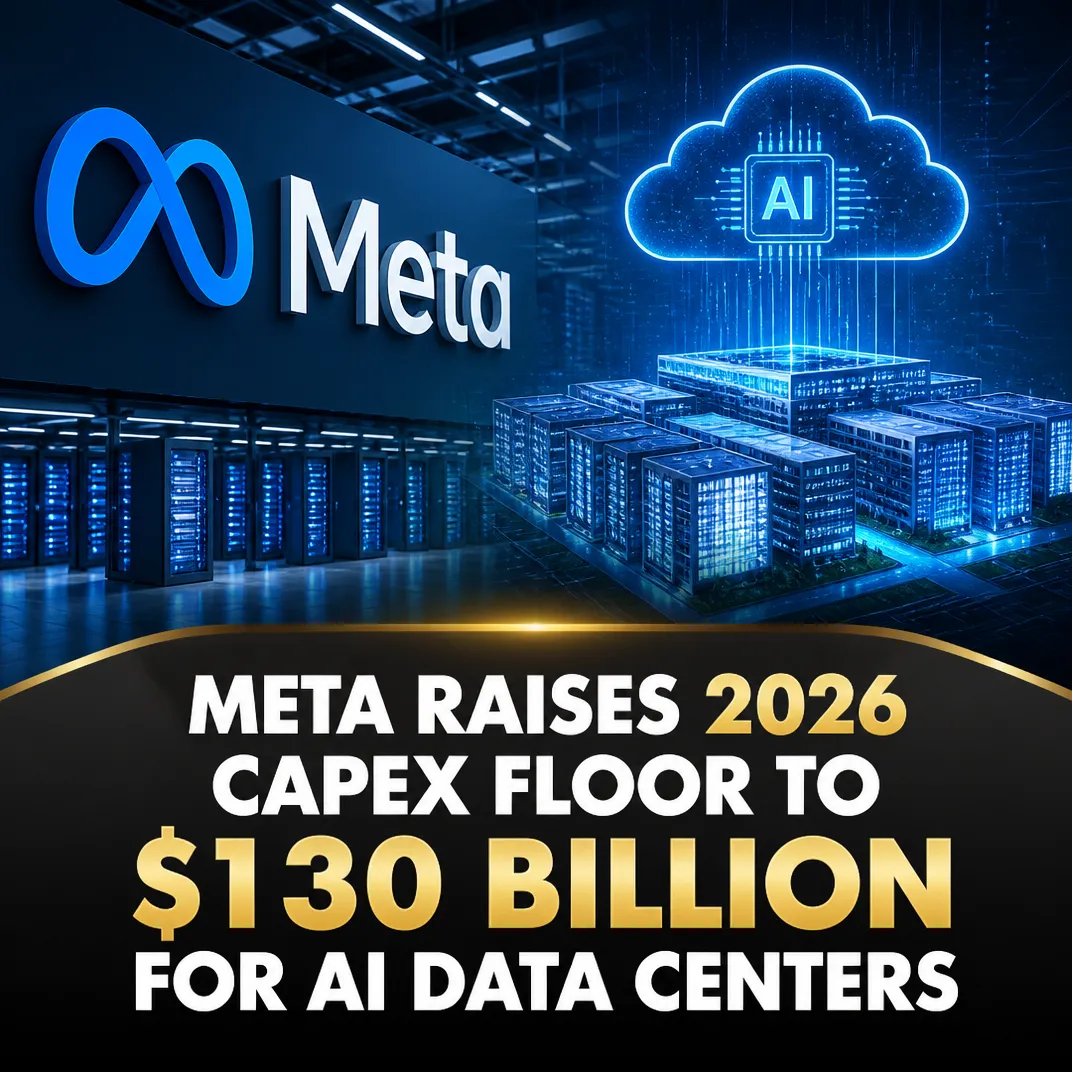
July 30, 2026, (Inside AI) — Meta Platforms has tightened its 2026 capital expenditure forecast to between $130 billion and $145 billion, up from a previous floor of $125 billion, signaling an intensifying commitment to AI infrastructure. The revision, disclosed Wednesday, reflects the company's aggressive buildout of data centers and computing power to support its artificial intelligence ambitions, even as shares fell about 5% in extended trading.
The new guidance narrows the range while raising the lower bound, underscoring Meta's determination to invest heavily in AI despite market jitters. The company also lifted the bottom end of its full-year expense outlook to $165 billion from $162 billion, citing $2.4 billion in legal charges from the second quarter. The upper limit remains at $169 billion.
Meta's spending spree is anchored in its advertising empire, which uses AI for ad targeting and recommendations across platforms like Reels and Threads. The short-video market is fiercely competitive, with Reels vying against TikTok and YouTube Shorts, while Threads challenges Elon Musk's X. These efforts are expected to benefit from a projected 14% rise in social media ad revenue to $421 billion in 2026, according to Madison and Wall, driven partly by the Winter Olympics and FIFA World Cup.
CEO Mark Zuckerberg is channeling ad profits into the pursuit of superintelligence, a hypothetical AI that surpasses human cognition in every domain. This vision fuels development of the Meta AI assistant and AI-powered smart glasses, though the latter faces significant privacy headwinds. Meta revealed in a court filing that four states are seeking $1.4 trillion in penalties over claims it designed Facebook and Instagram to addict young users and misled about safety.
The financial strain mirrors broader industry trends. Alphabet recently reported its first cash burn on record in the second quarter, rattling investors as AI costs mount. Big Tech's collective AI spending is forecast to exceed $700 billion this year, with Morgan Stanley projecting over $1 trillion next year. Meta's own data center projects include a gigawatt-scale facility in rural Louisiana, expected to reach 5 GW of compute capacity with investment surpassing $50 billion.
Off-Balance-Sheet Ventures Mask True Cost #
To manage debt, Meta is structuring data centers through joint ventures. A new entity for its El Paso, Texas, site is 80% owned by BlackRock and 20% by Meta, similar to an arrangement with Blue Owl Capital for the Louisiana project. This off-balance-sheet approach may obscure the full financial commitment, even as the company explores leasing computing power to Anthropic in a deal potentially worth up to $10 billion over two years, Reuters reported.
Such partnerships highlight a strategic pivot: Meta is not just building for itself but positioning as an AI infrastructure provider. The Anthropic talks, if finalized, would mark a significant revenue stream, though details remain unconfirmed. This dual role as both consumer and supplier of AI compute could reshape Meta's business model, but it also exposes the company to counterparty risks and regulatory scrutiny.
Legal Perils Threaten AI-Driven Revenue #
While AI investments aim to boost engagement, Meta's legal battles over youth safety could undermine its financial foundation. The company warned in April that regulatory actions in the EU and U.S. "could significantly impact" its business. The $1.4 trillion penalty sought by states, though unlikely to be awarded in full, casts a long shadow over Meta's risk profile. These proceedings contributed to the $2.4 billion charge that raised the expense forecast. Meta's smart glasses, a key AI hardware play, also face privacy challenges. The devices, which integrate the Meta AI assistant, have drawn scrutiny over data collection practices. As regulators worldwide tighten rules on biometric and behavioral data, the glasses' market viability may hinge on Meta's ability to navigate a patchwork of privacy laws, a task complicated by its track record on user safety.
Despite these headwinds, Meta's ad business remains robust. The company's AI-driven targeting systems are delivering results, and the broader digital ad market is buoyed by cyclical events. Yet the tension between massive capex and uncertain returns is palpable. Investors are increasingly wary of AI spending that lacks immediate payoff, as Alphabet's experience shows. Meta's narrowed forecast suggests management is walking a tightrope between ambition and fiscal prudence, a balancing act that will define its trajectory in the coming year.