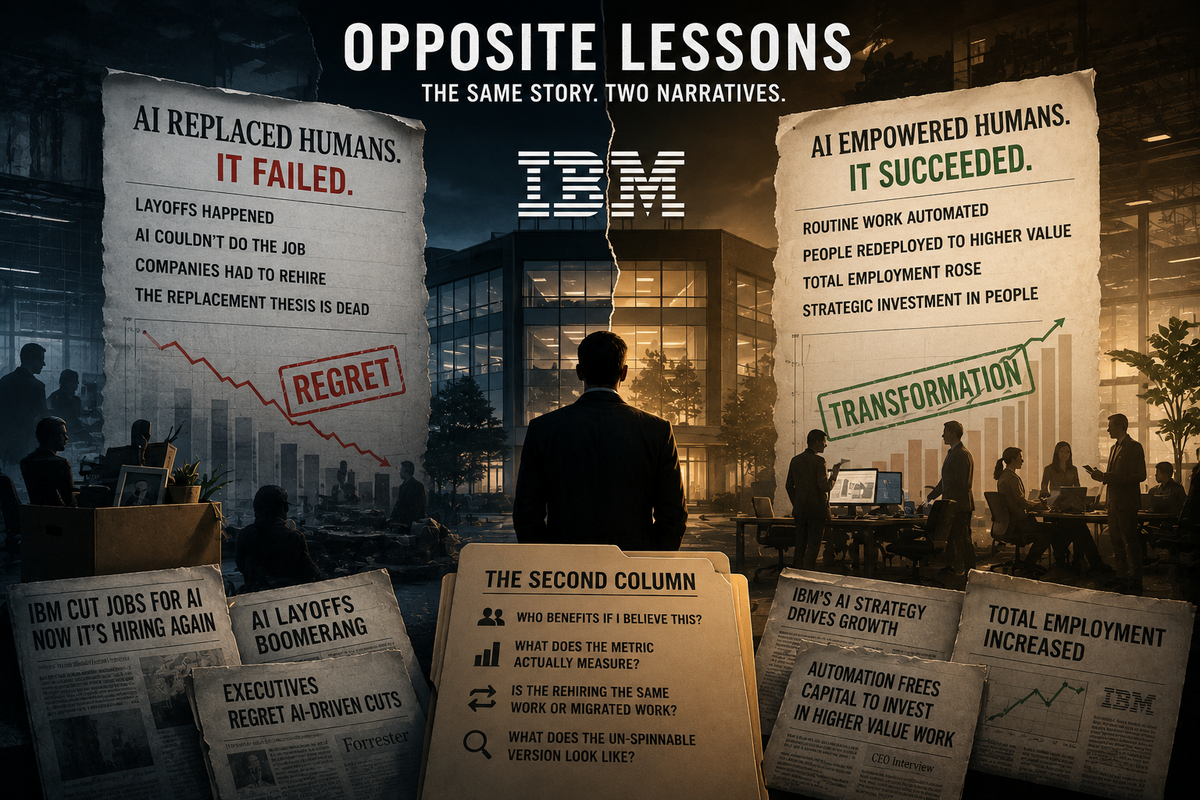
The AI-layoff reversal has become the most-told business story of 2026, and almost none of the telling is analysis. The same handful of cases – Klarna rehiring, IBM's headcount rising, a bank walking back 45 redundancies – are being narrated as two flatly contradictory morality tales from one set of facts, depending on who is doing the narrating and what they are selling. The case study has become a costume. An operator who reads these as evidence is reading a sales argument that has dressed itself as a lesson. Here is how to find the column the teller left off the slide.
There is a genre of business writing having its biggest year since the digital-transformation deck, and it goes like this. In 2024 a company fired humans and bought a chatbot. Wall Street applauded. Then, quietly, the company started hiring people back – because the AI couldn't do the job. The lesson, delivered with the confidence of a closing argument: the replace thesis is dead, AI is a tool not a team, invest in people.
The genre has a name now – the "layoff boomerang" – and a research apparatus behind it. The data is not fabricated. Careerminds found that 32.7% of companies that cut roles for AI had rehired a quarter to half of them, and 35.6% had rehired more than half. Visier measured rehiring of terminated employees ticking up. Forrester reported a majority of executives regretting AI-driven cuts. These are real numbers from real surveys, and an operator should take them seriously. The problem is not the data. The problem is two-fold, and it is structural. First, the exact same events anchoring the boomerang story are simultaneously anchoring its opposite – and both can't be the lesson. Second, look at who ran the marquee survey. Careerminds, whose rehiring figures are quoted in nearly every boomerang piece, is an outplacement and career-transition firm – a company whose business is selling services to organisations churning their workforce. The single most-cited statistic in the "AI failed" narrative is published by a vendor that profits from the churn the narrative describes. That does not make the number false. It makes the number motivated, and the first job in reading a reversal is telling those two things apart.
One dataset, two sermons
Consider IBM, which appears in both sermons by name, as proof of opposite claims.
In the boomerang telling, IBM is a cautionary tale: it deployed an AI HR system, suffered, and had to rehire. In the other telling – call it the redeployment sermon, preached by automation vendors and the company itself – IBM is a triumph: it automated routine HR work so successfully that it freed capital to hire more people in higher-value roles, and its total headcount went up. Same company, same AskHR system, same eighteen months. Two stories that cannot both be the moral, drawn from one set of facts.
The facts, when you go to them, fit the triumph telling far better than the caution one – which is itself revealing, because the caution telling is the more viral. AskHR automated roughly 94% of routine HR activity, ran over eleven million interactions in a year, and pushed an internal satisfaction score from deeply negative to strongly positive. IBM's CEO has said directly that total employment rose because automation freed investment for software, sales, and marketing roles – work where people "face up against other humans." And the headline number everyone repeats – 8,000 HR workers replaced – is, by the CEO's own correction, several hundred. The viral claim that IBM rehired the same people it fired has no public evidence behind it at all; the company never reversed AskHR and is still expanding it.
So the boomerang sermon is citing, as its marquee example of AI-replacement-failure, a case of AI-replacement-success. It works as evidence only if nobody checks. And mostly nobody checks, because the case arrives pre-interpreted – a logo, a number, a moral – in a format that looks exactly like analysis and asks nothing of the reader.
The sharpest evidence of this is not that two different camps tell two different stories. It is that the same article routinely tells both, and counts on you to keep only one. Scan the coverage and a structural tic repeats across outlet after outlet: a headline announcing that IBM "had to rehire" after AI "fell short," sitting on top of a body that, four paragraphs down, quotes Krishna saying total employment rose and the freed resources went to higher-value roles. The headline sells the boomerang; the body reports the redeployment; the reader retains the headline. The contradiction is not between publications – it is inside a single piece, between the part written to be remembered and the part written to be accurate. The case study is not just a costume. It is a costume with the receipt still pinned to the inside of the collar, and almost no one turns it over.
Why the same facts split into opposite stories
This is not random confusion. The direction a reversal story bends is a function of who is telling it and what that teller needs to be true.
The boomerang has a constituency: HR consultancies selling change-management and reskilling services, talent firms selling rehiring, displaced-worker advocates, and every middle manager who opposed the cuts and now gets to be right. For all of them, AI-must-have-failed is the premise that sells the service or settles the argument. The redeployment story has the opposite constituency: automation vendors, AI platform companies, and the executives who made the cuts and need them to look like strategy rather than panic. For them, AI-must-have-succeeded is the load-bearing claim. Neither group is lying, exactly. Each is doing what every interested party does with an ambiguous case – reaching for the reading that underwrites what they were already going to say.
The result is a market flooded with case studies that are actually position papers. The "study" supplies a real company and real events; the "case" supplies a conclusion the events don't compel. The reader, scanning for signal, mistakes the presence of a logo and a statistic for the presence of analysis. It is the costume effect applied to discourse: the piece wears the costume of a lesson – the structure, the data point, the confident close – without taking on the obligation a lesson carries, which is to follow the facts even when they cut against the teller's interest.
The case that fits no sermon
The way to see how much spin is loaded onto IBM and Klarna is to find a reversal that resists both stories, and stand it next to them.
Commonwealth Bank of Australia cut 45 customer-service roles for a voice-bot system, then reversed – and the reversal is unspinnable, because the bank confessed it in flat bureaucratic language no narrator can bend. Its initial assessment that the roles were not required, the bank said, did not adequately consider all relevant business considerations, and this error meant the roles were not redundant. There is no triumph reading available – the bank called its own analysis an error and apologised to the affected staff. And there is no clean boomerang-villain reading either, because the failure was not that the bot couldn't do empathy. The failure was a number that ran backwards: CBA had claimed the voice bot cut call volumes by 2,000 a week, when in fact volumes rose, forcing the bank to offer overtime and pull team leaders onto the phones – a discrepancy surfaced not by the bank but by the Finance Sector Union at the Fair Work Commission. The metric on the slide said the bot reduced load; the load increased. That is the judgment-gate reversal stripped of all narrative – a deflection number pointing the opposite direction from reality, at a bank posting a record A$10.25 billion cash profit that had no cost pressure forcing the cut in the first place.
CBA is the control case. It is what a reversal looks like when nobody has a product to sell on top of it – a company that miscounted, said so, and corrected. Held against that plainness, the IBM-as-triumph and IBM-as-caution tellings both reveal themselves as what they are: the same event, painted twice, by people standing to gain from opposite colors.
And to be fair to the boomerang – because the honest version of this argument is not "every reversal is secretly a win" – some of its cases are exactly what they claim. Duolingo recurs across the same coverage as a genuine instance: it leaned on chatbots to replace human work, found service quality dropped, and rehired. That is a real failure of a real replacement, told straight. Its existence is precisely why the genre is dangerous rather than merely wrong. If every reversal were secretly a success, you could discount the whole genre and move on. But success and failure both occur, the genre tells them in the identical shape – logo, statistic, confident moral – and that uniform shape is what strips the reader of the ability to tell which is which. The problem was never that the stories are false. It is that true and false reversals are narrated identically, so the format carries no information about which one you are holding.
Reading for the second column
Every AI-workforce story has two columns. The first is the one on the slide: the headcount cut, the savings figure, the resolution rate, the rehiring number. The second is the one left off: what the metric on the slide was actually measuring, what it omitted, and what the teller needed you to conclude. The operator's skill is reconstructing the second column from a story that only shows the first. Four questions do most of the work.
Who benefits if I believe this? Identify the teller's constituency before weighing the claim. A reskilling vendor's boomerang case and an automation vendor's redeployment case are both admissible evidence and both motivated; knowing the motive tells you which way to discount. A reversal story with no identifiable seller behind it – a regulator's finding, a company's own filed admission – is worth more than ten with a service attached.
Did the metric on the slide measure the job, or a proxy for the job? Klarna's resolution rate measured tickets closed, not problems solved; the gap between those is where the reversal lived. IBM's 94% containment measures questions answered, not judgment exercised. A reversal story almost always turns on a metric that looked like performance and was actually throughput. Find the metric, then ask what it couldn't see.
Is the rehiring the same work, or migrated work? This is the distinction the boomerang collapses and the redeployment story over-claims. "They rehired" can mean the automation failed and the old job came back, or it can mean the automation worked and freed labor moved up the stack. Those are opposite lessons. The slide will not tell you which; the org chart and the new job titles will.
What does the un-spinnable version look like? For any reversal you're being sold, ask what the CBA-style flat admission would say – the version with no service attached. If you can't find that version, you are reading positioning, and the honest move is to treat the conclusion as unproven rather than as a case study you can cite.
Bottom line
The reversal genre got popular because reversals are genuinely happening – the boomerang data is real, the rehiring is real, the regret is real. But popularity attracted sellers, and sellers turned a phenomenon into a format, and the format now manufactures conclusions the underlying facts don't support. The case study became a costume, and the costume fits both "AI failed" and "AI won" equally well because it was never load-bearing in the first place.
The forward call: as AI-workforce reversals keep landing through 2026, expect the case-study-as-position-paper to consolidate into branded "frameworks" – named maturity models and reversal taxonomies, sold by the same constituencies, each pre-loaded with the conclusion its author needs. The tell will be a reversal "study" that names no metric, identifies no omitted column, and arrives with a service to sell on the next page. When you see it, you are not reading what happened at the company. You are reading what the author needs you to do next. The only durable defense is the boring one: go to the second column yourself, and trust the reversal that nobody profits from telling.
Sources: IBM AskHR figures (94% containment of routine HR tasks, 11.5M interactions in 2024, internal NPS from -35 to +74, $3.5B productivity gain across 70+ areas) and CEO Arvind Krishna's redeployment account (total employment rose, reinvestment in software/sales/marketing, the "several hundred" correction to the viral 8,000 figure) per Krishna's Wall Street Journal interview, corroborated across Entrepreneur, BGR, HR Asia, People Matters, Indian Defence Review, and Daily Galaxy (2025–2026). The debunking of the "IBM rehired the same workers it fired" claim is independently confirmed by TMCnet (Rich Tehrani, 2025) and visible directly in the structure of the boomerang coverage itself, where headlines asserting a forced rehiring sit atop bodies quoting Krishna's redeployment account (e.g. Resident, Glass Almanac, Boston Organics, 2025). Duolingo cited across the same coverage as a genuine rehire-after-chatbot-shortfall case. Klarna reversal and Siemiatkowski's "we went too far" admission per Bloomberg-sourced reporting (2025). Commonwealth Bank of Australia's reversal of 45 customer-service roles, its "did not adequately consider all relevant business considerations" admission, the claimed 2,000-calls-a-week reduction that proved to be an increase, and the Fair Work Commission dispute, per Bloomberg, ACS Information Age, the Canberra Times, iTnews, and the Finance Sector Union (August 2025). Boomerang aggregate data per Careerminds' own survey of 600 HR professionals (conducted 12-14 February 2026; 32.7% rehired 25-50% of cut roles, 35.6% rehired more than half, 30.9% found rehiring cost more than the savings), with Careerminds' outplacement/career-transition business model per its own description; plus Visier (via Axios), Forrester Predictions 2026, and Gartner. Cross-references to prior Signal Memo coverage: the judgment gate (Klarna), the costume effect. The "second column" framing and the analysis of reversal case studies as constituency-driven positioning are original to this memo.
Verification note, in the spirit of this memo's own argument: every load-bearing claim here has been traced to a primary or near-primary source. The IBM redeployment facts and the debunking of the "same-workers-rehired" claim are corroborated across multiple independent outlets and IBM's own CEO. The CBA confession, the 2,000-calls-a-week discrepancy, and the Fair Work Commission context are confirmed across Bloomberg, the ACS Information Age, the Canberra Times, iTnews, and the Finance Sector Union's own account. The Careerminds figures (32.7% rehired 25-50%, 35.6% rehired more than half, the speed and cost breakdowns) are taken from Careerminds' own published survey of 600 HR professionals conducted 12-14 February 2026 – and Careerminds' identity as an outplacement and career-transition provider is likewise per its own corporate description. The one claim this memo deliberately does not assert is the viral "IBM rehired the workers it fired," which the same reporting debunks; it is cited here only as an example of the genre's error, not as fact.