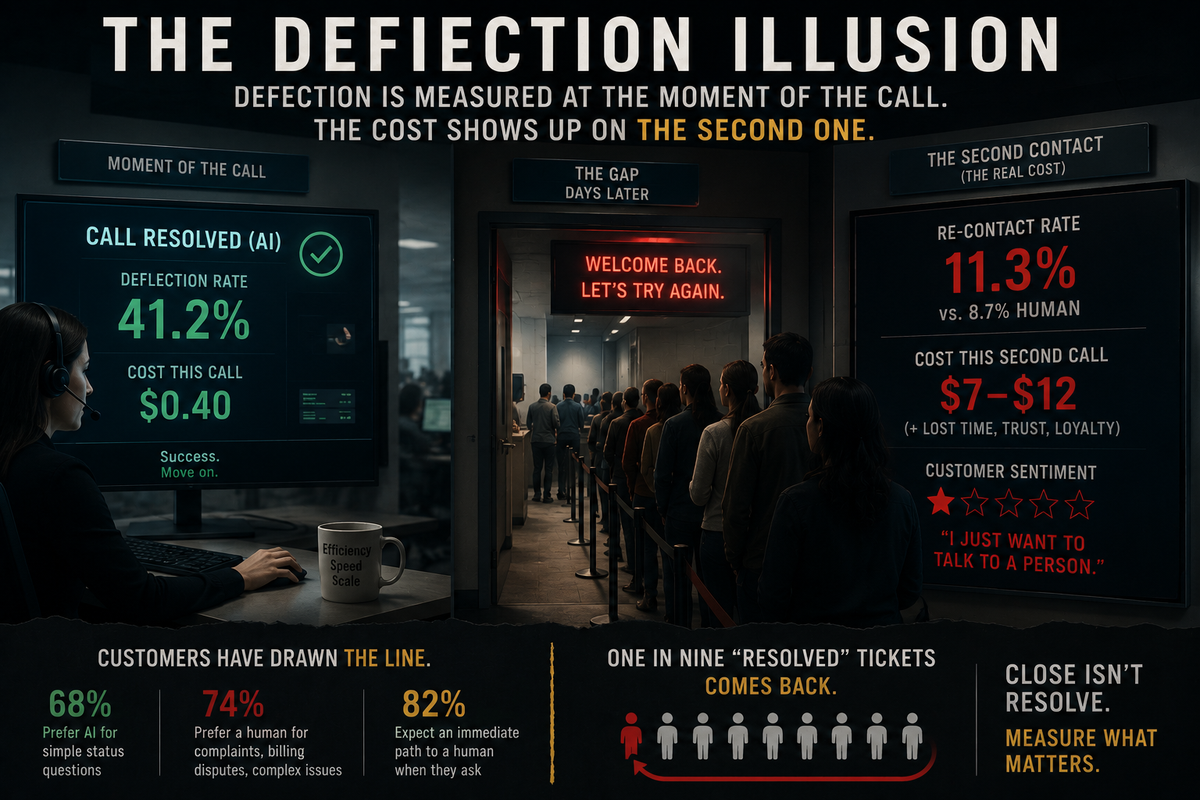
Voice AI is being deployed fastest into the exact conversations customers least want it to handle – complaints, billing disputes, anything with feeling in it. That tier is also where the AI performs worst, and where the "resolved" ticket is most likely to come back. Deflection is measured at the moment of the call. The cost shows up on the second one. Two numbers, both public, describe a gap that most CX dashboards are structurally unable to see.
Every enterprise now has an AI that answers the phone instantly, never breaks for lunch, and handles a thousand calls at once. You have a thumb, a phone, and whatever patience you brought with you. That asymmetry is the most widely-felt consequence of the agent boom, and it is not going to reverse – the economics run one direction. An automated voice interaction costs something like forty cents against seven to twelve dollars for a human agent. No comparable math exists on the consumer side, so no comparable arms race is coming.
But the asymmetry is not the interesting part. The interesting part is which conversations the automation is being aimed at, and what the scoreboard measuring it cannot see.
The gap between what's deployed and what's wanted
Two survey findings, published in the same research, point in opposite directions.
Customers are broadly fine with AI on simple things: 68% say they prefer it for status-style questions, up from 41% two years ago. That is a real and rapid shift in public tolerance, and it is the number vendors quote.
The companion number is quoted far less often. 74% prefer a human for complaints, billing disputes, and sentiment-heavy contacts. And 82% expect a clear, immediate path to a human when they ask for one. Nearly a third – 31% – explicitly mistrust AI on financial or account-changing actions, a figure that has not moved in two years despite everything else moving.
So the public has drawn a line, and the line is legible: automate the lookup, leave me a human for the fight. Now look at where deployment is actually heading. Voice AI handled 19% of inbound contact-center volume in 2026 against 6% in 2024, with a forecast of 33–37% for 2027 – banking and telco leading. Median tier-1 deflection across enterprise CX programs sits at 41.2%. Seventy-eight percent of the top fifty banks run production voice agents, up from 34% in 2024. The growth is not confined to the status-check tier the public blessed, because the volume – and therefore the savings – is not confined there either. Billing disputes are expensive calls. Expensive calls are the ones with an ROI case.
The industry is automating across the line the customer drew, and doing it fastest in the verticals where the line matters most.
The number the dashboard can't see
Here is where it stops being a preference story and becomes an operator problem.
Complaint handling is the lowest-performing intent tier for autonomous AI, at 3.34 out of 5 CSAT. That alone is unsurprising – a hard conversation is hard. The number that should reorganize how a CX leader reads their own dashboard is the next one: re-contact rate runs 11.3% on AI-resolved tickets against 8.7% on human-resolved ones.
Sit with what that means arithmetically. Roughly one in nine AI "resolutions" produces another contact. The deflection was booked at the moment the AI closed the interaction. The re-contact lands days later, in a different report, attributed to a different ticket, often on a different channel. The system that counts the win and the system that counts the cost are not the same system, and nothing automatically reconciles them.
Name it: the deflection illusion. Deflection is a measurement taken at the moment of contact, while resolution is a property that only reveals itself later. The gap between them is not fraud and not even error – it is a timing mismatch baked into how the metric is defined. Every CX dashboard in production measures the thing that is easy to observe at the moment it happens, and the industry has spent two years optimizing against it.
This is the same shape as the judgment-gate failure that undid the most famous customer-service AI reversal of the past two years: a resolution rate that counted tickets closed rather than problems solved. The mechanism has not changed. Only the channel has – from chat to voice, where the stakes and the emotions are both higher.
Why "done piloting" isn't quite true either
There is a rhetorical layer worth puncturing, because it shapes budget decisions. The conference message this year was that AI agents are done piloting – the test phase is over, deploy at scale.
The deployment data says something more careful: 64% of enterprise CX teams ran an agentic AI pilot in 2026, but only 27% had at least one channel in full production. That is a large majority experimenting and a small minority shipping. "Done piloting" is a statement about where the industry's confidence is, not about where its production systems are – and the people making the statement mostly sell the systems.
The honest read of the moment is that voice AI works, demonstrably and economically, in a narrower band than the marketing implies, and that the band it works in is roughly the band the public already accepted. The pressure to widen it comes from the savings on the expensive calls, which are the calls the public specifically did not accept.
What an operator should actually do
Three moves, none of them requiring you to slow down deployment.
Instrument the second contact, not just the first. If your deflection metric and your re-contact metric live in different reports, your AI looks better than it is by roughly the delta between them. Tie every AI-resolved interaction to a 7- and 30-day re-contact window on any channel, and report deflection net of returns. A team that does this is measuring resolution; a team that doesn't is measuring closure and calling it resolution.
Segment your automation by intent tier, and be honest about the complaint tier. The data supports aggressive automation of status, tracking, and simple account queries – customers prefer it there. It does not support the same posture on billing disputes and complaints, where satisfaction is lowest, re-contact is highest, and 74% of your customers actively want a person. The efficient move is not "automate everything and escalate on failure," because the AI's failures in this tier don't announce themselves – they leave as resolutions and return as new tickets.
Treat the human path as a product feature, not a leak. 82% of customers expect an immediate route to a person on request. Contact centers routinely design that path to be hard to find, because every escape is a lost deflection. That optimization is precisely backwards in the complaint tier: a fast escalation costs one human call, while a blocked one costs the AI call, the re-contact, and the relationship. Measure the escape hatch as a saving, not a failure.
Bottom line
The voice-agent boom is real, the economics are real, and the consumer tolerance is real – within a band. What's not real is the picture the scoreboard paints, because deflection is scored the moment the call ends and the bill arrives later, on a different line, in a different report. One in nine AI resolutions comes back. Almost nobody's dashboard subtracts it.
The forward call: as voice AI pushes toward the forecast 33–37% of inbound volume in 2027, the constraint that bites first will not be model quality – it will be re-contact. Expect the metric itself to change within a year or two: "deflection rate" giving way to something like net resolution or deflection net of re-contact, first from a vendor differentiating on honesty, then as a standard line in CX reporting. When that metric appears, a chunk of the efficiency gains booked in 2026 will quietly restate downward. The companies that instrumented the second contact early will already know their real number. Everyone else will find out when the definition changes underneath them.
The customer, meanwhile, will keep drawing the same line they've drawn all along: happy to talk to a machine about where the package is, and wanting a person when something has gone wrong. That preference has been stable for two years while everything around it changed. It's the most reliable number in the whole dataset, and it's the one the deployment roadmaps keep treating as an obstacle.
Sources: Consumer preference and trust figures (68% prefer AI for simple status questions, up from 41% in 2024; 74% prefer a human for complaints, billing disputes and sentiment-heavy contacts; 82% expect an immediate path to a human; 31% mistrust AI on financial or account-changing actions; 57% report a positive recent AI service experience) per Zendesk CX Trends 2026 and associated 2026 CX research, as compiled by DigitalApplied. Voice-AI volume share (19% of inbound in 2026 vs 6% in 2024; 33–37% forecast for 2027) per Forrester Wave research as compiled in the same source. Median tier-1 deflection of 41.2% (top quartile 58.7%, bottom quartile 22.4%) per Zendesk CX Trends 2026. Complaint-tier CSAT of 3.34/5, AI-vs-human CSAT gap (4.10 vs 4.30), and re-contact rates (11.3% AI-resolved vs 8.7% human-resolved) per Zendesk CX Trends 2026. Pilot-to-production figures (64% piloted, 27% with at least one channel in full production) per Gartner CX research as compiled. Per-interaction cost comparisons (~$0.40 automated vs $7–12 human) per NextLevel.AI's 2026 Voice AI Trends report; bank deployment figures (78% of top 50 banks in production, up from 34% in 2024) per the AInora Voice AI Adoption Report 2026. Cross-reference to prior Signal Memo coverage: the judgment gate. The "deflection illusion" framing, the deployment-versus-preference mismatch analysis, and the net-resolution forward call are original to this memo.