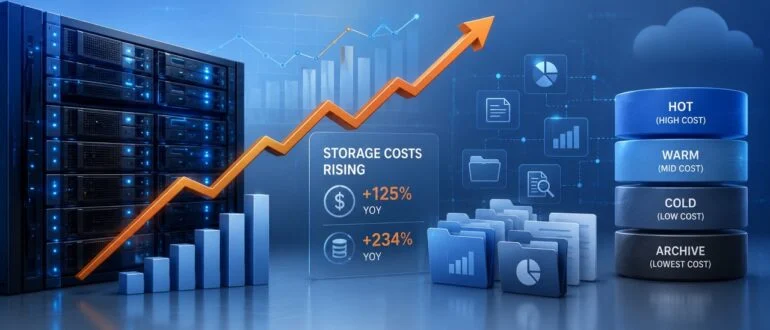
Storage costs haven’t simply spiked once this year. They’ve been climbing steadily since late 2025, and the increases are large enough that analysts have given the trend its own name: memflation.
Gartner forecasts DRAM prices will rise roughly 125% in 2026 and NAND flash prices will climb around 234%. We’re of course blaming AI for this but AI infrastructure vendors including the major CSPs are indeed consuming the wafer capacity that used to go toward enterprise storage and memory. The effect on hardware buyers has been steep: pricing on a 30TB enterprise SSD reportedly rose more than 470% between Q2 2025 and Q1 2026, according to the Vdura Flash Volatility Index. Analysts are telling IT leadership to budget for a 30-60% price increase over January 2026 levels in the first half of this year alone.
This is not a short-term blip to wait out. The shortage driving these prices is structural, not cyclical, and most forecasts don’t expect real relief until 2027. Meanwhile, many enterprise IT organizations are already spending more than 30% of their total IT budget on storage, backup, and disaster recovery, according to the Komprise 2026 State of Unstructured Data Management.
Do You Know Your Storage Costs?
This raises an uncomfortable question: how many IT and infrastructure leaders can say, with precision, what a gigabyte of their storage costs per month, fully loaded? Most can’t, and it isn’t because they’re careless. It’s because the real cost is split across two very different accounting models.
On the OpEx side (cloud storage, consumption-based pricing) the true cost is usually visible, if not always well tracked. On the CapEx side (on-prem hardware) it’s scattered across acquisition budgets, multi-year depreciation schedules, power and cooling, rack space, and the operations staff who keep the platform running around the clock.
Most cost models stop at the purchase price and never account for what comes after, which means most organizations are underestimating total cost of ownership. With enterprise data, of course, storage costs are unpredictable since data is growing on average 20% a year across the board, driven largely by unstructured data (files, images, logs, research output, sensor data) that makes up most of it today.
Yet few organizations have full visibility into their unstructured data. Without that, you can’t understand its growth, its data profiles that require different handling and how to save money. This visibility gap is also affecting AI plans. Some industry estimates suggest that only 1% of that unstructured data reaches AI. Data quality has been cited time and again as a troubling barrier to AI success, which makes sense given that unstructured data lacks structure and context needed to accurately feed AI pipelines. That’s a blind spot large enough to undermine an AI strategy before it starts; no model can be trained on data nobody can see, classify, or trust.
How Unstructured Data Management Drives Cost Accountability
Unstructured data management is the discipline of knowing what data an organization has, what it costs, who owns it, and what should happen to it next. It sounds basic. Most organizations don’t do it consistently or comprehensively, and they’re leaving money on the table.
It starts with visibility. Before any cost gets cut, it has to be seen: a showback report that lays out, by site, department, or team, exactly what storage is costing today, split cleanly between OpEx and CapEx so nothing gets missed.
Leadership teams routinely go from a vague sense that storage is “expensive” to seeing a specific department responsible for a specific six-figure line item, and that moment changes the conversation from abstract to actionable.
Most teams including the C-suite resist the notion of deleting data or moving it to an archive just in case its needed, but that mindset is a luxury today with multi-million storage and backup budgets. Once executives see the cost of storing and protecting 5 to 10-year-old data that nobody uses, opinions change.
In a previous role, my team was asked to cut unstructured storage costs by 35%. Once we had real visibility into the data and could act on it, we landed closer to a 65 to 70% reduction. The gap between the target and the result was entirely waste that we couldn’t see until we measured it. Visibility surfaces waste, and the waste tends to fall into a few consistent categories:
- Orphaned data (files on primary storage that belong to accounts no one can trace back to an active employee) is one of the most common and most expensive. It is typically not used or needed.
- Duplicate data, often scattered across multiple storage platforms rather than one system, is another.
- Cold data, the files nobody has touched in years but that still sit on the most expensive tier available, is usually the largest bucket of all. One organization I recently worked with had cold data constituting 96% of its storage footprint across multiple petabytes, and the hardest part wasn’t finding it. It was identifying who owned it, since the people who could authorize a decision had left the organization years earlier.
How Unstructured Data Visibility Supports Security, AI and More
Once the data is visible, IT and data teams can also classify and manage it based on its contents. Now you have a data governance program. Legal and compliance teams can flag data subject to retention schedules or litigation hold. Sensitive data (personal information, health records, financial records) can be tagged and routed to the right policy instead of sitting exposed on general-purpose storage. This requires a consistent way to query, tag, and act on data at scale, which is exactly the capability most legacy storage environments were never built to provide.
That same capability is what makes AI initiatives viable rather than aspirational. Feeding a model requires knowing which data is current, which is duplicate, which is sensitive, and which is authoritative. Organizations that have already done the classification work through metadata enrichment and extraction have a real head start. The ones still auditing storage with spreadsheets are trying to build an AI strategy on a foundation that is largely opaque.
Start Small, Prove It, Then Make It Everyone’s Job
Using visibility to become cost-conscious about data is a culture shift, and culture shifts need a credible example rather than a mandate. A wise path is to start with one department, usually your own. Build the cost model, run the showback report, and put the number in front of leadership: this is what our own storage is costing us. That number tends to land harder than any slide deck, because it’s specific, it’s recent, and it’s owned internally rather than benchmarked against an industry average.
From there, the goal is to turn that first department into an internal champion and repeat the exercise elsewhere. Each department that goes through the process becomes proof that it works, and proof travels faster than a mandate from the top. Over time, this becomes less a project owned by one team and more a shared service: a way for every department, data steward, and compliance team to see its own piece of the picture and act on it, without waiting on a central team to do it for them. Storage costs and data risk are everyone’s problem now, not just the infrastructure team’s. Start small. Think big. The organizations that get ahead of memflation aren’t the ones with the biggest budgets. They’re the ones who turned visibility into a habit before the price of not having it became too large to ignore. And by bringing intelligent data economics to the storage budget, you are now better equipped to tackle the even larger issue at hand: managing data for AI value and with a clear ROI.