Marvell used FMS 2026 to introduce new memory infrastructure technologies aimed at helping hyperscalers and cloud providers scale memory independently from compute. The portfolio spans server-level AI storage, rack-scale CXL memory expansion and pooling, and pod-level optical shared memory.
The releases target growing memory demands from agentic AI inference. Larger models, longer context windows, and expanding key-value caches are increasing requirements for memory capacity, bandwidth, and connectivity. In traditional server-attached architectures, these demands can lead to processor stalls and inefficient data movement.
Memory disaggregation allows memory to be expanded, pooled, and shared independently of compute resources. Marvell said its approach is designed to improve memory accessibility, reduce latency and data movement, and increase processor utilization. The goal is to produce more tokens within existing data center power and space constraints.
Will Chu, executive vice president and general manager of Custom Cloud Solutions at Marvell, said AI infrastructure is moving from isolated servers toward integrated systems that combine compute, memory, and connectivity. He added that more independent memory scaling is necessary to improve resource utilization and manage the cost and power requirements of AI deployments.
Server-Level AI Storage #
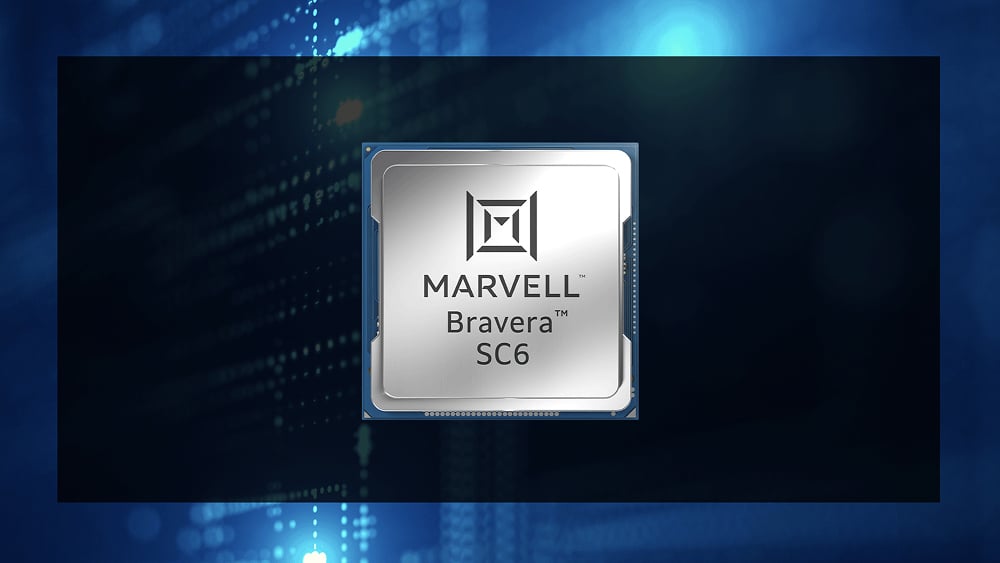
The Marvell Bravera SC6 PCIe 6.0 SSD controller is designed to support AI inference workloads that require frequent movement of KV-cache data between high-bandwidth memory and SSD storage. Marvell said the controller provides twice the speed of its Bravera SC5 PCIe 5.0 predecessor.
By improving cache transfer performance, the SC6 is intended to increase storage efficiency for AI, cloud, and enterprise workloads. The controller also targets lower write amplification and longer NAND service life. Support for NAND from multiple suppliers gives hyperscalers greater flexibility when sourcing and deploying SSDs.
The Bravera SC6 is expected to begin sampling in the fourth quarter of 2026.
Rack-Scale Memory Expansion and Pooling #
Marvell’s Structera X memory expansion solutions build on the company’s existing Structera CXL platform and are designed to help hyperscalers address memory-intensive AI workloads through larger and more flexible memory pools. Developed with hyperscaler partners, the platform supports memory expansion and resource sharing across servers.
Structera X is intended to improve the utilization of existing memory investments while accommodating larger models, longer context windows, and increasing KV-cache requirements. By separating memory capacity from individual server configurations, the platform can support more adaptable CXL-based expansion and pooling architectures.
Marvell said the approach is designed to improve infrastructure utilization and operational efficiency while reducing total ownership costs. It also establishes a foundation for future CXL memory pooling and sharing systems.
Pod-Level Optical Shared Memory #
Marvell’s Photonic Fabric components include optical memory modules, network interface controllers, and chiplets for a shared-memory architecture spanning multiple racks. The system is designed to connect XPUs and racks across distances of up to 50 meters.
The architecture supports up to 32TB of warm KV-cache offload with high bandwidth and low latency. Instead of retrieving KV-cache data from storage, AI systems can access it from the shared optical memory tier. Marvell said this can improve inference throughput, support larger models and longer context windows, and increase token efficiency.
The company projects up to two to three times higher token throughput within existing data center space and power constraints. Actual performance will depend on system configuration, workload characteristics, and the implementation of the surrounding AI infrastructure.
Marvell is showing the portfolio at FMS 2026, booth #805. The announcement lands in a week dominated by inference-memory news, and it dovetails with NVIDIA’s Storage-Next and SCADA push: Marvell has pointed to that architecture requiring PCIe Gen7 SSDs sustaining 100 million IOPS, and controllers like the Bravera SC6 are the stepping stones toward drives built for GPU-driven small-block access.