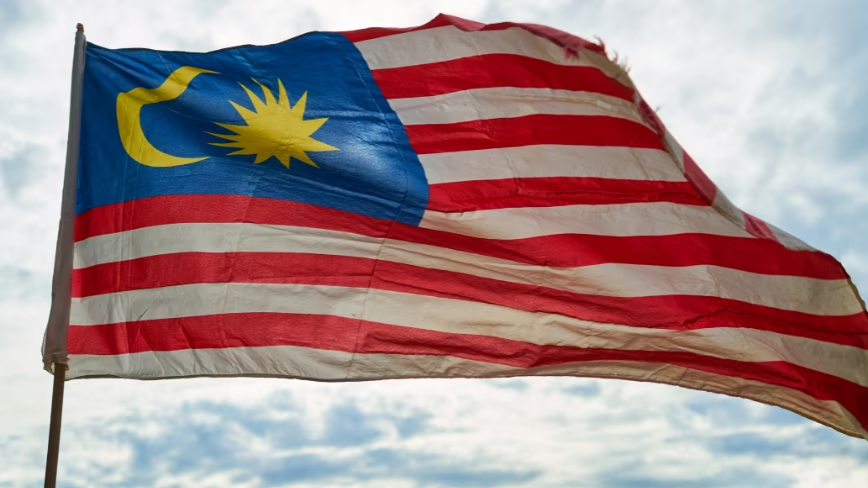
The shipment passed through Kuala Lumpur declared as ordinary computer components. Inside the 72 server units, Malaysian customs officers found something the paperwork did not mention: advanced artificial-intelligence chips worth 52.9 million ringgit, or about $13m, sitting in the airport’s free trade zone and waiting to move on.
Malaysia’s customs department announced the seizure on Friday, describing it as a thwarted smuggling attempt through the country’s main airport.
The inspection took place on 5 June at KLIA, where officers opened a consignment that had been flown in and logged for the free trade zone, the kind of bonded area designed to let goods pass through a country without formally entering it.
According to the department, the servers were destined for re-export to another Asian country.
That detail is the heart of the case. Preliminary investigations, the department said, indicated the syndicate behind the shipment was using Malaysia purely as a waypoint, choosing it to avoid the restrictions that would have applied on a direct route to the final destination.
The cargo, valued at RM52.92m including duties and taxes, originated from an Asian country and had been labelled as computer components to slip past inspection. It did not.
The seizure lands on a fault line that has defined the AI hardware trade for two years. Malaysia imposed export controls in 2025 on the movement of high-performance US-origin chips, a response to pressure from Washington, which has been trying to choke off the flow of advanced semiconductors to China.
The chips matter because they are the scarce input for training large AI models, and the controls have turned ordinary logistics hubs into chokepoints worth policing.
Southeast Asia sits awkwardly in the middle of that effort. The region’s ports and airports are exactly the sort of intermediaries that smuggling networks favour, precisely because so much legitimate electronics trade already flows through them.
US prosecutors have alleged schemes that routed Nvidia chips through Malaysia and Singapore, and the country spent much of 2025 fielding accusations that it was a transit point whether it wanted to be one or not.
The KLIA seizure is, in that sense, Malaysia demonstrating the controls have teeth.
What the announcement did not include was as notable as what it did. The customs department did not name the chip manufacturer, did not identify the syndicate, and did not specify the destination country beyond “another Asian country.”
In smuggling cases that move through bonded zones, those gaps are common at the early stage, when investigators are still tracing the consignment back to its handlers and forward to its buyer.
The economics behind the trade are straightforward. Restricted chips command large premiums in markets they are barred from reaching, and a margin that size will always find a logistics route to chase it.
The hardware sits at the centre of a global build-out that has the region’s manufacturing economies racing to capture, from South Korea’s chip-sector bonuses to the multibillion-dollar fabrication bets reshaping the supply chain.
The same demand that drives those investments is what makes a server full of chips worth smuggling.
The free trade zone at the centre of the case is worth understanding, because it explains why airports like KLIA keep appearing in these stories. Goods in a bonded zone are technically not yet imported, which lets legitimate traders consolidate and re-route shipments without paying local duties.
That same convenience is what smugglers exploit, treating the zone as a laundering step that strips a shipment of its origin before it continues to a restricted destination. Catching the cargo there, rather than after it has left, is the difference between a seizure and a missed one.
For now, 72 servers are sitting in Malaysian custody rather than powering a data centre somewhere else. The customs department says its investigation is continuing.
Get the TNW newsletter #
Get the most important tech news in your inbox each week.