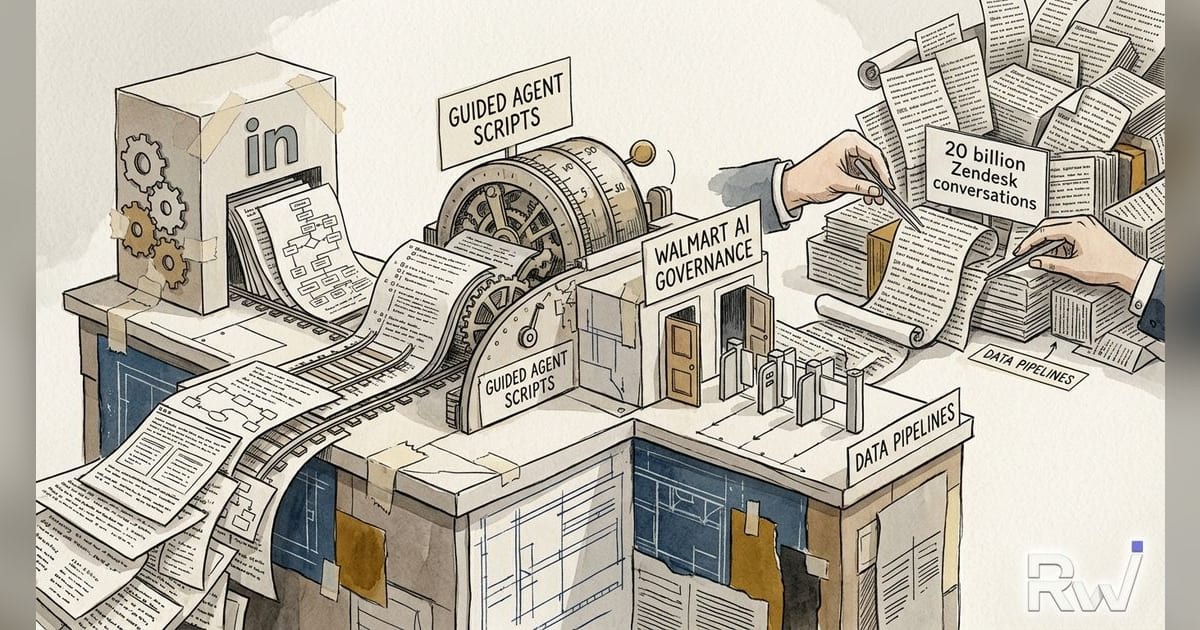
Animesh Singh, LinkedIn's senior director of AI platform and infrastructure, said the professional network has shifted roughly 80% of one agent workflow into scripted, deterministic code after finding that an LLM supervising another LLM could reproduce the same failure modes.
The architecture, described alongside Walmart and Zendesk at VB Transform 2026 and reported by VentureBeat on July 17th, places models at the edges of the workflow, where reasoning is required. Conventional software controls the loop, and evidence from each step is written to disk before execution continues.
Singh was joined by Walmart technology strategy chief Desiree Gosby and Sami Ghoche, the Forethought co-founder who became Zendesk's vice president of applied AI after Zendesk completed its acquisition of Forethought on March 26th. Financial terms were not disclosed.
Ghoche built Forethought around the thesis that AI would reshape customer service, years before generative AI became a standard software pitch. He and co-founder Deon Nicholas raised more than $100 million, according to their own accounts, and developed agents for support workflows before selling Forethought to Zendesk. Ghoche is now confronting the less marketable half of that thesis: customer-service agents cannot learn reliably from a company's history until that history has been cleaned, structured and made retrievable.
The three executives reached production from different directions. Their remedies shared a clear pattern. More agent deployments are moving control, memory, evaluation and governance outside the model.
LinkedIn moved the model to the leaves
LinkedIn's first constraint was basic compute orchestration. Kubernetes commonly starts containers on demand, a process that can take seconds. Singh said that delay was too long for workloads in which agents are expected to initiate and complete a series of steps without making a user wait at each one.
LinkedIn responded with pre-provisioned pools of containers. Agent workloads can be assigned to containers that are already running instead of waiting for new environments to start. Singh did not provide comparative latency, utilization or cost figures, leaving the size of the improvement unquantified.
The harder problem emerged in evaluation. LinkedIn had built a five-point scoring system that allowed an LLM to assess another model's output. Hallucinations still passed through because the evaluator could share the generator's weaknesses.
LinkedIn then took orchestration away from the model. Singh said his group built its own control flow, restricted LLM calls to reasoning steps and made the rest of the process deterministic. Persisting evidence after each step gives the system an audit trail and a point from which it can inspect or resume a failed run.
That design also narrows what autonomy means in production. LinkedIn is using model judgment inside a workflow whose sequence and state remain controlled by ordinary software. The approach gives engineers fewer unpredictable branches to monitor and reduces the number of decisions that depend on probabilistic output.
Walmart's viral harness created governance debt
Walmart encountered a management problem after giving an agent-building harness directly to employees. Gosby said adoption spread internally among workers she called "citizen developers," allowing employees to build agents without waiting for a place on an engineering roadmap.
The distribution strategy also produced dozens of overlapping agents, according to Gosby. Walmart's response was a governance layer that identifies duplication, selects the strongest implementation and creates a path into production.
Walmart did not disclose how many employees used the harness, how many agents were built or how the agents performed. The experience still identifies a predictable cost of making agent creation easy: duplicated logic, uneven controls and several tools competing to perform the same task.
Gosby's group has also built an internal gateway that supports three classes of work. Deterministic workflows handle tasks that require fixed execution. Planner-and-reasoner systems handle open-ended work. Hybrid systems combine both. Security, governance and evaluation pass through the gateway regardless of which model performs the reasoning.
The gateway lets Walmart choose between frontier and open-weight models by workload. Compliance-heavy processes can remain scripted, while tasks requiring judgment can call a model without giving that model control over the full system.
Ghoche's 20 billion conversation warning
Zendesk's version of the problem begins with data. Ghoche cited a public figure of 20 billion customer conversations in Zendesk's repository. A large context window does not turn that archive into a usable knowledge system, he said. Zendesk still needs the underlying pipelines that select, structure and deliver relevant information to an agent.
The observation carries extra weight coming from Ghoche. Forethought sold AI agents that worked across chat, email and voice, and Ghoche said when the acquisition was announced that joining Zendesk would accelerate Forethought's original customer-service mission. The deal gave his group access to a much larger distribution channel and data base. It also increased the burden of making that data usable across customers with different policies, workflows and support histories.
Ghoche recommended building evaluations first. Evals force a team to define the task, split it into measurable components and decide what evidence counts as success. Without that work, a larger archive or a more capable model gives operators additional inputs without a reliable way to judge the result.
The control layer is becoming the product
LinkedIn has built an AI gateway that gives outbound model calls the same interface across public clouds and its own data centers. It also maintains a separate memory subsystem so context is not tied to a single provider. Walmart's gateway serves a similar strategic purpose: models can be replaced while governance stays in place.
This architecture reduces switching costs and keeps enterprise context under the operator's control. It also creates an opening for infrastructure suppliers selling durable execution, checkpoints, memory and agent registries. LangSmith Deployment, for example, markets persistent state, task queues and execution that can survive restarts. Temporal raised $300 million at a $5 billion valuation on February 17th, with the company pitching durable execution as the missing layer between agent prototypes and production systems.
The demand is broader than these three companies. A 2026 Google Cloud survey of 1,402 IT leaders found that 83% believed infrastructure upgrades were required for production-grade autonomous systems. Four out of five cited security, governance or MLOps among their most significant challenges.
The panel's strongest claim, that infrastructure rather than models is holding agents back, remains broader than the evidence disclosed. LinkedIn, Walmart and Zendesk presented architectural lessons rather than controlled comparisons. None supplied error rates, end-to-end latency, costs, adoption figures or return-on-investment measurements.
Models also remain part of the constraint. Gartner has predicted that more than 40% of agentic AI projects will be canceled by the end of 2027, citing costs, unclear value and inadequate risk controls. Gartner separately argued that current models lack the maturity to complete many complex, long-running objectives autonomously.
LinkedIn's design offers a practical answer to that limitation: give the model fewer chances to be wrong. Walmart is applying the same principle through workload classification and governance. Ghoche is applying it through data preparation and evaluation. Their production systems depend less on unconstrained autonomy than the agent label suggests, and far more on the software engineering surrounding each model call.