More and more content on the internet is now being written by AI, but not all of it is being appreciated.
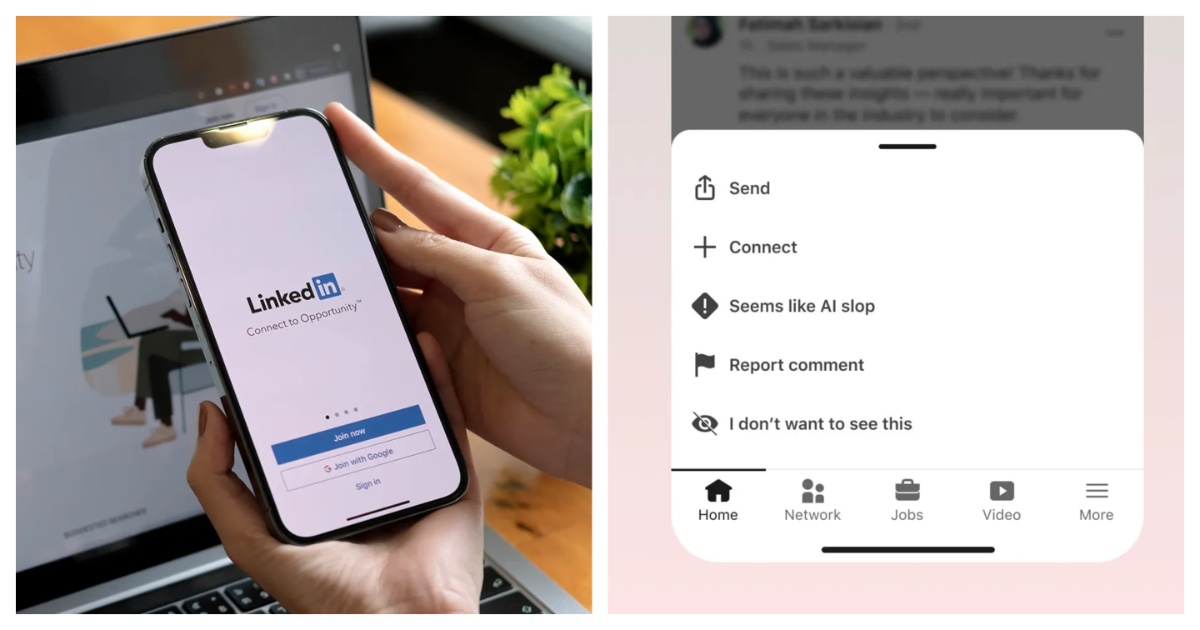
LinkedIn is adding a new option to its comment and post menus that lets members flag something with a simple label: “Seems like AI slop.” It sits right next to the usual report and hide options, and it’s the platform’s clearest admission yet that its feed has a quality problem it can’t quite classify on its own.
The feature was announced by Hari Srinivasan, LinkedIn’s Chief Product Officer for its ecosystem, in a post laying out a broader set of changes aimed at pushing back on AI-generated filler. Srinivasan framed it as something the company is treating with real urgency, writing that people come to LinkedIn to connect with real people and share real perspectives, and that keeping it that way is a top priority.
The company says it is already catching hundreds of thousands of automated comment attempts every day, and has blocked billions of other automation attempts, things like mass posting and scaled content spam, over the past couple of months. That volume alone says something about how large the slop problem has become on a platform that used to be mocked mostly for its try-hard humblebrags, not for looking like it was run by bots.
The new reporting option is meant to work alongside a set of classifiers LinkedIn is rolling out to detect AI-generated or generally low-quality posts before they spread. The company says this should cut down on how much slop shows up in suggested content and in posts from outside a user’s network. But classifiers are only as good as what they’re trained to recognize, and LinkedIn seems to know that definitions of “slop” shift depending on who’s looking at the post. That’s the reasoning behind opening it up to user reports as well, letting member feedback tune the models rather than leaving the call entirely to automated detection.
There’s also a quieter change coming for anyone who posts on the platform. LinkedIn plans to test a private notification in a user’s analytics dashboard, telling them when other members felt their post came off as inauthentic or too obviously AI-written. Srinivasan was careful to separate this from a verdict handed down by a detector, saying the company wants people to get feedback from real humans on what reads as authentic, not an algorithm that might get it wrong. He also drew a line between AI use and slop itself, pointing out that plenty of people run their drafts through AI tools to sharpen their thinking, and that this alone doesn’t make a post inauthentic.
That distinction connects to another decision buried in the announcement. LinkedIn asked itself why people even turn to AI when writing posts in the first place, and the answer it landed on was that LinkedIn’s tone is hard to nail, and people don’t feel confident writing in it unassisted. In response, the company is dropping its “enhance your post” feature, the one that could rewrite a draft in that recognizable LinkedIn voice, and replacing it with a proofreading tool that’s meant to fix grammar and phrasing without changing what someone is actually trying to say.
The update also expands profile and company page verification, so members have a better sense of who’s actually behind an account or a piece of content. Alongside that, users will be able to block comments from company pages they’d rather not see anymore, giving people a bit more control over who shows up in their notifications.
LinkedIn has faced a slow drift toward AI-flavored posting for a while now, from generic “here’s what I learned” threads to comments that read like they were generated to fill a quota. The platform’s own bio trends have shown how quickly people latch onto whatever AI is doing next, for better or worse, and even leadership-level posts about restructuring, like Satya Nadella’s comments on how AI is reshaping job roles, tend to get flooded with the same kind of templated replies. Whether a report button changes that meaningfully is hard to say. Srinivasan’s post ends by promising more changes are coming, along with better communication about them, which suggests LinkedIn itself isn’t confident this is the last update on the subject.