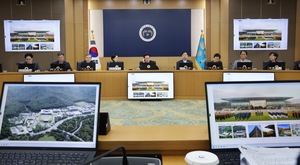
President Lee Jae Myung on Tuesday called for accelerating the construction of a presidential office in Sejong, reaffirming his goal of shifting more of the country’s core administrative functions away from Seoul.
Speaking at a Cabinet meeting at the Government Complex Sejong, Lee said the city should firmly establish itself as a central hub of state affairs as part of the government’s push for balanced regional development.
“Efforts must be made to ensure the stable relocation of key national functions so that Sejong, which symbolizes balanced national development, can firmly establish itself as a central axis of state affairs,” Lee said.
Lee called for faster construction of both the presidential office and the planned National Assembly building in Sejong, along with related infrastructure.
“We should make every effort with the determination to open the era of the Sejong presidential office within our administration’s term and even hold our final Cabinet meeting there,” he said.
Tuesday’s meeting marked the fourth Cabinet meeting Lee has chaired in Sejong since taking office.
The push to relocate key government functions to the central region dates back to the Roh Moo-hyun administration, which sought to build a new administrative capital in the Chungcheong region as part of efforts to ease the concentration of population and economic activity in Seoul.
The plan suffered a major setback in 2004 when the Constitutional Court struck down a special law for the new capital, ruling that Seoul’s status as the nation’s capital was protected by constitutional custom and could not be changed without a constitutional amendment.
A follow-up law was enacted in 2005 to establish an administrative city instead, and the planned city was officially named Sejong in 2006. The city was formally launched as a special self-governing city in 2012.
Separately, Lee reiterated his push to accelerate three major industrial projects Monday in a government-industry review meeting.
The government unveiled the projects in late June as a centerpiece of its strategy to secure new growth engines amid slowing growth, demographic challenges and intensifying global competition over artificial intelligence.
The projects focus on semiconductors, physical AI and AI data centers, which the government sees as closely linked parts of an AI-driven industrial ecosystem, spanning computing chips, AI infrastructure and the application of AI to manufacturing and other physical systems.
Lee also called for strategic investment in additional industries, including small modular reactors, renewable energy, quantum computing, aerospace and advanced biotechnology.
“Strategic investment in these areas should also be pursued as meticulously and intensively as the three mega projects,” Lee said.
MND, DAPA expand nuclear sub organizations
The Cabinet also approved organizational changes to establish dedicated units within the Defense Ministry and Defense Acquisition Program Administration to accelerate South Korea’s nuclear-powered submarine program.
The move follows a 2025 agreement between Lee and US President Donald Trump, under which Washington approved South Korea’s construction of nuclear-powered attack submarines and agreed to work with Seoul on the project, including securing nuclear fuel.
The Defense Ministry will establish a Nuclear-Powered Submarine Policy Planning Group to coordinate government policy and institutional arrangements for the project.
Its responsibilities will include legislation governing the program, consultations with the United States and the International Atomic Energy Agency on nuclear fuel and the establishment of a nuclear safety regulatory framework.
DAPA, meanwhile, will rename and expand its existing submarine program office into a dedicated organization for the nuclear-powered submarine program, while establishing new teams responsible for the submarine itself and its nuclear propulsion system.
The organization will oversee the submarine’s design and construction as well as the development of key technologies, including its nuclear reactor.
The restructuring follows the government’s May release of its basic plan for developing nuclear-powered submarines.
The Cabinet also approved the establishment of a new information security policy office directly under the vice defense minister to strengthen oversight of military intelligence agencies, including the Defense Counterintelligence Agency.
The organizational changes will take effect Friday, according to the Defense Ministry and DAPA.
flylikekite@heraldcorp.com