Persona AI exec highlights HD Hyundai, Posco alliances to put humanoids on factory floors
After humanoid robots took center stage in recent years' AI-driven hype, the critical challenge shifted to real-world deployment — with automotive assembly lines and logistics serving as the primary proving grounds.
Michael Perry, head of commercial strategy at Persona AI, however, argues that humanoid robots could have their greatest impact in heavy industries such as shipbuilding and steelmaking. He says they could deliver significant economic value while easing acute labor shortages in hazardous, complex environments where traditional automation falls short.
That focus has drawn Houston-based Persona AI to South Korea, home to industrial giants including HD Hyundai and Posco, where it aims to test how its robots perform in working industrial settings.
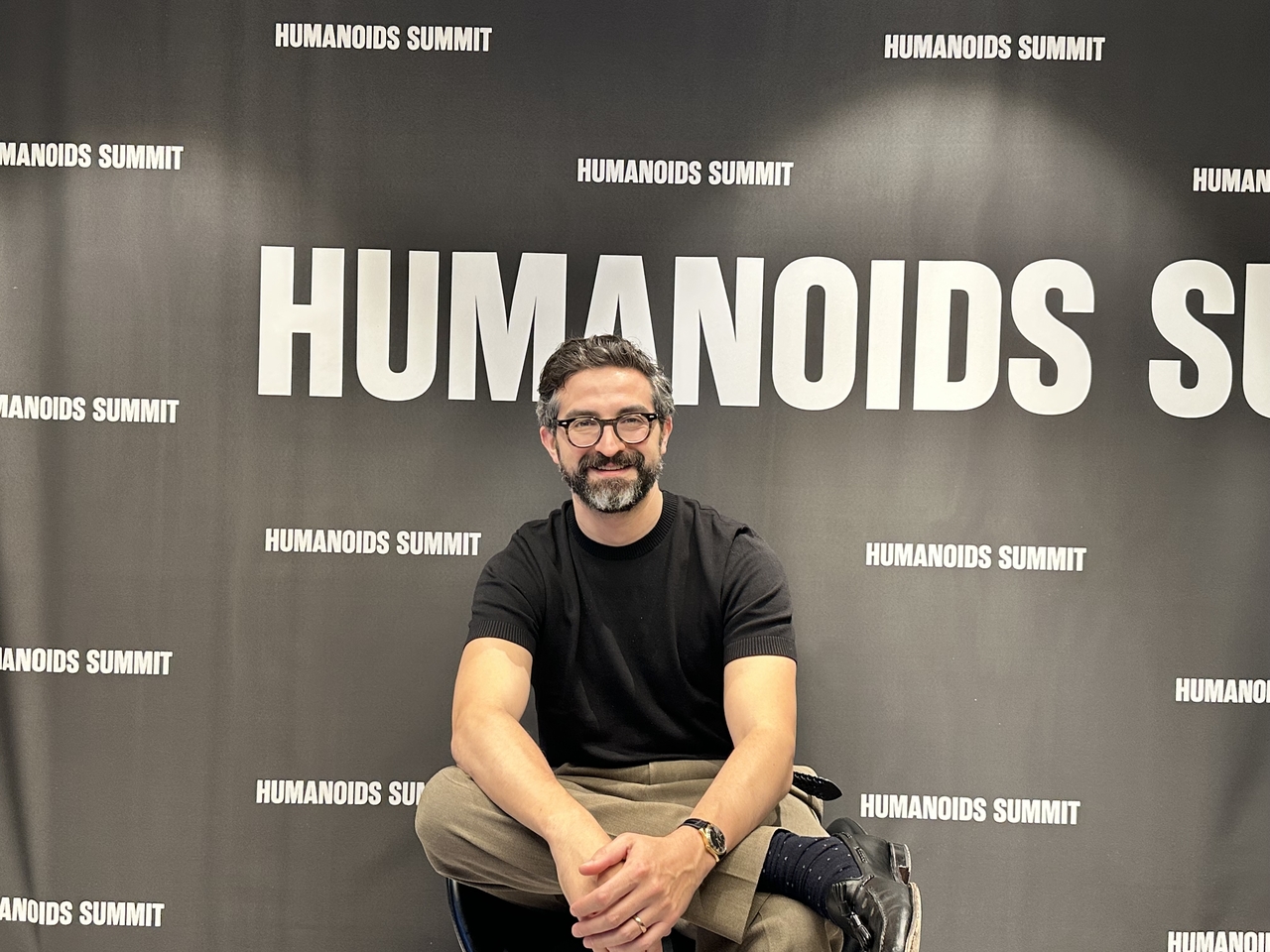
“I believe that for humans, heavy industry is going to be the place where the technology has the largest impact," Perry said during an interview with The Korea Herald on the sidelines of Humanoid Summit Seoul, where he delivered a keynote address.
"I think Korea also has all the right characteristics to be the first adopters of that technology.”
According to Perry, Korea offers a rare combination of “high need and high skill” — combining acute labor shortages in heavy industry with advanced digital, robotic and AI transformation capabilities required to deploy humanoid robots at scale.
To this end, Persona AI is collaborating with HD Korea Shipbuilding & Offshore Engineering and HD Hyundai Robotics, with a bipedal humanoid prototype slated for deployment this year. The initial test aims to prove that a humanoid can navigate an unstructured shipyard, handle a standard welding torch, and produce consistent welds matching real-world production standards.
For the field testing in 2027, Perry said the goal is to enable the bipedal robot to walk autonomously while also integrating human teleoperation. Workers can then easily give necessary instructions to robots to improve work and safety. Persona AI also holds strategic ties with Posco, which invested $3 million as an equity shareholder to bring industrial humanoids to steel manufacturing and logistics. The two companies are running a proof-of-concept project to explore how multiple robots can collaborate using specialized rigging tools and help transport 20- to 40-ton steel coils across designated sites.
Perry also signaled interest in working with Hyundai Steel as the Korean steelmaker recently broke ground on its new electric arc mill project in Louisiana.
“Persona AI is actually the first humanoid company to sign a state-level agreement, and that state happens to be Louisiana, which is ... positioning itself at the forefront of humanoid robotics,” Perry said. He added that Persona AI is already testing robots with a local Louisiana steel fabricator, leaving the door open for future industrial tie-ups in the state.
Given the intense power demands of industrial humanoids, Perry explained that the company is testing various battery chemistries — including high-nickel and lithium iron phosphate (LFP) — to balance endurance and power density with cycle life and safety.
When asked if Persona AI would partner with Korean battery trio — LG Energy Solution, Samsung SDI and SK On — Perry hinted at active talks. “We welcome any and every conversation, and some of them may already be happening.”
Compared with Hyundai Motor Group’s high-profile Atlas humanoid robot developed by Boston Dynamics for automotive assembly, Persona AI believes its Gen 1 humanoid holds a distinct edge in high-stakes, heavy-industry craftsmanship.
While acknowledging Atlas’ impressive mobility, Perry argued that automotive-tailored humanoids are primarily engineered for repetitive “pick-and-place” tasks. “If you give the robot a welding torch, it could crush it or turn it on by accident,” Perry said, noting that the Gen 1 robot is specifically fitted with high-torque, precision-controlled motors that enable fine-motor grasping and tool manipulation without damaging sensitive industrial equipment.
Perry also highlighted modularity and heavy-duty engineering as Persona AI’s key advantages over Atlas. Unlike humanoids designed for predictable, indoor automotive plants, the Persona AI platform is built to endure extreme outdoor conditions and features swappable sensor payloads.
That flexibility allows the robot to pivot seamlessly from shipyard welding and painting workshops to offshore oil rigs and mining operations — a versatile industrial DNA that Perry noted is “just not in the ethos of Atlas at least for now.”
Amid labor union concerns in Korea — including Hyundai Motor Co. union's pushback against Atlas over job displacement concerns — Perry dismissed fears of “dark factories,” emphasizing a model of “shared autonomy.”
He noted that global studies consistently show automation drives operational efficiency, helping companies expand their businesses and ultimately hiring more workers. Perry said it is essential for companies to demonstrate that humanoids are collaborative tools built to work alongside people, not eliminate them.
hyejin2@heraldcorp.com