Books The book is for the person who owns the sign-off. The engineer whose demo now has to go live. The architect triaging a stack of agent proposals.
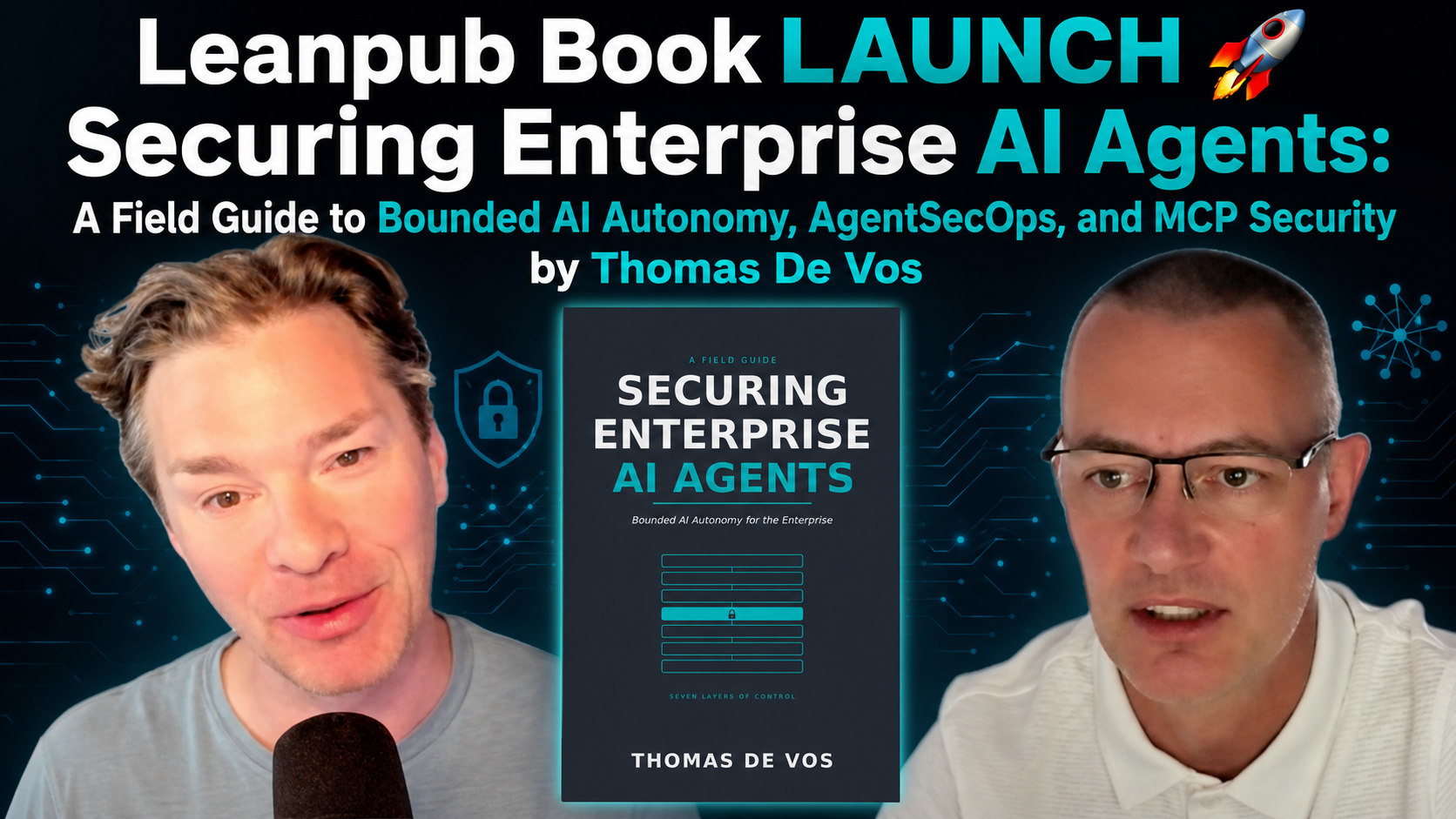
Welcome to the Leanpub Launch video for Securing Enterprise AI Agents: A Field Guide to Bounded AI Autonomy, AgentSecOps, and MCP Security by Thomas De Vos!
About the Book #
Your CTO just asked the question. The team wants to put an AI agent in front of customers. Not a chatbot. An agent that can read from the CRM, decide, and act. Payments, cases, refunds, entitlements.
Is it safe to ship?
What is your plan?
Whose name goes on the decision?
The old security playbook was not written for this. Reviewing prompts and logging chatbot sessions is not enough once an AI system can pick a tool, call an API, and change state in production. Something that can act needs an identity, a boundary, an audit trail, and a way to fail safely. It also needs someone who has thought carefully about what happens when the model decides badly, when the retrieval layer returns poisoned content, or when a tool wrapper leaks a token.
Securing Enterprise AI Agents is the field guide that answers those questions. Six parts, twenty-one chapters, worked examples drawn from financial services because that is what regulated builds look like. Part I reframes the risk model. Part II is the reference architecture for a production agent, from human user down through the orchestrator, the model, the tool wrapper, MCP, policy, and data layer. Part III turns evals and observability into the release control your CI does not have yet. Part IV is secure RAG, including the parts most teams skip. Part V is coding agents in professional teams. Part VI is deployment, policy as code, incident response, and how to run all of this as one AgentSecOps discipline.
The book is for the person who owns the sign-off. The engineer whose demo now has to go live. The architect triaging a stack of agent proposals. The security lead asked to bless something they cannot fully see. The engineering director choosing where the next quarter of platform investment goes.
No AGI speculation. No vendor comparison. No "challenges and opportunities" bullet lists at the end of every chapter. You will leave with a seven-layer reference architecture you can defend to an auditor, a production readiness checklist you can run in an afternoon, and a working definition of bounded AI autonomy that keeps the model useful without giving it the whole surface.
About the Author #
Engineer and AI practitioner with over a decade building production AI systems for global financial institutions. Focused on the intersection of autonomous agents, regulatory compliance, and operational reliability. Currently leading AI strategy for banking, insurance, and fintech clients across multiple continents.