Book Launch The first thing many people hit with an AI coding assistant is a plateau. A correction you make on Monday is gone by Thursday. The time saved on typing goes back into reading the output. Better phrasing helps for a session, then stops helping. This book is about the layer above the prom...
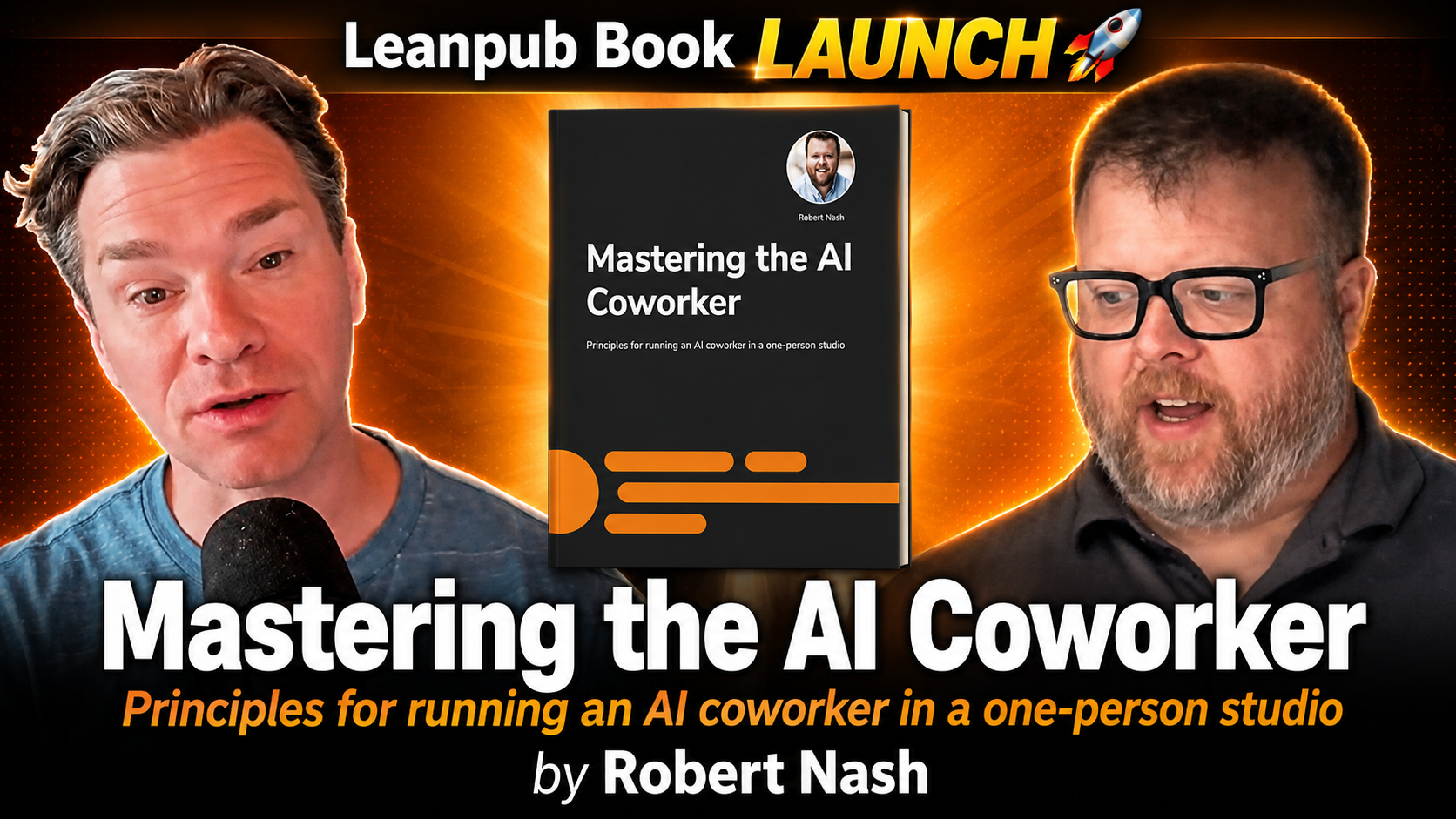
Welcome to the Leanpub Launch video for Mastering the AI Coworker: Principles for running an AI coworker in a one-person studio by Robert Nash!
The first thing many people hit with an AI coding assistant is a plateau. A correction you make on Monday is gone by Thursday. The time saved on typing goes back into reading the output. Better phrasing helps for a session, then stops helping.
This book is about the layer above the prompt, the operating model. Where truth lives, how a correction becomes a standing rule that still holds months later, how knowledge accumulates across sessions, and which judgments stay in human hands.
I run a one-person software company, and what this book describes is what runs it. On my own products, where the risk is mine to carry, I no longer read every line. Agents do that instead. They review the code, hold it to the conventions, check the copy and watch for drift. I still decide whether to trust what comes back, and that decision has not automated. Most of the book is about what has to be in place before it can be made on evidence rather than on feel.
Nothing in here rests on memory. Every factual claim traces to something dated in my own records, and the parts of that record which are public you can check without asking me. Audient, an on-device search and transcription app for audio archives, is on the Mac App Store; Apple rejected the first submission and approved the resubmission three days later. Behind it sit more than five hundred distilled memory files and more than eighty packaged workflows. None of that made the model smarter. It made the environment stop leaking.
The failures are in here as well, with their post-mortems. You have to see where a method broke to know what it is worth.
What it will not do, stated here rather than discovered later. No productivity multiple: I have run no controlled study and will not pretend otherwise. No manual for any one tool, whose vendor documents it better than I could. No secret prompts, because the argument of the book is that phrasing is the wrong layer to work at.
Six parts, and they build. The first two are why an operating model is needed at all, and where truth has to live for one to work. The middle three are the machinery, the disciplines that keep it honest, and case studies told from the record. The last is how to begin, at a scale one person can carry.
The worked examples use Claude Code, a terminal-based AI coding agent, and you do not need to run it. Principles sit in the chapter bodies, and anything tied to a tool or a point in time sits in a dated sidebar. You should be comfortable at a command line, with version control, and with plain text files. None of that is explained here.
Chapter 1 opens at the plateau, which is where most people meet this problem, and where I met it.
I run Async Digital, a one-person software studio in Cardiff, and this book is a report from running it. Alongside it I am a senior iOS engineer in fintech, and I have worked in aviation and property, field service and healthcare, retail and social media. My first degree was Biochemistry and I left with a research masters, so I have a fair idea what a real controlled study demands, and I have not run one here. What I offer instead is a daily record of the work, failures included.