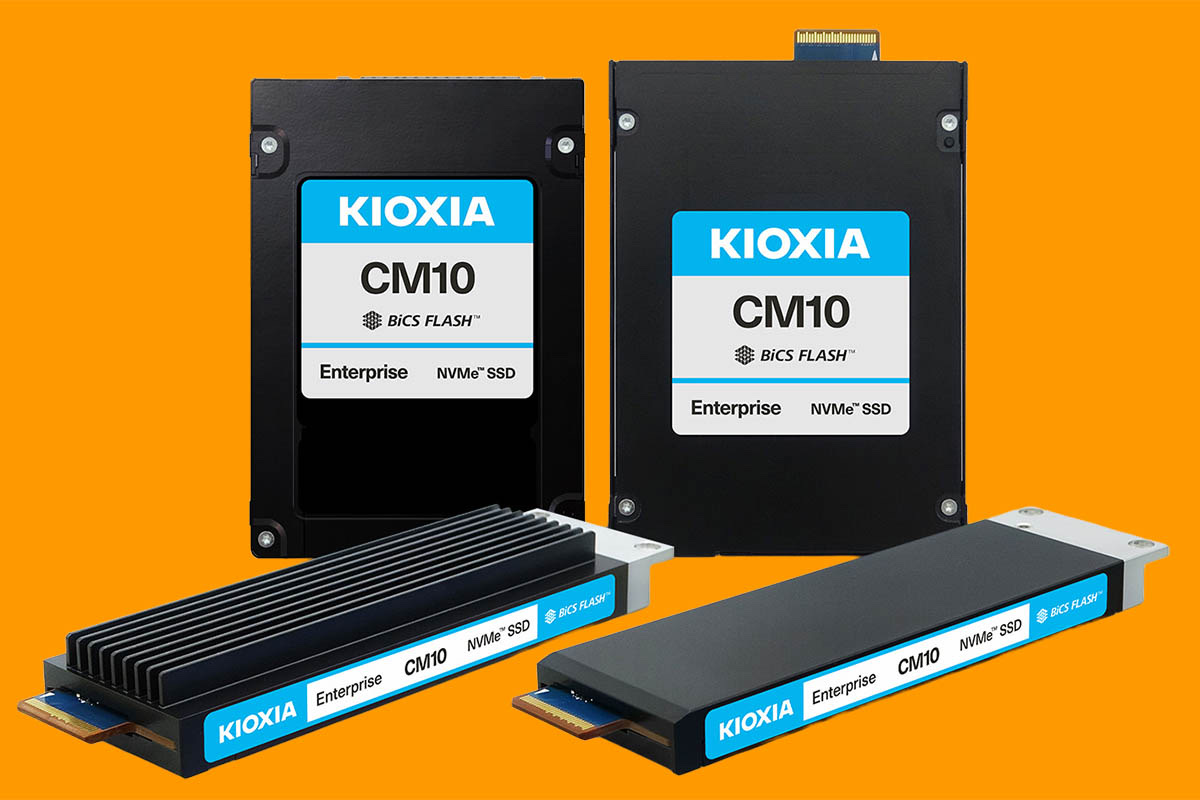
Ahead of FMS 2026, Kioxia launched its new CM10 series, marking the company’s entry into PCIe 6.0 enterprise storage with direct liquid cooling capability for AI infrastructure deployments. These new SSDs leverage Kioxia’s BiCS FLASH generation 10 memory technology and target high-performance KV cache workloads alongside NVIDIA CMX context memory solutions.
Kioxia CM10 Series Specifications and Features #
This new CM10 series delivers substantial performance gains over the previous CM9 generation, with Kioxia claiming up to approximately 92 percent higher sequential read performance and up to approximately 85 percent higher random read performance. These improvements address the scaling demands of AI models approaching trillions of parameters and context windows expanding to millions of tokens.
KIOXIA offers the CM10 series across multiple form factors to accommodate different deployment requirements. Its E3.S and E1.S variants support direct-cold-plate liquid cooling for specific thickness profiles, while all forms remain compatible with traditional air-cooled environments. The EDSFF lineup includes E3.S at 7.5 mm thickness and E1.S in both 9.5 mm and 15 mm profiles. 9.5 mm variants of both form factors support direct liquid cooling environments. There is also a dual-port design in E3.S for high availability for traditional HA storage arrays.
A 2.5″ option extends the CM10 Series to conventional enterprise chassis that cannot accommodate EDSFF forms or require higher capacity per drive slot. The 2.5″ CM6 is 15mm in thickness and maintains a dual-port design like the E3.S variant for high availability applications. Something interesting from the slides is that the 2.5″ is listed as using BiCS FLASH generation 8 TLC flash memory with PCIe 5.0 compliance, rather than the Gen 10 memory and PCIe 6.0 interface found in EDSFF models. On STH, we have been warning that the traditional U.2/ U.3 drives were likely to start giving way to EDSFF connectors as the electrical requirements of PCIe Gen6 hit. This is a great example of that.
Final Words #
We expect to see the Kioxia CM10 series drives in AI storage tier deployments where ephemeral KV cache benefits from flash latency between GPU HBM and networked storage. Still, the new announcement is important since we are seeing chips like the NVIDIA Vera CPU and the AMD EPYC Venice series hit the market. The new CM10 series represents Kioxia’s response to AI infrastructure storage demands that extend beyond traditional enterprise SSD requirements. Direct liquid-cooling capability addresses thermal constraints in dense GPU pods, where KV cache storage sits adjacent to accelerator racks. Its performance claims against the CM9 generation suggest meaningful headroom for context memory workloads that NVIDIA CMX solutions target.
Perhaps most notable is that we are finally seeing a split in NVMe SSDs away from around a decade and a half of 2.5″ U.2 form factors leading the way. Separating PCIe 6.0 EDSFF forms from PCIe 5.0 2.5″ variants allows Kioxia to serve both next-generation liquid-cooled deployments and existing air-cooled infrastructure with a single product family branding. The use of BiCS FLASH generation 10 in EDSFF form factors versus generation 8 in 2.5″ form factors reflects the thermal and density requirements. Perhaps we will see more of that with PCIe Gen5 drives using older NAND generations, while Gen6 drives use newer ones.