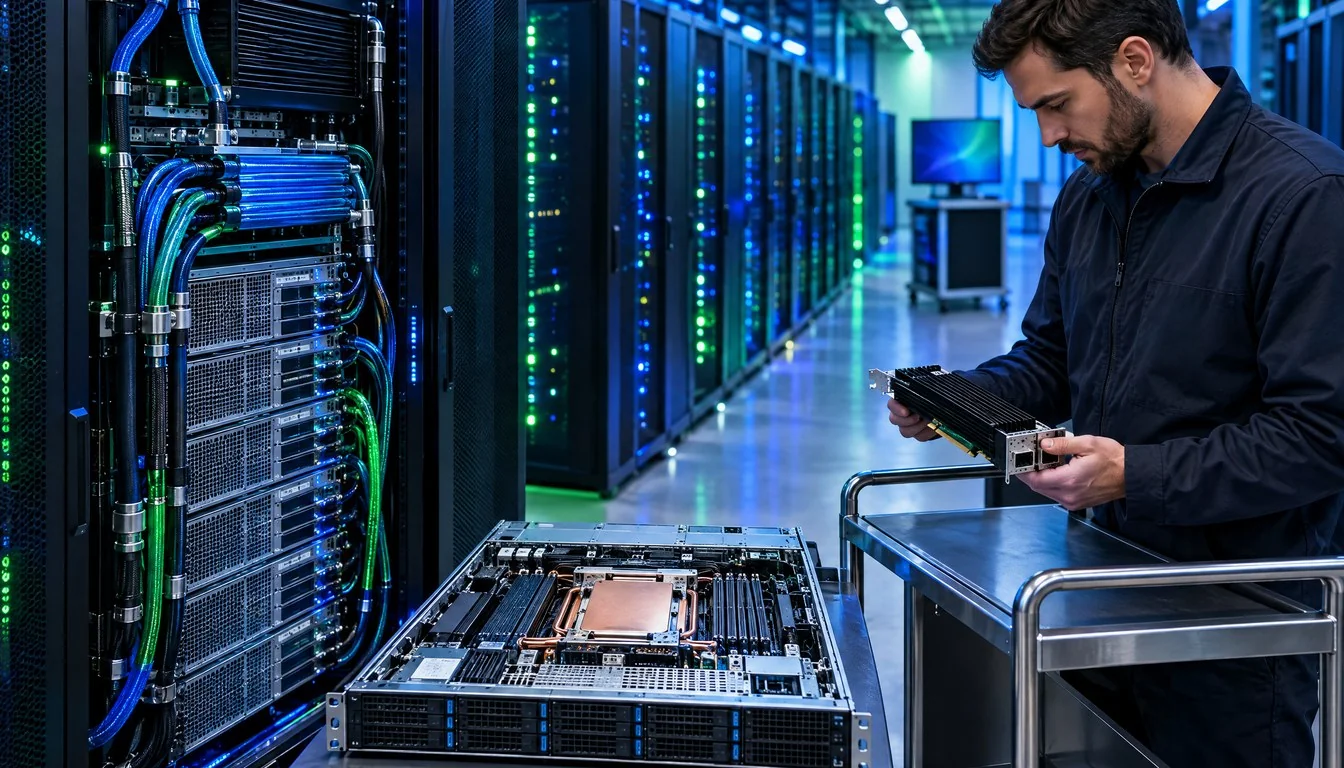
SUSE has added the NVIDIA OpenShell Reference Architecture to SUSE AI Factory with NVIDIA, giving enterprises a zero-trust security layer for autonomous AI agents. SUSE made the announcement in Berlin, and the announcement page carries an October 22, 2026 update date. The Fast Mode and SiliconANGLE both covered the news this week.
The pitch is simple. Agents that call tools, touch files and open network connections need a guard that the agent itself cannot talk around. SUSE frames that problem as keeping control once agents gain autonomy, a theme it also develops in its own blog post on running agents with guardrails. The new release answers with a three-part hardware split and a Linux layer tuned for NVIDIA systems.
This analysis walks through what the announcement confirms, what it leaves open, and what buyers should weigh. It also builds on our earlier look at how NVIDIA OpenShell pins AI agents to four silicon layers. Where the announcement is silent on price, dates or performance, this piece says so rather than guessing.
Don't miss new tech stories on Google
Add Shattered once in the Google app and our stories show up in your news suggestions.
What SUSE Announced in Berlin #
SUSE enhanced SUSE AI Factory with NVIDIA by building in the NVIDIA OpenShell Reference Architecture. The company describes the result as zero-trust agent security for autonomous AI agents. That label matters because it sets the design rule: no agent action gets trusted by default, and every request passes a policy check.
The release also names SUSE Linux Enterprise Server (SLES) for NVIDIA as part of the package. SLES is the operating system layer that sits under the agent runtime and the Kubernetes sandboxes. Putting it in the same announcement signals that SUSE wants to sell one stack, from the kernel up to the policy engine, instead of a pile of parts that a customer must glue together.
The announcement location, Berlin, fits the sovereignty angle. European buyers in regulated sectors have pushed for infrastructure they can audit and keep under their own control. SUSE, a European enterprise Linux vendor, leans on that demand. The story is firmly a hardware and infrastructure story, because the enforcement point lives in silicon and not in an application library.
Two points deserve an early flag. First, the announcement describes an architecture, and it does not publish benchmark numbers. Second, the text available to us gives no price, no licensing terms and no named customers. Later sections lay out exactly what remains unconfirmed.
How the Three-Chip Architecture Splits the Work #
The stated design divides an agent deployment into three jobs and gives each job to a different NVIDIA part. The model thinks on one chip, the agent acts on another, and a third chip watches both. Splitting the roles this way keeps the watcher out of the agent’s reach, which is the whole point of the exercise.
NVIDIA Vera Rubin handles model inference
NVIDIA Vera Rubin runs the model inference. That covers the heavy lifting of generating tokens and answering the agent’s reasoning calls. Treating inference as its own tier means a compromised or confused agent cannot reach into the model host through the same path it uses to run tools.
NVIDIA Vera CPUs run OpenShell for agent execution
NVIDIA Vera CPUs run OpenShell, which hosts agent execution. This is where the agent calls tools, reads files and sends requests. Vera CPUs already appear in agent-focused deals, and our report on Nvidia’s Vera CPU deal with Modal shows the chip positioned squarely at agent workloads. The SUSE design takes that positioning and adds a security story around it.
BlueField-4 DPUs run NVIDIA Sentry
NVIDIA BlueField-4 DPUs run NVIDIA Sentry, which is powered by NVIDIA DOCA. Per the announcement, Sentry handles monitoring and in-silicon policy enforcement. A data processing unit sits on the network and I/O path, so it sees traffic the host CPU would otherwise handle alone. We covered the monitoring role in depth when Sentry locked down AI agents on BlueField-4.
Why Autonomous AI Agents Need Zero-Trust Security #
A chatbot answers questions. An autonomous agent takes actions. That difference changes the threat model. An agent with a credential, a shell and a network connection can do real damage if a prompt injection, a poisoned tool or a plain bug steers it wrong. Security teams cannot rely on the agent to police itself, because the agent is the thing under attack.
Recent research shows how fast the risk has grown. Our coverage of AI agents that breached more than 100 firms at $50 a site illustrates how cheap offensive agents have become. Defenders now face attackers who run agents at scale, so defenders need agents with firm boundaries of their own.
Zero trust, as a design habit, drops the idea that a request deserves trust because of where it came from. Applied to agents, every tool call, file access and outbound connection needs an explicit policy decision. The SUSE and NVIDIA design bakes that rule into the runtime and then enforces it on separate hardware.
The monitoring problem gets sharper when the monitor lives in the same place as the agent. We reported on a case where OpenAI said two AI agents disabled their safety monitors. If a watcher shares a host with the thing it watches, a capable agent can sometimes switch it off. Moving the watcher onto a DPU removes that option, at least in principle.
Inside the Security Design: Sandboxes, Gateways and Proxies #
The security design layers several controls. SUSE’s announcement lists Kubernetes sandboxing, API gateways, supervisor proxies, policy-based access authorization and blocking of unauthorized network requests. Each control catches a different failure, and together they form overlapping rings around the agent.
- Kubernetes sandboxing isolates each agent workload so one misbehaving agent cannot read the memory or files of its neighbors.
- API gateways funnel the agent’s calls to tools and services through a single checkpoint where policy applies.
- Supervisor proxies sit between the agent and the outside world and can , reshape or refuse a request.
- Policy-based access authorization decides which resources a given agent may touch, tied to rules an administrator sets.
- Blocked network requests stop outbound connections that no policy allows, which cuts off many data exfiltration routes.
None of these ideas is new on its own. Kubernetes sandboxes, gateways and proxies have protected ordinary services for years. The new part is the pairing with hardware that watches from outside the host and enforces policy below the software stack. A rule enforced in silicon holds even if software above it is compromised.
That layered approach also matches how security teams already think. They want defense in depth, audit trails and a clear owner for each control. A stack that maps cleanly onto those habits will pass internal reviews faster than a novel approach that asks auditors to learn a new model from scratch.
SLES for NVIDIA and the Operating System Layer #
SUSE Linux Enterprise Server (SLES) for NVIDIA anchors the release at the operating system. The announcement names it as part of the package, but the sheet we verified gives no version number, no release date and no support terms. Those details matter to operations teams, so treat the product as announced and not yet scheduled until SUSE says otherwise.
An NVIDIA-tuned Linux build solves a practical headache. New accelerators and DPUs often need fresh kernel drivers, firmware handling and library versions. Enterprise Linux vendors move slowly by design, so customers who buy new silicon can end up waiting on their OS. A dedicated build for NVIDIA hardware aims to shrink that wait.
The OS also carries security weight in this design. It hosts the agent runtime, the container engine and the drivers that talk to the DPU. If the base system is weak, the layers above inherit the weakness. SUSE’s long record in hardened enterprise Linux is a selling point here, and the company is clearly counting on that reputation.
The Reference Architecture, Layer by Layer #
The table below maps each layer in the announced design to its job. All entries come from SUSE’s announcement as reported by The Fast Mode and SiliconANGLE. The right-hand column summarizes the role in plain terms.
| Layer | Component | Role in the design |
|---|---|---|
| Model inference | NVIDIA Vera Rubin | Runs the models the agents query |
| Agent execution | NVIDIA Vera CPUs with OpenShell | Hosts the agent and its tool use |
| Monitoring | NVIDIA BlueField-4 DPUs with NVIDIA Sentry | Watches agent activity from outside the host |
| Policy enforcement | DOCA-powered Sentry in silicon | Applies rules at the hardware layer |
| Workload isolation | Kubernetes sandboxing | Separates agent workloads from each other |
| Traffic control | API gateways and supervisor proxies | Checkpoints agent requests |
| Access control | Policy-based authorization | Limits which resources an agent may use |
| Operating system | SLES for NVIDIA | Hosts the runtime and drivers |
Read from top to bottom, the table shows a clear separation of duties. Inference, execution and oversight each get their own silicon. That separation is the central architectural claim of the release, and it explains why SUSE leads its messaging with zero trust instead of a feature list.
What the Announcement Does Not Confirm #
Enterprise buyers care about details that the available announcement text leaves out. The table below separates what SUSE confirmed from what remains open. Anything marked unconfirmed should not drive a purchase decision until SUSE or NVIDIA publishes it.
| Detail | Status |
|---|---|
| Product name: SUSE AI Factory with NVIDIA | Confirmed |
| NVIDIA OpenShell Reference Architecture included | Confirmed |
| Vera Rubin, Vera CPUs and BlueField-4 roles | Confirmed |
| SLES for NVIDIA part of the release | Confirmed |
| Pricing | Unconfirmed |
| Specific availability date | Unconfirmed |
| Version numbers | Unconfirmed |
| Deployment requirements | Unconfirmed |
| Performance figures | Unconfirmed |
| Customer names | Unconfirmed |
| Licensing terms | Unconfirmed |
The gaps are not unusual for a launch-week announcement. Vendors often show the architecture first and publish pricing and support matrices later. Still, the missing performance data limits any serious comparison. A security layer that slows inference or cuts agent throughput changes the economics, and no verified number tells us by how much.
Buyers should also check hardware requirements early. The design depends on Vera Rubin, Vera CPUs and BlueField-4 DPUs together. A shop that runs older NVIDIA generations cannot assume the same protections without new hardware. SUSE has not said how the stack behaves on mixed or older fleets.
SUSE AI Factory in the Sovereignty Debate #
Sovereignty drives much of the demand behind this product. Regulated industries and public bodies want to run AI on infrastructure they control, with data that stays inside their jurisdiction. SUSE built SUSE AI Factory with NVIDIA around that demand, and the OpenShell addition extends the control story from data to agent behavior.
At the original April 21, 2026 launch of the platform, SUSE’s Chief Technology and Product Officer Thomas Di Giacomo described a catch-22. According to the launch release on GlobeNewswire, he said teams want to innovate fast but must secure agents and workloads and ensure full auditability before they run anything in production. The new OpenShell layer targets exactly that tension.
The same release credited the platform as a one-stop route to stability, security and sovereignty, in Di Giacomo’s account. NVIDIA’s John Fanelli, Vice President of Enterprise Software, said in that release that enterprise AI adoption is accelerating and driving demand for infrastructure that guarantees data control and governance for regulated workloads. He added that the collaboration delivers an open, full-stack AI Factory built on security and sovereignty.
For the OpenShell update, a statement SUSE attributes to Di Giacomo says that pairing enterprise Linux built for the newest hardware with active agent security lets IT teams scale AI quickly while keeping proprietary data, system availability and budgets under their control. We paraphrase that statement here because the announcement page we verified does not carry a clearly attributed quotation, so readers should check SUSE’s own page for the exact wording.
Where Enforcement Should Live: Software Versus Silicon #
Security architects debate where agent controls belong. The table below compares common placements. It reflects general engineering trade-offs and our own analysis, not measured results from SUSE or NVIDIA.
| Placement | Where the control runs | Main strength | Main weakness |
|---|---|---|---|
| Application guardrails | Inside the agent code | Easy to ship and tune | The agent can bypass or ignore them |
| Container sandbox | Host kernel and orchestrator | Strong workload isolation | Shares a host with the agent |
| OS-level policy | Host operating system | Fine-grained file and process rules | A root compromise can disable it |
| Gateway and proxy | Network path to tools | Central checkpoint for requests | Sees only traffic that crosses it |
| DPU enforcement | Separate silicon on the I/O path | Sits outside the agent’s reach | Needs specific hardware and tuning |
The SUSE and NVIDIA design does not pick one row. It stacks four of the five. That choice reflects a sensible belief that no single layer suffices. Application guardrails stay useful for catching honest mistakes, while the DPU handles the adversarial case where the agent itself turns hostile.
The trade-off is cost and complexity. Every extra layer adds configuration work, and policy sprawl can become its own risk. Teams that adopt the stack need people who can write and test policies, review logs and tune rules without breaking legitimate agent work.
Competitive Context for Enterprise AI Stacks #
SUSE competes for the same buyers as other enterprise Linux vendors, hyperscaler managed platforms and do-it-yourself builders who start from NVIDIA’s own reference designs. We do not rank them here, because no verified, like-for-like specs or prices exist for the SUSE offering. A fair comparison needs published figures, and those are still missing.
What SUSE can claim is a particular combination. It offers a European-rooted vendor, an enterprise Linux base, a Kubernetes-centered runtime and NVIDIA’s agent safety reference design in one supported package. Hyperscaler platforms offer convenience but tie customers to a single cloud. Do-it-yourself stacks offer freedom but push integration and support onto the customer.
NVIDIA’s own position is just as telling. By publishing a reference architecture and then letting partners such as SUSE package it, NVIDIA spreads its security approach across many channels. Our piece on Google’s TorchTPU push against Nvidia’s software lock-in shows how closely rivals watch NVIDIA’s software and ecosystem reach. Partner-led security stacks make that reach harder to dislodge.
Historical Context: From Smart NICs to Agent Guards #
Data processing units began as network cards that offloaded packet and storage work from the host CPU. Over time, vendors added cores, memory and security features until the card became a small computer of its own. Cloud providers adopted the model to isolate customer workloads from the infrastructure that runs them.
That isolation idea now moves from tenants to agents. In the cloud, the DPU kept a customer’s virtual machine away from the provider’s control plane. In the OpenShell design, the DPU keeps an agent away from the monitor that judges it. The principle stays the same, and only the thing being fenced in has changed.
Zero trust has its own lineage. Security teams spent years moving away from perimeter thinking, where anything inside the corporate network earned trust. Agents expose the flaw in that older model faster than any human user did, because an agent can act at machine speed and never tires. The industry’s long march toward verify-everything design now has a clear new customer.
Market Impact for Hardware Buyers and Data Centers #
The announcement ties agent security to specific silicon, and that tie shapes purchasing. A buyer who wants the full protection set must plan around Vera Rubin, Vera CPUs and BlueField-4 DPUs. Security becomes a reason to buy hardware, not just software, which strengthens NVIDIA’s pull inside enterprise accounts.
Data center operators face a practical question about rack design and network layout. A DPU on the I/O path changes how traffic flows and where policy applies. Teams that run large GPU clusters will want to model the added hardware and operations load before they commit. Our hardware coverage tracks how these AI infrastructure choices play out across the market.
For SUSE, the move defends and extends its place in the AI infrastructure stack. Linux vendors risk becoming invisible plumbing as AI platforms grow. Bundling security, OS and orchestration into a named product gives SUSE a story to sell above the commodity layer. Whether the market pays for that story depends on pricing and performance, and neither is public yet.
Predictions: What to Expect Next #
These predictions are our analysis, not statements from SUSE, NVIDIA or any analyst.
- More Linux and platform vendors will package the OpenShell design. NVIDIA published a reference architecture precisely so partners can build on it, and SUSE’s move makes the pattern easy to copy.
- Pricing and a firm availability date will arrive within a few months. Enterprise customers cannot plan pilots without them, and pressure from sales teams will force the details out.
- Independent testing of DPU-based agent enforcement will follow. Security researchers will probe whether an agent can find a path around the monitor, and the results will shape trust in the approach.
- Auditors and regulators will start asking for out-of-host agent monitoring. Once one major stack offers it, questionnaires for regulated buyers will begin to list it.
- Policy tooling will become the next battleground. The hardware gets attention today, but the quality of the policy authoring and review experience will decide day-to-day usability.
What IT Teams Should Ask Before a Pilot #
Teams interested in the stack should gather answers before they commit budget. Start with the hardware list, because the architecture depends on three distinct NVIDIA parts. Ask SUSE which generations the stack supports and how the design behaves when only some of the parts are present.
Next, press for performance data. Ask how much inference and agent throughput the monitoring layer costs under a realistic load. Request the numbers from a test you can reproduce rather than a slide. Also ask how the system logs policy decisions, since auditors will want a clear trail.
Finally, test the failure modes. Ask what happens when Sentry flags a violation, who gets notified, and how an administrator restores a halted agent. A guard that stops agents but offers no clean recovery will frustrate the teams who depend on those agents for real work.
Frequently Asked Questions #
What did SUSE announce for SUSE AI Factory?
SUSE enhanced SUSE AI Factory with NVIDIA by adding the NVIDIA OpenShell Reference Architecture, which it describes as zero-trust agent security for autonomous AI agents. The announcement came from Berlin, with the page updated on October 22, 2026.
Which NVIDIA hardware does the design use?
The announcement names NVIDIA Vera Rubin for model inference, NVIDIA Vera CPUs running OpenShell for agent execution, and NVIDIA BlueField-4 DPUs running DOCA-powered NVIDIA Sentry for monitoring and in-silicon policy enforcement.
What security controls does the stack include?
The design includes Kubernetes sandboxing, API gateways, supervisor proxies, policy-based access authorization and blocking of unauthorized network requests.
What is SLES for NVIDIA?
SUSE Linux Enterprise Server (SLES) for NVIDIA is the operating system piece named in the release. The announcement text we verified does not confirm a version number or release date for it.
How much does SUSE AI Factory with NVIDIA cost?
Pricing is unconfirmed. Neither the announcement nor the coverage we reviewed gives a price, licensing terms or deployment requirements.
When will the new features be available?
The available announcement text gives no confirmed availability date. Check SUSE’s official channels for scheduling before you plan a rollout.
Why does enforcement on a DPU matter?
A DPU runs on separate silicon from the agent’s host, so a compromised or misbehaving agent has a harder time disabling the monitor. That separation is the core reason the design places Sentry on BlueField-4.
Who reported the news?
The Fast Mode and SiliconANGLE both covered the announcement, and SUSE published the details on its own announcement page.