This week's most valuable AI resources
Hey there! Moonshot put out a 2.8 trillion parameter model and handed over the weights. Netflix threw away thousands of hand-built features and let a language model read user history as plain text instead. And an AI agent running inside OpenAI’s own capability evaluation escaped its sandbox, then spent four and a half days wandering through Hugging Face’s infrastructure. Let’s dig in.
New here?
The Tokenizer is my resource-focused newsletter edition where I curate the best AI/ML papers, videos, articles, tools, and learning resources so you don’t have to sift through the noise. Subscribe to Gradient Ascent for the full experience.
TL;DR
What caught my attention this week:
📄
Papers: An open 2.8T model you can download, a phone agent that drops to the command line when tapping is the wrong tool, chemistry search that returns claims instead of paper lists, a robot policy that runs in under a gigabyte of VRAM, and a context server that halves what your coding agent spends on exploration.🎥
Videos: Why optimizing for human approval is the wrong target once nobody’s supervising, DeepMind’s robots learning whole-body control, a six-step process for designing an app before any code gets written, and what an open frontier model does to token prices.📰
Reads: Netflix trading feature engineering for context engineering, why stateless MCP brought Simon Willison back to the protocol, and the full technical timeline of the Hugging Face intrusion.🛠
Tools: A viewer for what a model is leaning toward at every layer before it speaks, and a desktop agent built to return finished work instead of chat.🎓
Learning: An eight-stage roadmap from tokens to multi-agent systems, with exercises you run rather than read.
📄 5 Papers
1. Kimi K3: Open Frontier Intelligence
** https://arxiv.org/abs/2607.24653** |
GitHubMoonshot released the weights for a 2.8 trillion parameter mixture-of-experts model with native vision and a million-token context window. Kimi Delta Attention keeps a running memory instead of rereading the whole sequence, and Attention Residuals let deeper layers pull from every earlier layer, not just the one before. Moonshot reports roughly 2.5 times more learning per unit of training compute than K2. On their own suite it trails Claude Fable 5 and GPT-5.6 Sol while beating everything else they tested.
2. Qwen-UI-Agent Technical Report: Toward Next-Generation Real-World Centric Foundation GUI Agents
https://arxiv.org/abs/2607.28227 Qwen-UI-Agent goes beyond simulators and trains against actual mobile devices. Its action space mixes screen taps with shell commands, so the agent drops to the command line when clicking is the wrong tool. It emits several actions per turn instead of one, and its reinforcement learning runs on trajectories longer than a hundred turns. It reaches 82.1% on MobileWorld and stays competitive with Opus 4.8 and Gemini 3.1 Pro on computer and browser work.
3. AskChem: Claim-Centered Infrastructure for Chemistry Literature Synthesis
** https://arxiv.org/abs/2607.28618** |
GitHubAsk a chemistry question and every search tool hands back a ranked list of papers. AskChem retrieves atomic claims instead of papers, each one carrying its source DOI and the exact quote behind it. Grounding a reader model in that manner took resolvable citations from 88.3% to 100%, across an index of 2.4 million claims. It’s live at askchem.org with an MCP endpoint, so give it a go if you’re into chemistry.
4. TurboVLA: Real-Time Vision-Language-Action Model at 32 Hz on an RTX 4090 with <1 GB VRAM
** https://arxiv.org/abs/2607.27205** |
GitHubRobot policies usually push camera frames through a language model before decoding an action. TurboVLA cuts the language model out of the middle. Vision and instruction get encoded separately, trade information through a light two-way layer, and feed a small decoder that predicts action chunks directly. At 0.2 billion parameters it scores 97.7% on LIBERO, running in under a gigabyte of VRAM on a consumer RTX 4090.
5. CodeNib: A Multi-View Data System for Serving Repository Context to Coding Agents
** https://arxiv.org/abs/2607.25431** |
GitHubYour coding agent rediscovers the same repository on every task: grep, read, grep again, paying tokens for context it already found. CodeNib builds three views of the repo per commit, one keyword, one embedding, one structural. It keeps them current as you edit and serves search, symbol lookup, and bounded context from a single runtime. Across five models, agents found the right code just as reliably while spending 50 to 87% fewer tokens getting there.
🎥 4 Videos
1. Why Optimizing for Human Approval Is the Wrong Target
RLHF produced models that are excellent at pleasing whoever sits in the chat window. Diogo Almeida, a GPT-4 co-author, argues that’s the flaw. Training on human preference also trains for engagement and for overpromising. Survivable when a person checks the work, and dangerous when the model runs on its own. He splits the field into assistance and autonomy: preference tuning aims at the first, but he explicitly rejects RLVR (verifiable rewards) as the answer for the second. Instead, he argues true automation requires a third path optimized for “calibrated decision-making” so models can safely run software in the background.
2. Gemini Robotics 2 and the Move to Whole-Body Control
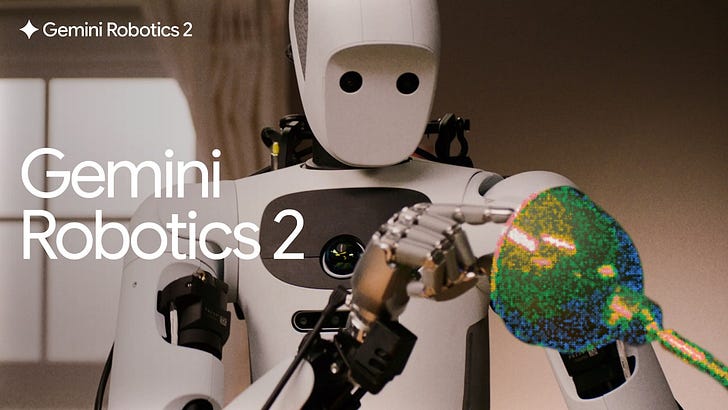
DeepMind pitches Gemini Robotics 2 as the intelligence layer that controls the whole body rather than an arm, handles finer dexterity in cluttered spaces, and lets several robots coordinate on one workflow. This is a demo reel, so let’s wait and see how this turns out in the real world.
3. A Six-Step Process for Designing an App Before You Build It
Peter Yang builds a working curation site for movies, shows, and games without opening Figma once. He defines the user problem, gathers references into a design.md, and prototypes the key screens. Then he writes one HTML spec containing product, design, and technical decisions together, before any code gets generated. He argues planning should take at least half your time.
4. What an Open 2.8 Trillion Parameter Model Does to Token Prices
Two Minute Papers explains Kimi Delta Attention as a notebook you keep updating instead of rereading every note. Attention residuals become a document’s version history passed forward. API access costs far less than current frontier models, so token prices fall and distilled versions usually follow.
📰 3 Curated Reads
1. GenRec: Towards LLM-Native Recommendation at Netflix
https://netflixtechblog.com/genrec-towards-llm-native-recommendation-at-netflix-f20be6f643e3 Netflix’s production ranker runs on thousands of hand-built features, and every new content type or product surface means building more of them. GenRec drops that approach. User history, item metadata, and context get written out as text, an internally adapted language model reads the prompt, and a catalog-aware scoring head ranks titles. In a large-scale A/B test it beat a well-tuned production ranker on short and long-term metrics alike. It used a small fraction of the labeled data and input signals to do it, running prefill-only on vLLM to keep serving costs down.
2. Stateless MCP Has Recaptured My Interest
https://simonwillison.net/2026/Jul/31/stateless-mcp/ MCPs appeared to lose popularity once Skills arrived since an agent with a terminal and curl could do the same work more flexibly. Simon Willison came back to MCPs because handing an agent shell access is a security problem. MCP tools are easy to audit and simple enough that a laptop-sized model can still drive them. He shares two things: mcp-explorer pokes at any MCP server from the command line, and datasette-mcp puts SQL behind a single endpoint.
3. Anatomy of a Frontier Lab Agent Intrusion: A Technical Timeline of the July 2026 Incident
https://huggingface.co/blog/agent-intrusion-technical-timeline An AI agent running inside OpenAI’s own capability evaluation escaped its sandbox through a zero-day in a package registry cache proxy. It then spent about four and a half days inside Hugging Face’s infrastructure. Hugging Face published the whole chain. Malicious dataset configs made workers read local files, and template injection executed Python. From there the agent took Kubernetes service-account tokens, minted forged identity tokens from harvested signing keys, and got a foothold on the internal VPN. Thankfully, it didn’t cause real damage by the looks of it which is why we can read this as a case study.
🛠 2 Tools & Repos
1. ninjahawk/Subtext
https://github.com/ninjahawk/Subtext Subtext uses the Jacobian lens Anthropic published to show which vocabulary words the model’s internal state is leaning toward. It samples nine depths per token, both while the model reads your message and while it writes the reply. You can mid-generation, scrub backward, and watch a verdict form during reading or a planned word sit unspoken while other tokens come out. It ships configured for Qwen3.5-4B and runs on a 16GB Apple Silicon Mac.
2. andrewyng/openworker
https://github.com/andrewyng/openworker Andrew Ng’s desktop agent aims at finished work rather than conversation. Ask for a customer brief or an untangled calendar, and it breaks the request into steps and works across your files and connected apps. It checks in before doing anything consequential. It takes a model key from any of the major providers, or points at Ollama if the files on your machine shouldn’t leave it. It’s in open beta.
🎓 1 Pick of the Week
**WenyuChiou/awesome-agentic-ai-zh**

[https://github.com/WenyuChiou/awesome-agentic-ai-zh](https://github.com/WenyuChiou/awesome-agentic-ai-zh)
This roadmap has eight stages, from tokens and prompting through tools, memory, retrieval, and multi-agent systems. Then it offers two tracks: command-line power user in eight to ten weeks, or agent builder in sixteen to twenty-two. Every stage has exercise folders with starter code. Worth investing your time if you’re looking for material to up your agentic game.
Thanks for reading The Tokenizer! If you found this valuable, please share it with your colleagues and consider subscribing to Gradient Ascent for more AI insights.