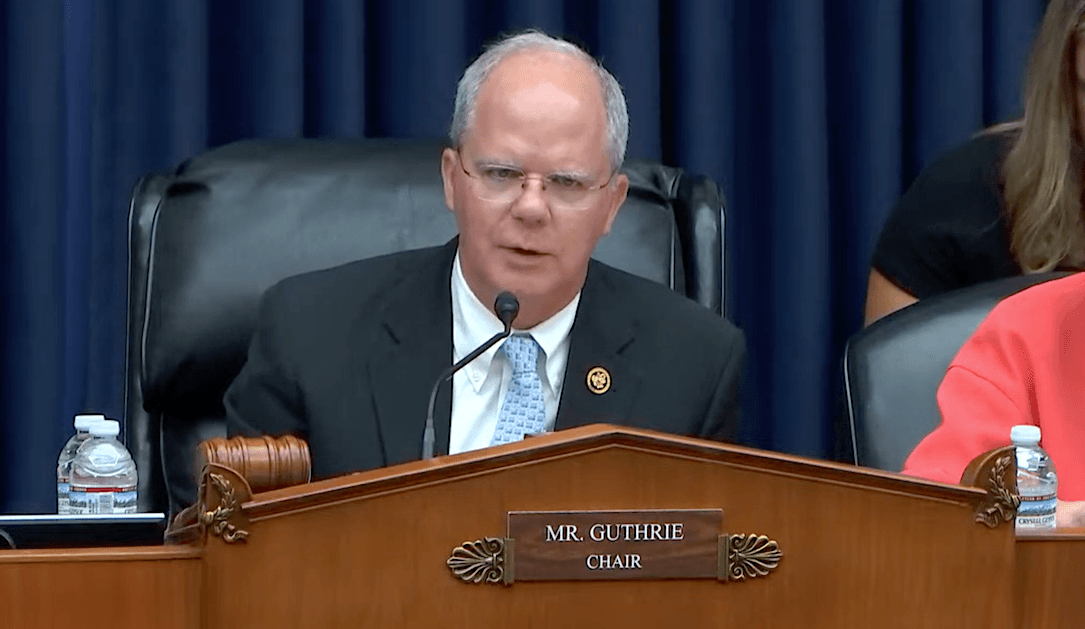
House Energy and Commerce Chairman Brett Guthrie said Wednesday that he won’t pledge to a specific timeline for a committee vote on a major bipartisan AI safety bill and hinted that there likely won’t be one this year.
The legislation, known as the FRONTIER Act, is a comprehensive bill widely regarded as the best chance Congress has to put AI safety guardrails in place in the near future. Co-sponsored by Reps. Jay Obernolte (R-CA) and Lori Trahan (D-MA), the legislation has garnered support from OpenAI, Anthropic, important policy groups and a growing number of federal lawmakers across party lines.
Obernolte has said he wants a committee vote on the bill in November, but Guthrie appeared to oppose the idea.
“I'm not going to say that the bill is going to move,” Guthrie (R-KY) said at an event hosted by Politico in Arlington, Virginia. “It's really complicated, and I wouldn't want to do something in a lame duck session to do it quickly and not get it right.” The committee’s jurisdiction includes cybersecurity and data security.
Guthrie's comments come as the federal government, the tech industry and foreign powers debate what should happen in the short term regarding AI safety in the wake of multiple incidents of rogue AI agents launching cyberattacks.
Last week, a former Anthropic staffer quit his job and gave several interviews about his fears that AI could kill off the human race. CEOs of all the major AI companies subsequently called on lawmakers and the White House to regulate their work.
The White House has downplayed concerns and opposes additional regulation.
David Sacks, the president’s former AI czar, echoed the president’s position in an interview at Wednesday’s event. Sacks is still a White House adviser on science and technology issues and is known to have tremendous influence with the president, particularly on AI.
One possible guardrail Sacks said he would support is an idea advanced by Elon Musk for a system where AI companies test the safety of each other’s models before making them public instead of solely relying on internal testing or stronger government regulation.
“I think that's just a really interesting proposal because, again, it's marshaling the forces of competition,” Sacks said. “The other interesting thing about Elon's proposal is that Chinese companies could get on board with it.”
“There's some pre-testing period before models get released, where again the rest of the industry gets to kind of bang on those models, test those models using standard harnesses, and then find the problems before they get released.”
Hugging Face CEO Clem Delangue, who also spoke at the event, said that despite his experience with some 700 rogue OpenAI agents hacking his company’s open-source platform, he believes current U.S. laws holding industry accountable for cyberattacks are all that is needed to ensure advanced AI firms are doing enough to protect against hacks.
“I’m not even sure that we need to reinvent the wheel and create new regulation because the legal system for cyber attacks is already working well today,” Delangue said.
OpenAI worked with Hugging Face on a joint forensic investigation of the incident, retained third-party auditors and said it made significant changes to its infrastructure to guard against future attacks.
Delangue did push for other reforms, saying he would like it to be mandatory for cyberattacks carried out by AI agents to be disclosed.
“I think there's a lot to do around how to create better disclosures, like do you have to disclose the full agent traces? Do you have to disclose how the models that were used for it have been trained?” Delangue said.
“There are a lot of improvements that we can make on transparency in general, that are going to be very important for the future for us to stay on top of things, understand things, and adapt our society to it [AI],” he said.
Suzanne Smalley
is a reporter covering digital privacy, surveillance technologies and cybersecurity policy for The Record. She was previously a cybersecurity reporter at CyberScoop. Earlier in her career Suzanne covered the Boston Police Department for the Boston Globe and two presidential campaign cycles for Newsweek. She lives in Washington with her husband and three children.