KAIST's Urban Robotics Lab wins first and second place in ECCV, RSS 2026 challenges
Tell a robot to “go to the blue sofa in the living room,” and it may navigate the building only to stop in the wrong place.
KAIST researchers have developed an AI system that makes the robot take a second look and ask itself, “Is this really the right place?” before deciding it has arrived.
The self-checking technology helped a joint team from the Korea Advanced Institute of Science and Technology and the Electronics and Telecommunications Research Institute finish first among 112 teams in an international robot navigation challenge held in Malmo, Sweden, on Sept. 9.
The KAIST lab also placed second in a separate challenge in Sydney in July with another system designed to help robots interpret unwritten rules, such as distinguishing the entrance to a parking lot from the exit.
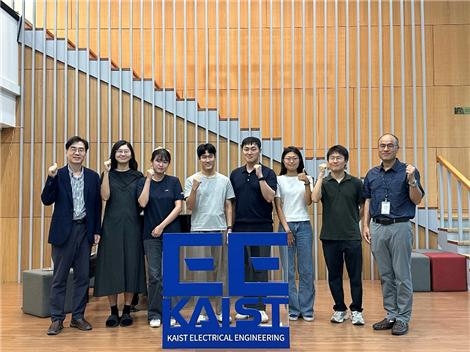
KAIST said Wednesday that the two systems were developed by its Urban Robotics Lab led by Myung Hyun, a professor in the School of Electrical Engineering.
The competitions were held in conjunction with the European Conference on Computer Vision 2026 and Robotics: Science and Systems 2026. Both tested embodied artificial intelligence, or the ability of robots to understand human instructions, perceive their surroundings and decide how to move through the physical world.
Checking the destination twice
For the VLNVerse Challenge at ECCV 2026, the Urban Robotics Lab joined ETRI’s Field Robotics Research Section to compete under the name URL-FRRS. Robots had to reach a destination after receiving either a simple goal or multistep directions, such as “Turn right at the end of the hallway and go through the second door.”
The researchers found that robots often failed not because they could not find a route, but because they mistakenly decided they had arrived. They might pass the correct destination or confuse it with a similar-looking room.
To address the problem, the team developed CoRe-VLN, short for Coverage-based Recovery for Vision-Language Navigation.
Before stopping, the robot scans its surroundings again and uses AI capable of processing text and images to determine whether the location matches its instructions. It checks features such as the color and shape of the target object and whether it is actually nearby.
If the location is wrong, the robot searches for a new route and resumes moving. The technology can be added to existing navigation systems without additional training. URL-FRRS recorded an average success rate of 90.7 percent across the competition’s two tasks. Although the runner-up posted the same rate, the team secured first place because it submitted its results earlier. The third-place team recorded 89.7 percent.
Reading unwritten rules
The lab’s second-place finish came in the NaviTrace Challenge at the Open-World Navigation Workshop of RSS 2026.
In that competition, a robot received a single image and a short command, such as “Go into the parking lot,” and had to determine the appropriate route.
People instinctively distinguish a parking lot entrance from an exit by reading road markings and observing the direction of traffic. Such cues are not stated in the command, leaving the robot to infer the spatial and social rules on its own.
The researchers developed PRISM-Nav, which divides the decision-making process among four AI agents instead of assigning all the tasks to a single model.
One identifies the destination, while another detects hazards such as stairs and curbs. A third interprets rules involving features such as sidewalks and crosswalks, and the fourth combines the information to select a route.
The researchers also simplified communication among the agents. Instead of describing locations through lengthy text or numerical coordinates, the agents mark destinations and hazardous areas directly on an image and share the annotated image. The system can operate in new environments without retraining.
The team scored 53 points, finishing second behind a joint team from Nanjing University and FiveAges.
The researchers used multiple instances of the relatively lightweight Gemini 3 Flash model and achieved better performance than Gemini 3.1 Pro Preview, a more powerful model used by the organizers as a benchmark. The result suggests that several smaller models working together can outperform a single higher-performance model on certain navigation tasks.
“I am delighted that the potential of our technology has been recognized in competition with researchers from around the world,” Myung said.
“This achievement shows that AI can independently make decisions and navigate unfamiliar environments without additional training.”
shwang9@heraldcorp.com