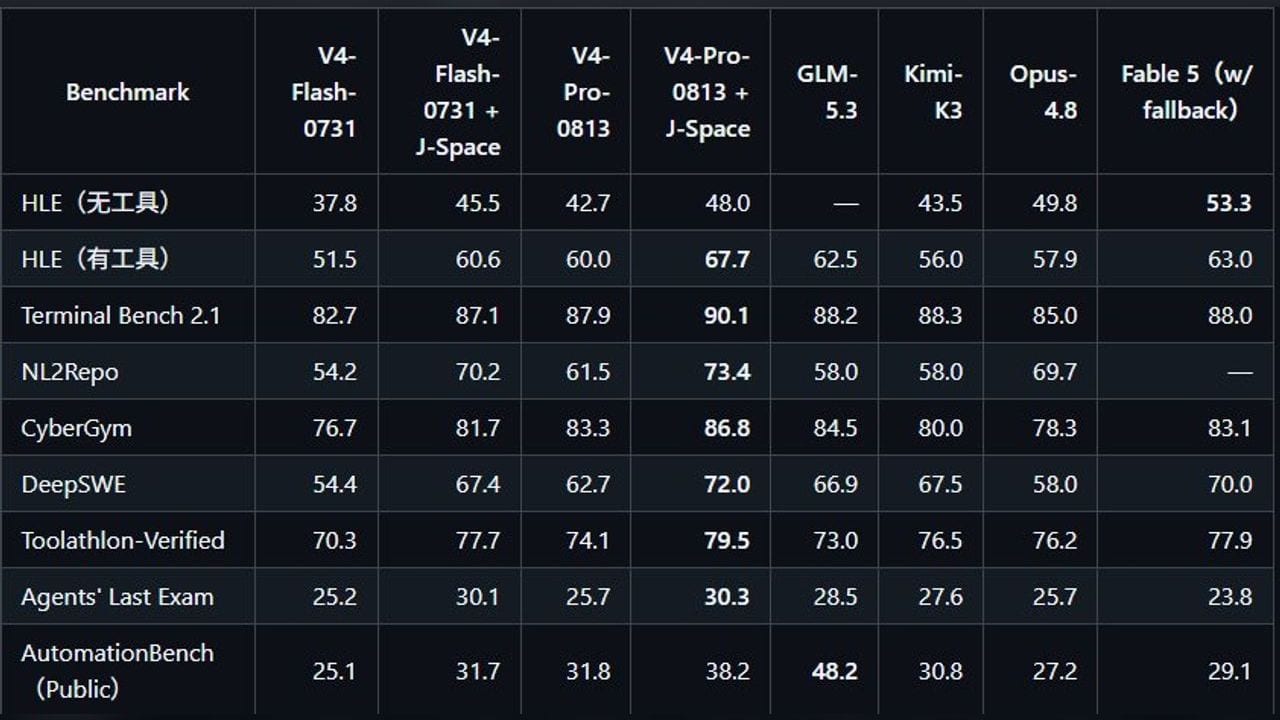
Open-source developer Tiger380 has published a benchmark report claiming that a text-based control layer materially improves DeepSeek V4 Pro's performance on reasoning and agent tasks. The findings drew attention on August 17th after Jun Song (@jun_song) wrote in a thread on X that the harness "completely outperforms Fable across every task."
The underlying DeepSeek V4 and J-Space report supports a narrower conclusion. Its results show DeepSeek V4-Pro-0813 gaining on all nine tested benchmarks when paired with J-Space, but they do not show it beating Anthropic's Fable 5 on every task. The tests were also single runs, and the cross-model comparison combines scores published under different evaluation methods.
Tiger380's J-Space Cognition Suite V3.6 does not alter model weights or fine-tune DeepSeek. It packages instructions, task-routing rules and an optional Python state controller into an inference-time layer designed to keep goals and constraints active during long jobs.
The suite routes work into fast
, full
and loop
modes. For longer tasks, it maintains a ledger covering the goal, active facts, verified findings, open questions and next action. It also directs the model to checkpoint progress, carry diagnoses into retries and verify how much of a task a test actually covers. The repository contains nine selectively loaded protocol modules alongside the optional controller.
Calling that a "simple harness" understates what is being tested. J-Space is a structured agent operating protocol, complete with state management, verification rules and recovery behavior. Its central bet is that some model failures come from losing track of the job across tool calls and context changes rather than from a lack of underlying reasoning capacity.
The DeepSeek gains are large
The report compares DeepSeek V4-Pro-0813 in the official DeepSeek Harness's minimal configuration with the same setup plus J-Space. It says the model's score increased from 60.0 to 67.7 on tool-enabled Humanity's Last Exam, from 87.9 to 90.1 on Terminal Bench 2.1 and from 61.5 to 73.4 on NL2Repo.
The reported DeepSWE score rose from 62.7 to 72.0. CyberGym moved from 83.3 to 86.8, while Toolathlon-Verified increased from 74.1 to 79.5. Smaller but still positive gains appeared on Agents' Last Exam and AutomationBench. On Humanity's Last Exam without tools, J-Space raised the reported score from 42.7 to 48.0.
Those results make the same-model comparison the strongest part of the report. The base model, task, tool conditions and scoring rules were held constant, according to Tiger380, with the operating protocol serving as the experimental variable.
The methodology still leaves considerable uncertainty. Each result represents one run rather than an average across repeated trials, and the report provides no confidence intervals. It also notes that DeepSeek's API may ignore the submitted temperature
and top_p
values in thinking mode. Small differences could therefore reflect run-to-run variation, while the larger gains need independent replication before they can be treated as stable.
The Fable claim does not survive the table
Tiger380's own comparison shows Fable 5 ahead on Humanity's Last Exam without tools, scoring 53.3 against 48.0 for DeepSeek V4-Pro-0813 with J-Space. GLM-5.3 also leads AutomationBench with 48.2, compared with J-Space's 38.2. No Fable result is listed for NL2Repo.
The report describes the J-Space configuration as leading the reference columns on seven benchmarks, a materially different claim from beating Fable across every task. The author also warns that the comparator scores retain each model vendor's published evaluation method. Fable, GLM, Kimi and Opus were not rerun inside one standardized J-Space evaluation.
That makes the cross-model table a collection of reference points rather than a controlled head-to-head test. It can show where DeepSeek's reported scores sit among public results. It cannot establish that J-Space has dethroned Fable under identical conditions.
J-Space borrows a research term for a different layer
The project's name comes from Anthropic's July 6th research describing a collection of internal model representations associated with concepts that can be reported, deliberately held and used in reasoning. Anthropic studied those neural activations with a technique called the Jacobian lens.
Tiger380's suite does not inspect or edit those hidden activations. It applies text instructions and external state-management machinery, using Anthropic's findings as inspiration for how an agent might maintain a working set and coordinate multi-step computation. The suite itself says it does not claim that text instructions directly expose every hidden activation.
That distinction matters because the benchmark gains, if replicated, would demonstrate the value of better inference-time orchestration rather than direct control over a model's internal J-space. DeepSeek's official V4 Pro model card describes a mixture-of-experts model with 1.6 trillion total parameters, 49 billion activated parameters and a one-million-token context window. A model of that size can still perform unevenly when an agent wrapper mishandles tools, context or verification.
J-Space's report offers evidence that the wrapper can change the result substantially. It does not yet prove that DeepSeek V4 Pro beats Fable 5, and it certainly does not prove it across every task. The more defensible finding is also the more useful one: model rankings can move when the harness changes, which means agent builders are benchmarking a combined system even when the leaderboard names only the model.