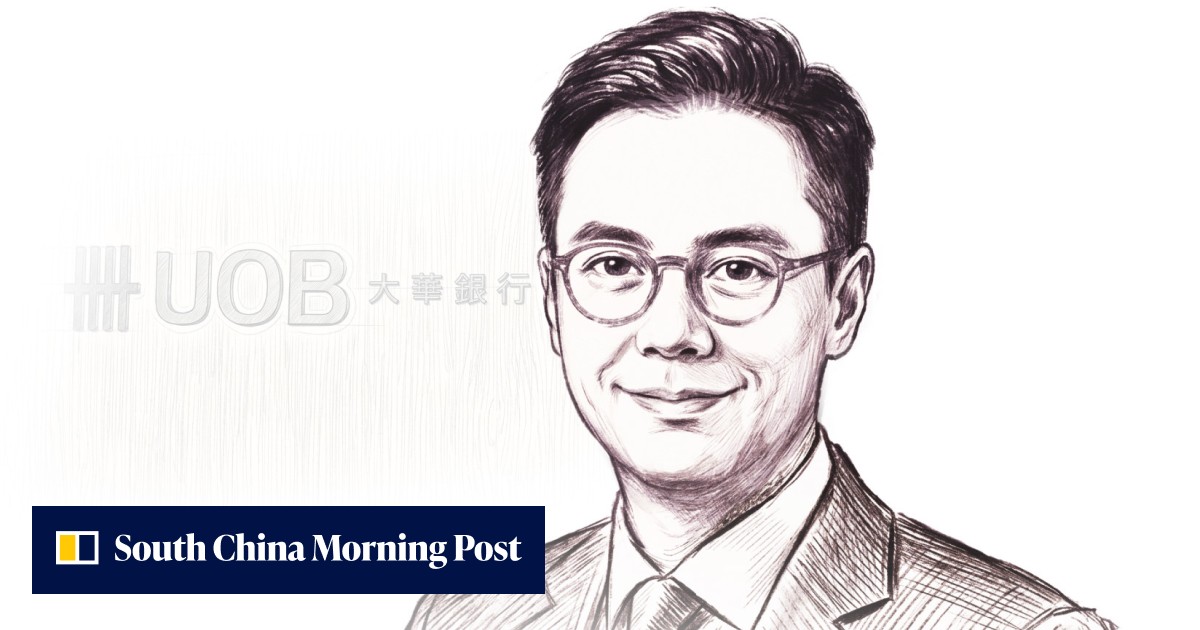
George Tung, CEO of UOB Hong Kong, is leveraging Hong Kong’s cross-border capital hub status by deepening ASEAN connectivity, integrating wholesale and private banking, and embedding disciplined risk management with AI-enabled oversight to navigate geopolitical shifts and rate volatility.
George Tung, CEO of UOB Hong Kong, is positioning the bank to leverage the city’s role as a cross-border capital hub by strengthening ASEAN links, deepening client trust and embedding disciplined risk management.
Capital rarely stands still in Asia. From mainland China to ASEAN and the Middle East, funds are constantly in motion, searching for stability, yield and trusted channels through which to flow. In an era shaped by geopolitical tension, trade realignment and volatile interest rates, the value of well-regulated financial hubs has only grown.
For George Tung, CEO of UOB Hong Kong, the moment presents both opportunity and responsibility. “Whenever there is money, there is opportunity and business for the banks,” he says.
Positioned between China and Southeast Asia – UOB’s home base – Hong Kong remains a “superconnector for capital”. The challenge now is not simply to intermediate transactions, but to connect ecosystems: corporates and families, capital and production, liquidity and long-term strategy.
Changing the game
When Tung began his banking career in 1989, the business was simpler. Clients came in for loans or deposits. Transactions were straightforward.
“In the past, people just wanted a simple banking transaction,” he recalls.
That world has shifted. Today, Hong Kong is no longer seen merely as a financial marketplace, but as a conduit.
“People do not look at Hong Kong as a financial hub any more. They think about Hong Kong as a conductor to channel capital, funding or investment flow in and out of China, and also in ASEAN,” he says.
Clients expanding via Hong Kong now expect more than products. “Nowadays, they would like to hear more ideas on how to solve their problems,” Tung explains.
For UOB, the response lies in its regional DNA. With deep roots in Singapore and a longstanding ASEAN presence, the bank positions itself as a cross-border partner rather than a transactional intermediary. “We have been there for decades already. We know the local knowledge. We can help the client navigate regulatory requirements and geopolitical risk. From end to end, UOB can help.”
That philosophy extends internally. Tung sees wholesale banking and private banking not as silos, but as one ecosystem.
“Behind [corporates], there are always shareholders and executives. They have families. They have their savings,” he says. “We see them as connected together. They belong to the same ecosystem.”
The ambition is integrated solutions supporting both business operations and family wealth in a single relationship.
“We see the opportunities to connect wholesale banking and private banking, and then we can help them in one go with one solution,” he says. “At the same time, we can enjoy the business and also enjoy the friendship. That’s most important.”
In a region where trust underpins deals, Tung reduces it to a single principle: “Precisely, relationship is the key.”
Shaping tomorrow
If one word defines Tung’s five-year outlook, it is connectivity. “I think connectivity is the keyword for the next five years,” he says.
Trade patterns may be shifting, from Chinese electric vehicles and technology exports to manufacturing diversification across Indonesia, Malaysia and Thailand, but Hong Kong’s role in financing and structuring those flows remains central.
“China remains the most economically versatile consumer goods production country. I think many countries are still buying,” Tung notes. “If you look at the trade figures, the vast majority of this transaction actually is conducted through Hong Kong.”
Geopolitical shocks have reinforced the city’s relevance. Referring to Middle East tensions, Tung observes: “It actually enhances some of the influx of capital from the Middle East into Hong Kong as a safe haven… The market is very liquid.”
The immediate task for UOB is to deploy that capital wisely. At the simplest level, clients may seek fixed deposits. More complex needs require structured products, cross-border financing and hedging strategies.
“Longer term, we have to listen to the business plan, and then hedge the interest rate,” Tung says. With rates volatile, speculation is less useful than discipline. “No need to keep guessing… just hedge away the unnecessary risk.”
Growth, however, must remain balanced. UOB Hong Kong employs around 460 staff, and Tung is clear that expansion requires robust control frameworks.
“The growth is not only for the front line. It is a balance between the front, the middle and the back,” he says. Compliance under both Singapore’s MAS and Hong Kong’s HKMA forms part of that discipline.
“We have to make sure that we are in full compliance… so that the growth will be well balanced between the opportunity and also the risk.”
Technology is another pillar shaping tomorrow. Younger generations rarely enter physical branches.
“Everybody is using an app… Especially the young generation, they don’t come into the bank. So we have to keep on enhancing ourselves to be digitised,” he says.
On artificial intelligence, Tung is pragmatic. “Some people are concerned about job losses. Try not to be overly worried about AI application,” he says. “AI doesn’t make decisions for you. It just advises you. You are the person who asks the right question.”
He calls AI “a major game changer” that can “save us time to analyse the market” and enhance productivity across the bank, but always under human oversight.
Lessons that last
Tung’s philosophy is shaped by nearly four decades of crises: the Asian financial crisis, 9/11, the global financial crisis and Hong Kong’s 2019 unrest. Each episode reinforced one lesson.
“Liquidity is the magic word,” he says.
“For thousands of times, we have heard that the customer has the assets, but they don’t have the liquidity. Actually, liquidity can cause a lot of trouble.”
His response begins with vigilance. “Every day when I wake up… I look at the market in New York: interest rate, FX rate, commodity, share prices, and then the headline news,” he says. “You always keep yourself amazed by what’s going on around the world.”
Institutionally, UOB relies on layered risk management and accountability.
“We have a very efficient and effective check-and-balance system. Everybody has their own accountability,” he explains. “Our priority is to protect our customers and ensure the integrity of the bank.”
Leadership, however, is not only about systems. Tung describes himself as a “situational leader”.
“If the situation is calm, people are capable, you don’t really need to intervene,” he says. “But if you see something the other way, then you have to be very proactive.”
Communication is central. So is emotional discipline.
“You have to be consistent… stay professional to deal with business partners and deal with people. Eventually your counterpart can feel it, and they will trust you more.”
Trust, accumulated over time, becomes reputation, and reputation underpins banking.
He is equally candid with young professionals considering the industry.
“Be truthful to yourself. Do you really like banking? It’s a hard life,” he says. “Don’t be misled by some fancy story… It’s not going to get any easier because it’s getting more and more complicated.”
Yet he believes deeply in commitment and mentorship.
“Once you make up your mind, stick to it,” he advises. “Within the bank, we have a mentoring system. They can speak more freely to their senior and seek advice.”
As for his ambitions in Hong Kong, Tung looks to his five-year tenure in South Korea, where UOB achieved annual growth of around 20 to 22 per cent.
“Of course I wish I can achieve similar things in Hong Kong,” he says.
The global outlook may remain uncertain, shaped by trade tensions and rate volatility. But Tung’s closing sentiment reflects both realism and resilience.
“Assuming everything’s moving static from now on… I’m still very confident that we’ll be able to achieve,” he says. “Then you will have something to smile about. No matter what happens, I will keep smiling.”