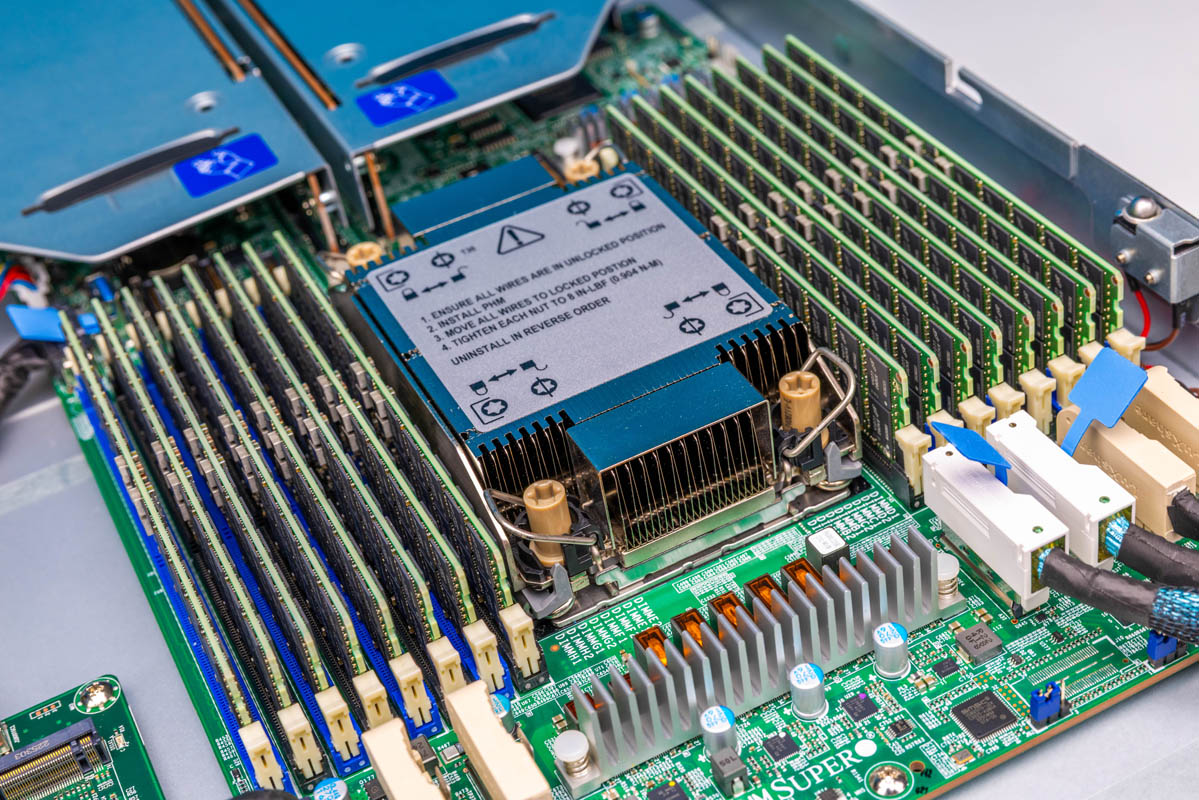
Intel this morning is announcing that the Xeon 6 family is going to be getting a mid-generation upgrade with support for newer and faster memory. Starting as soon as this August, Intel is going to be enabling support for DDR5-8000 RDIMMs for select Xeon 6 6700P SKUs, raising the limit from the chips’ current cap of DDR5-6400. Meanwhile in Q1 2027, the company will be adding support for second-generation MRDIMMs to Xeon 6900P processors, allowing them to use the newer memory format – albeit without support for higher frequencies.
Xeon 6700P To Support DDR5-8000 RDIMMs
In a blog post penned by Intel’s Srini Krishna, Krishna laid out Intel’s surprising product plans as well as Intel’s rationale for them. In brief, Intel believes that CPU memory bandwidth is a bottleneck for modern AI workloads, and as a result the company will be enabling support for faster memory on some of their existing Xeon 6 chip SKUs so that customers can build/upgrade their Xeon 6 servers to offer more memory bandwidth beyond what they can offer today with the fastest DDR5-6400 RDIMMs that are already qualified for the platform.
In practice, this helps to put the existing Xeon 6 “Granite Rapids” chips closer to par with Intel’s recently-launched Xeon 6+ “Clearwater Forest” chips, which shipped with similar memory support right out of the gate. We had a chance to take a look at DDR5-8000 RDIMMs (as well as Gen 2 MRDIMMs) at this year’s Computex, and while memory in general remains a commodity in short supply, memory vendors already have their upgraded DDR5 memory products completed, and now they just need systems to plug them into. Originally we were expecting these to be just Xeon 6+ and AMD’s upcoming EPYC “Venice” processors, but Intel has other ambitions for their current Xeon 6 platform – no doubt in part because Granite Rapids is not slated to be replaced with Diamond Rapids until 2027.
Dissecting the technical aspects of Intel’s announcement a bit, the company seems to be intending the leverage the high quality memory controller used by Granite Rapids, which in some respects was overbuilt from the very start. Even though the first chips were designed early in the decade and launched in 2024 – before JEDEC even had a specification for DDR5-8000 memory – Intel invested heavily in their memory controller in order to allow it to run at higher memory speeds in order to support MRDIMMs. By multiplexing additional DDR5 memory chips, MRDIMMs are able to accommodate a DDR5 memory bus running at speeds up to 8800 MT/sec. And, despite the technical differences this entails on the DIMM side of that connection, from the CPU end of that memory bus the key feature needed to make this work is a high-quality memory controller that can consistently run at DDR5-8000 speeds.
Ultimately, now that more traditional RDIMMs have largely caught up to MRDIMMs in terms of bandwidth, it would seem that Intel is going to be able to reuse those memory controllers to run regular RDIMMs at similar speeds.
Taken altogether, being able to run RDIMMs at DDR5-8000 speeds stands to greatly boost the amount of memory bandwidth available to Intel’s Xeon 6 chips. Compared to the DDR5-6400 limit they are qualified for today, DDR5-8000 is 25% more bandwidth on paper. And in practice, Intel is claiming a 20% increase in measured memory bandwidth in their testing. Though to be sure, the real-world performance benefits of the additional memory bandwidth are not going to be that great outside of corner cases; Intel’s own blog post is only claiming a 3 to 6% performance gain “across a broad range of workloads.” Which is consistent with previous memory speed bumps for CPUs, as the additional memory bandwidth is only as helpful as memory bandwidth itself is the bottleneck for a workloads.
More interesting, perhaps, is that Intel is claiming a slight improvement in memory latency as well. At JEDEC timings, DDR5-8000 has an absolute latency of 14ns, about 3% lower than the 14.38ns of DDR5-6400. But Intel is claiming a 6% improvement in latency, which is a bit greater than what we would expect on paper based on those specifications.
| JEDEC DDR5-A Specifications | |||||||
Data Rate(MT/s) |
CAS Latency (cycles) |
Absolute Latency (ns) |
Peak BW(GB/s) |
|||| DDR5-3200 | A | 3200 | 22 | 22 | 22 | 13.75 | 25.6 | DDR5-3600 | A | 3600 | 26 | 26 | 26 | 14.44 | 28.8 | DDR5-4000 | A | 4000 | 28 | 28 | 28 | 14 | 32 | DDR5-4400 | A | 4400 | 32 | 32 | 32 | 14.55 | 35.2 | DDR5-4800 | A | 4800 | 34 | 34 | 34 | 14.17 | 38.4 | DDR5-5200 | A | 5200 | 38 | 38 | 38 | 14.62 | 41.6 | DDR5-5600 | A | 5600 | 40 | 40 | 40 | 14.29 | 44.8 | DDR5-6000 | A | 6000 | 42 | 42 | 42 | 14 | 48 | DDR5-6400 | A | 6400 | 46 | 46 | 46 | 14.38 | 51.2 | DDR5-6800 | A | 6800 | 48 | 48 | 48 | 14.12 | 54.4 | DDR5-7200 | A | 7200 | 52 | 52 | 52 | 14.44 | 57.6 | DDR5-7600 | A | 7600 | 54 | 54 | 54 | 14.21 | 60.8 | DDR5-8000 | A | 8000 | 56 | 56 | 56 | 14 | 64.0 | DDR5-8400 | A | 8400 | 60 | 60 | 60 | 14.29 | 67.2 | DDR5-8800 | A | 8800 | 62 | 62 | 62 | 14.09 | 70.4 |
In any case, it is notable that Intel will only be bringing support for DDR5-8000 memory speeds to “select” Xeon 6700P chips. The company is not immediately disclosing which chips those will be, but it is worth keeping in mind that Intel only validated select chips for MRDIMM DDR5-8000 operation in the first place. So presumably only the chips that are already qualified to run at those speeds (and perhaps not even then) will be getting support for DDR5-8000 RDIMMs.
It is also worth noting that the faster memory speeds are solely for 1DPC operation. Intel’s blog post makes no mention of 2DPC operation (which is far harder on the memory controller), so presumably that it staying at the platform’s current limit of DDR5-5200. In which case the gap between 1DPC and 2DPC – and in practice the bandwidth penalty for using 2DPC to maximize the amount of memory in a system – is about to get much, much wider.
Finally, it is also interesting to note that these speed upgrades are only slated for Intel’s Xeon 6700P (Granite Rapids-SP) platform. Intel’s announcement makes no such upgrade announcement for the company’s most powerful Xeon 6900P (Granite Rapids-AP) platform. Though 6900P owners will not be walking away empty-handed either.
Xeon 6900P Gains MRDIMM Gen 2 Support
Alongside the announcement of support for faster RDIMMs for the Xeon 6700P platform, Intel’s blog post this morning is also being used to announce that support for second-generation MRDIMMs will be coming to their Xeon 6900P processors – but not support for the DIMMs’ higher memory speeds.
Of the two announcements this morning, this is arguably the more surprising announcement. The other big advancement for DIMMs for next-generation server platforms, Gen 2 MRDIMMs are slated to reach speeds up to 12800 MT/sec, keeping them a comfortable 60% ahead of top RDIMMs in bandwidth. However, with Intel’s Granite Rapids memory controllers already running near their limits to enable 8800 MT/sec Gen 1 MRDIMMs in the first place, Intel does not have the headroom to actually raise clockspeeds here.
The end result is that the Gen 2 MRDIMM announcement is not about improving memory bandwidth on Xeon processors, but rather about ensuring compatibility with future MRDIMMs. With Xeon 6+ processors supporting Gen 2 MRDIMMs right from the start, it would seem that Intel wants to make sure that customers can use the same MRDIMM supplies for both processors – albeit without support for Gen 2’s faster memory speeds for Xeon 6 processors. Along those lines, when we questioned Intel about this announcement and what the benefit would be for customers, here is what the company told us: “Providing Gen2 MRDIMM support is primarily about ecosystem evolution: ensuring continued availability of high-bandwidth memory options, broadening vendor and module choices, and providing a forward-compatible path as the industry transitions to newer MRDIMM generations. The benefit is platform continuity and flexibility rather than additional bandwidth.”
Meanwhile a quick look at Micron’s product catalog shows that the company has already moved their first-generation MRDIMMs to end-of-life status; so it would seem that production for the original MRDIMMs is already winding down. Which considering how much more widely Gen 2 MRDIMMs will be supported (both inside and outside of Intel), it does not come as too big of a shock that capacity-constrained memory vendors want to move on from producing DIMMs that can only be used with a single Intel product line.
Final Words
With the AI boom in full swing, Intel seems intent on pulling out all the tops to ensure its Xeon 6 processors are as fast and as competitive as possible in the present and in the future. Banking on the high-performance memory controller within the Granite Rapids silicon, the company is going to leverage it to provide a rare mid-lifecycle upgrade to their Xeon chips to support faster and newer memory standards, and ultimately make them even better suited for running AI workloads.
Reading between the lines, the timing of Intel’s announcement leaves little doubt that this upgrade is meant to be, in part, a shot across AMD’s bow. AMD’s annual enterprise/AI event is taking place this week, and their next-generation EPYC “Venice” chips are slated to launch a bit later this year. So anything Intel can do to reinforce the Xeon 6 family ahead of that is to their advantage, and it would cut into any lead AMD gains from supporting the same faster memory. It would also help to bridge the gap with Intel’s own next-generation server silicon, Diamond Rapids, which is not slated to ship until 2027.
In any case, according to Intel the company will begin deploying support and releasing BIOS updates for DDR5-8000 RDIMMs for the Xeon 6700P platform as soon as this August. Meanwhile, Xeon 6900P owners will see Gen 2 MRDIMM support arrive in Q1 of next year.