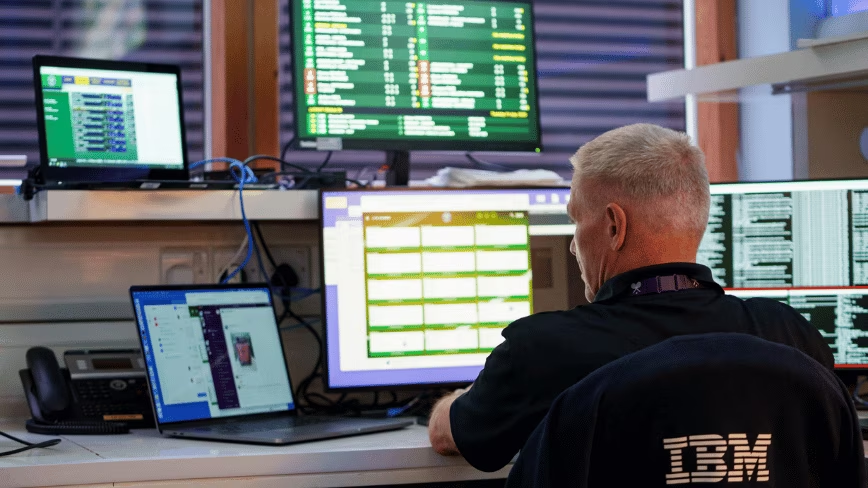
A serve flashes on the Wimbledon scoreboard before the ball stops bouncing. That number comes from a partnership older than most players on court.
IBM has been Wimbledon’s technology partner for 36 years, since it planted serve-speed radar behind the baselines in 1991. This year the two extended their deal to 2030, Fortune reported.
The reach has outgrown the grass. More than half a million people attend over the fortnight, but they are a sliver of the audience. Wimbledon generated roughly 18 billion impressions across its digital channels in 2025. That reached an estimated 730 million people, the All England Lawn Tennis and Croquet Club says.
Visits to the site and app rose more than 20 per cent in the past year.
Inside ‘Court 19’ #
The engine room sits out of sight. IBM’s hub, nicknamed “Court 19”, lies beneath the 18th grass court. Over the tournament it processes about 2.7 million data points: ball speed, shot placement, momentum swings. It turns them into the features fans tap on the app.
For IBM, tennis is not really the point. Wimbledon is a proving ground. Kameryn Stanhouse, its vice-president of global sports and entertainment partnerships, says there is “a real fear around AI” among executives. “Not because leaders doubt they need it,” she says. It is that their jobs may be on the line if they get it wrong. A high-stakes stage, the pitch goes, shows IBM can deploy the technology without breaking it.
When the machine gets it wrong #
That fear is not abstract. In 2025, Wimbledon replaced its 300 line judges, a fixture for 147 years, with automated electronic line-calling. The debut was rocky. The system missed three calls in one quarter-final and shouted “fault” mid-rally, forcing an umpire to step in. Jack Draper questioned its precision, and Emma Raducanu called some rulings “dodgy”.
That system runs on Sony’s Hawk-Eye, not IBM. But the episode hangs over every talk about handing match-changing calls to a machine. IBM stresses its own features are “human-led”. A governance layer scores confidence and checks for bias before anything reaches a fan. It is a fine distinction, and one a furious fan is unlikely to notice when a screen gets it wrong.
Some of the old theatre has gone too. Players once challenged a call, the crowd hushed, and the replay lit up the big screen. Even IBM’s “Likelihood to Win”, which recalculates odds after every point, drains a little suspense. Stanhouse calls it a fair trade. “Fans argue less about the marginal calls and more about the tennis itself,” she says.
A shop window for enterprise AI #
The commercial logic is plain. The global sports market could top $600bn by 2030, Kearney forecasts. IBM is far from the only firm using sport to prove its AI before selling it elsewhere. Stanhouse says a match offers what few enterprise pilots can: huge volumes of live data, under pressure and in public.
The productivity pitch is sharper still. To rebuild the app and site, IBM used an accelerator it calls Bob. It migrated more than 15,000 digital assets to a new platform. Work that would take five specialists months took one engineer a month, Stanhouse says. The final transfer ran in 47 minutes.
What comes next is more personal and more remote. IBM has already built a Masters golf app for Apple Vision Pro and expects tennis to follow. Quantum computing may find a role too, though IBM says it has not yet found one in sport.
Why it matters #
Wimbledon is a rare public test of whether AI can slot into something people love without spoiling it. A 2025 Capgemini study found 70 per cent of fans want real-time data. Yet more than half fear too much tech erodes the feel of live sport. That is the tightrope. As Stanhouse puts it, no technology will ever call the winner in advance.
“Somebody could wake up with a crick in their neck and can’t serve the way they used to.”
Get the TNW newsletter #
Get the most important tech news in your inbox each week.