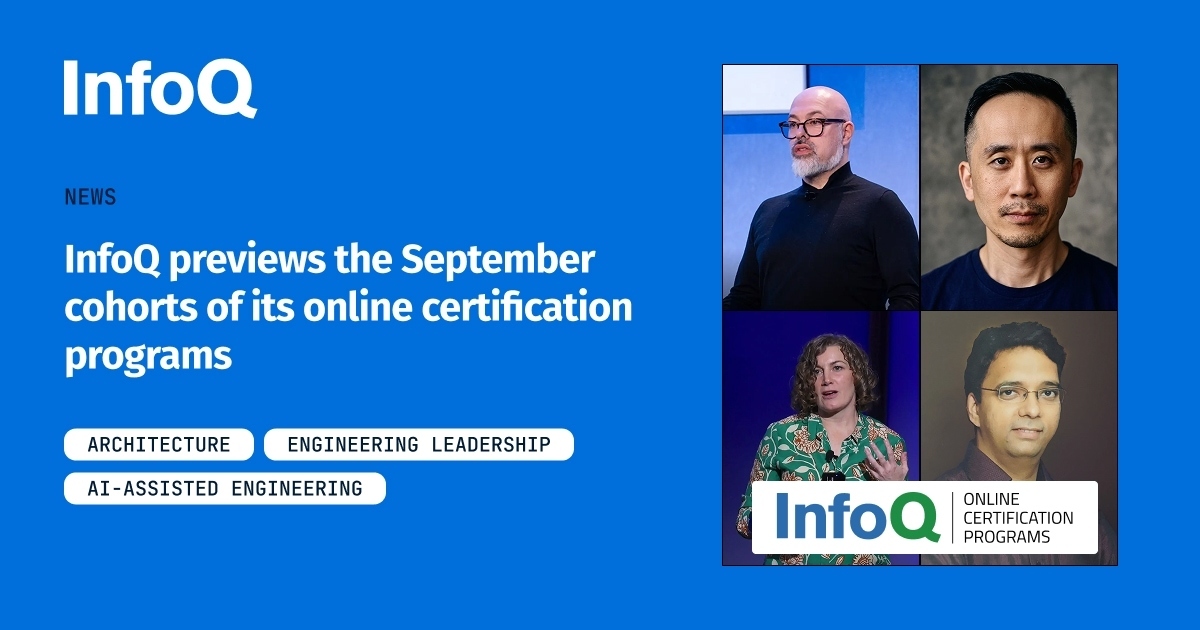
Enrollment is open for September cohorts in three InfoQ Online Certification Programs: Architecture, Engineering Leadership, and AI-Assisted Engineering. Each group meets online for one four-hour session a week across five weeks. You’ll complete the certification with new skills, validation of existing decisions, and a peer network to exchange ideas.
Participants watch a QCon talk before joining, then spend the live session applying a framework from it to a decision from their own work. They do this alongside a small group of experienced senior engineers and architects from other companies. Sessions are not recorded to encourage open discussion.
Engineers usually only encounter these facilitators through conference talks, but in these cohorts, they work directly with the group every week.
Architecture: Luca Mezzalira, starts September 14
Mezzalira wrote Building Micro-Frontends (O'Reilly) and writes the Dear Architects newsletter. He has consulted with over 100 teams on distributed architectures across 20 years. This means he has seen an unusual number of architecture decisions through to their consequences.
"In the real world, you wait years to see if your architecture was right or wrong," Mezzalira says. "We designed this cohort to shortcut that process."
His syllabus treats architecture as sociotechnical work. It spends as much time on how decisions get made and defended to a CTO as it does on the patterns themselves. The course covers decentralized decision-making, platform engineering, and developer adoption. It also covers the constraints AI agents introduce. For the capstone, participants co-author a technical article.
The best are published on InfoQ. Completing the program earns the InfoQ Certified Software Architect in Emerging Technologies (ICSAET) certification.
Engineering Leadership: Michelle Brush, starts September 18
Brush is an Engineering Director for SRE at Google, leading the teams that keep Compute Engine and Persistent Disk reliable. Before that, she was Director of HealtheIntent Architecture at Cerner. Earlier, she was the lead engineer on Garmin's automotive routing algorithm. She wrote two chapters of 97 Things Every SRE Should Know.
Her syllabus builds toward a final week on what a system costs after it ships. This covers capacity planning, operational load, and incident response, which closely describes her current job. The weeks prior cover organizational dynamics, then technical strategy and execution. They also cover which metrics tell the truth about whether a strategy is working.
"These cohorts bring together senior engineers and architects from different companies to work through the decisions behind leading technical work, the calls about strategy, execution, and accountability," Brush says. "The value is the peer group, working on the same problems in different contexts."
For the capstone, each working group builds a strategy for a real leadership problem and writes it up as a co-authored article. The best are published on InfoQ. AI-Assisted Engineering: Zichuan Xiong and Premanand Chandrasekaran, starts September 18
Xiong is Head of AIOps at Thoughtworks and builds agentic AI systems for software operations. Chandrasekaran is Head of Technology at Thoughtworks and has spent two decades leading engineering teams across financial services, retail, education, and healthcare. Their cohort runs on one split throughout: generation stays with the agent, while verification does not.
"Teams are adopting coding agents faster than they're building the verification around them," Xiong says. "The harness is everything outside the model: the permissions, the sensors, the review gates, the CI checks that let an agent correct itself before a human ever sees the change."
Over the five weeks, participants build a harness against a real brownfield codebase anchored on Claude Code. The course covers agent permissions, sensors, characterization tests, independent review, and CI for agents running unattended. The capstone has three parts: the harnessed repository, one rule or agent skill codified from the participant's own recurring review findings, and a write-up comparing five weeks of logged results against week-one predictions.
Full syllabuses and registration details for all programs are at certification.qconferences.com.