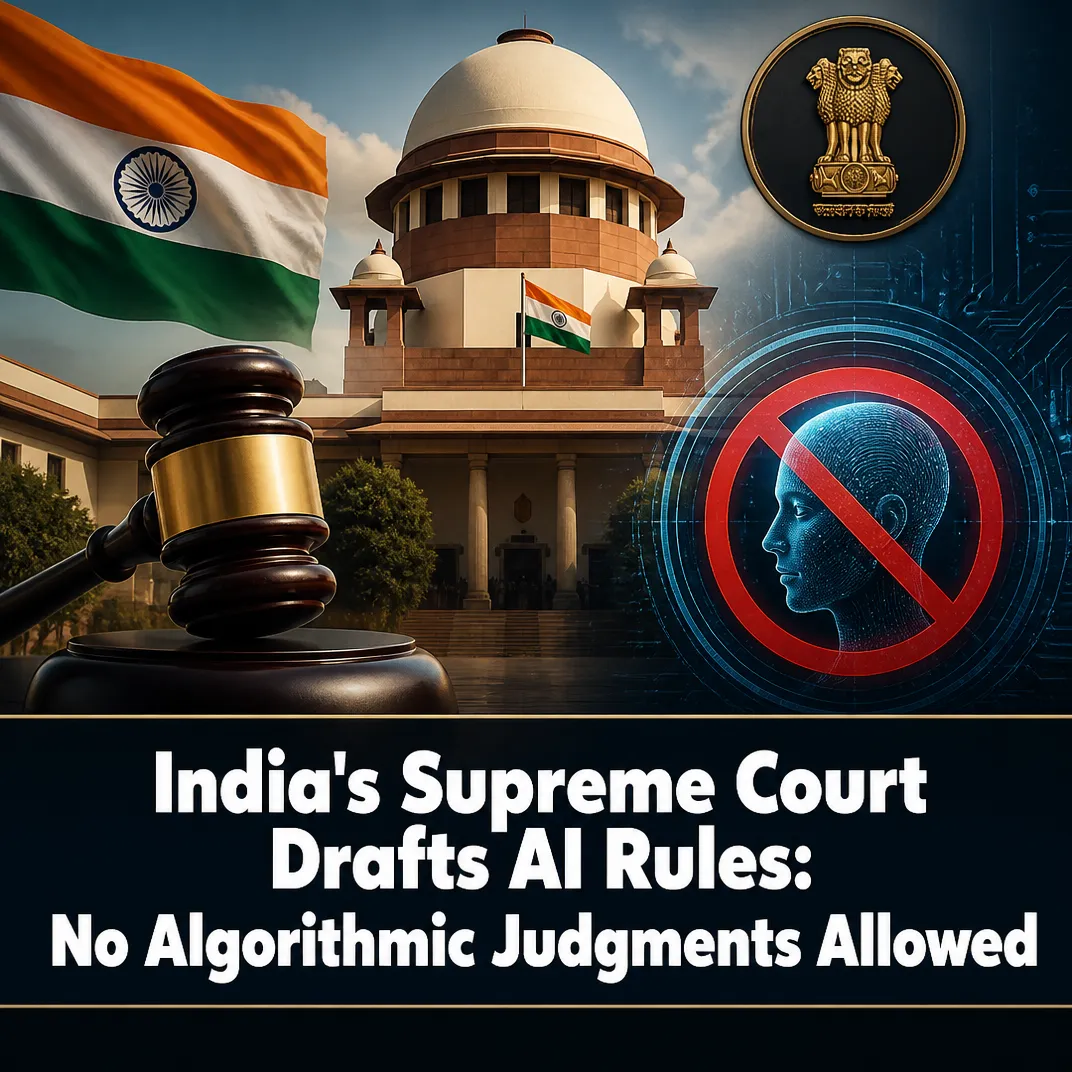
July 14, 2026, (Inside AI) — The Supreme Court of India has released draft regulations to govern artificial intelligence in the judiciary, setting a firm boundary: AI may assist, but it will never decide. The draft, open for public comment until July 15, arrives as courts worldwide grapple with automation's promise and peril.
India's proposed framework explicitly permits AI for administrative and assistive tasks—case management, transcription, translation, legal research, document summarization, and accessibility. Yet it draws an absolute line against algorithmic adjudication. No judicial outcome can rest on AI alone; human authority remains determinative.
The regulations list "absolute and non-derogable" prohibitions that no authority can override. These include risk scoring for flight risk, recidivism prediction, bail eligibility evaluation, witness credibility assessment, and any behavioral prediction of parties or witnesses. Blackbox AI systems are banned in matters affecting personal liberty.
This approach mirrors global caution. The European Union's AI Act classifies certain AI uses in law enforcement and justice as high-risk, requiring strict oversight. However, India's draft goes further by enumerating specific judicial functions as off-limits—a move some experts say addresses unique challenges in a system burdened by over 40 million pending cases.
The regulations will phase in unevenly. For the Supreme Court, they take effect on a date notified by the Chief Justice of India. For high courts and subordinate courts, each high court's chief justice sets the date. Different provisions can activate at different times, allowing courts to adapt gradually.
Critics warn that the prohibitions, while robust, lack detail on enforcement. The draft relies on internal committees and nominated officers for supervision, but does not specify penalties for violations or independent audit mechanisms. Without transparency, AI tools could still influence decisions subtly, especially if judges lean on AI-generated summaries without fully understanding their limitations.
Proponents argue the regulations are a necessary start. "It's better to have clear red lines than no lines at all," said a senior judicial official familiar with the drafting process, speaking on condition of anonymity. "The technology is moving fast, and we need guardrails now."
Historical context underscores the stakes. In the United States, algorithms used for risk assessment in bail decisions have faced criticism for racial bias. A 2016 ProPublica investigation found that COMPAS, a widely used tool, falsely flagged Black defendants as high risk at nearly twice the rate of white defendants. India's blanket ban on such tools sidesteps that controversy entirely.
Yet the regulations leave room for AI's advisory role, which could still reshape judicial workflows. AI-assisted legal research might speed up case preparation, but it also raises questions about the quality of machine-generated citations. In 2023, a U.S. lawyer faced sanctions after ChatGPT fabricated legal cases. India's mandate for human verification aims to prevent such errors, but it adds to judges' already heavy workloads.
The draft also prohibits submitting AI-generated output as evidence without full disclosure of its AI origin. This aligns with growing global norms around deepfakes and synthetic media, but enforcing it in a system where digital literacy varies widely remains a challenge.
As the July 15 deadline approaches, legal scholars and tech companies are expected to weigh in. The final regulations could influence other democracies in Asia and Africa that look to India's judiciary as a model. For now, the message is clear: in Indian courts, the gavel stays in human hands.