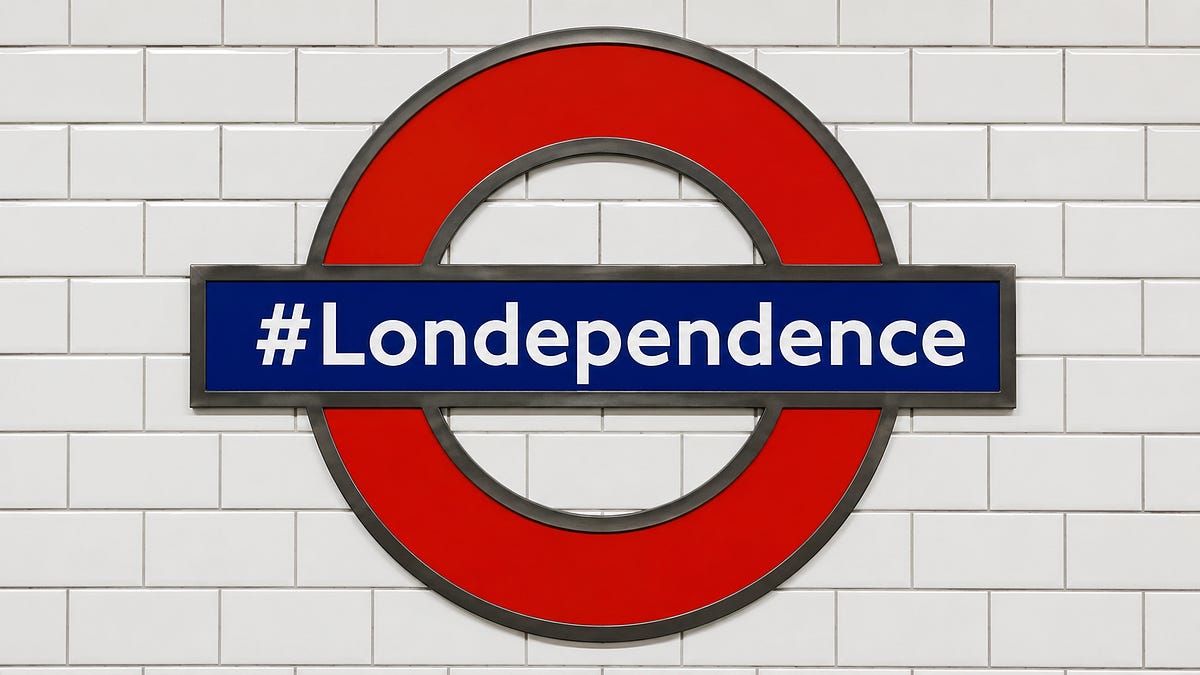
Reflections on ten years of #Londependence.
**POD! *On * YIMBY Pod this week, we dig more into plans to use AI to speed up the planning system, speaking to Faculty AI’s
Paul Maltby, who is working on the Augmented Planning Decisions programme. Plus – does Wychavon even exist?!
Listen here, or wherever you get your pods! It’s ten years this week since I had one of the strangest few days of my life.
It was the early hours of the 24th June 2016, and David Dimbleby had just declared to the nation that the numbers were conclusive: Britain had voted to leave the European Union.
At the time, I was living in Crouch End, the leafy North London suburb that is not just a Remainer heartland, but almost a parody of smug, affluent liberalism. The day before the referendum, I had hung my EU flag out of my window. It was unfortunate, in retrospect, that this was the only thing I did to help the Remain campaign.
So unsurprisingly, I was devastated by the result. It was a gut-punch. The nation was rebutting all of the smug, liberal values I believed in – and still believe in today. And it was made worse knowing the uncertainty it would create for my partner, who is a Canadian and Dutch dual citizen, resident in Britain thanks to her EU passport.
So feeling powerless, I did the only thing that powerless people can do in times of distress. I started a petition.
Heading to Change.org, I hastily typed out a somewhat tongue-in-cheek cry of despair: London is an international city, and we want to remain at the heart of Europe.
Let’s face it - the rest of the country disagrees. So rather than passive aggressively vote against each other at every election, let’s make the divorce official and move in with our friends on the continent.
This petition is calling on Mayor Sadiq Khan to declare London independent, and apply to join the EU - including membership of the Schengen Zone (Umm, we’ll talk about the Euro...).
Mayor Sadiq, wouldn’t you prefer to be President Sadiq? Make it happen!
#londependence
I posted the link to Twitter and Facebook, and promptly forgot about it as I continued to scroll through the morose Remainers on my Twitter timeline, collectively trying to make sense of the darkness that was descending on our politics.
Then just as I was about to, finally, go to bed, I remembered the petition and checked to see if anyone had signed. I couldn’t believe my tired eyes. It had somehow accrued over 1,000 virtual signatures in a matter of minutes.
My jaw dropped, and I continued to refresh as the sun began to peek over the horizon. The numbers continued rising… 1,500…. 2,000…. 4,000… 10,000. The petition was starting to snowball.
It appears that half-asleep and not entirely sincerely, I had accidentally sparked a new secessionist movement.
Starting a movement #
At some point, I did try to sleep. I think I lasted maybe an hour. But despite having been awake for almost a day at this point, it was impossible not to keep refreshing the petition. The number of signatures continued to rise. Every time I checked the page, another thousand signatures had been added – thanks in part to Change.org’s aggressive Facebook integration.1
And then my inbox started to ping. Journalists around the world wanted to speak to me. So as the numbers continued to soar – I believe reaching over 100,000 in the first day – I was fielding phone calls and trying to explain why I really believed in the cause I had decided that I stood for mere hours earlier.
The Evening Standard, Independent, BBC News, Huffington Post and Newsweek all wrote stories. I was invited to be on London Live’s TV news bulletin, followed by BBC World later that evening. I can’t remember what I said now – I presume I was barely coherent given the lack of sleep.
The momentum continued over the weekend, and the story of the petition went international. TV crews from around the world, who had travelled to London to cover the referendum, wanted to come to our flat and film me – I was the perfect, lighter ‘skateboarding dog’ story for the end of otherwise serious news bulletins.
And because I figured it would be good for my writing career, I accepted every single invitation to draw attention to myself. French TV came first, then Slovak. Then Canadian TV via Skype. Then Al Jazeera. Then Italian TV.2 It is not an exaggeration to say that on that Saturday afternoon, crews were literally queuing outside my house, waiting for the previous one to finish up.
As recordings went on, I think I developed some good lines. I had a good joke about how we could put Barbara Windsor and Michael Caine on the money, and how I didn’t want border guards on the M25. I also got pretty good at pretending to answer my front door, for the sake of the cameras. And I quickly learned the politician’s trick of the pivot: taking whatever I had been asked, and saying something like, “Well, I think what my petition really represents is…”., and then responding to the question that I wished I had been asked instead.
However, what really made this whole weekend the strangest is that while I was rapidly transforming myself into the Che Guevara of a dangerous new liberation movement, my partner’s now-late mother happened to be staying with us, having come over to visit from Canada.
She was a near-deaf, Dutch woman, and I don’t think she ever really understood me. And she most definitely didn’t when she arrived back from a trip out with my partner, to find me in the living room, having a camera pointed at me, with a Japanese TV crew sat on the floor.
My biggest mistake #
The petition continued to climb, even if the pace was slowing. By the Sunday morning, I was starting to wonder how to leverage this fleeting fame – and I got a little too high on my own supply.
Clearly, I’d tapped into the public mood on some level – even if it was obviously a bit of a joke. So I wondered… could I make something more out of it? Do I genuinely believe in this cause? Well no, obviously, but could I channel this energy to do something more useful – like campaign for more London devolution? That was something I do definitely believe in.
This was when I did something unwise. I started a crowd-funding campaign.
Blasting out an announcement to the now six-figure Londependence mailing list, I didn’t have a clear plan about what to spend it on. But nevertheless, within minutes, donations began pouring in. Within a couple of hours, it was already on £3,000, even though I’d provided few details on what I intended to do with the money raised.
And this was the glaring problem.
I told myself that I was seizing the moment, but I soon felt a knot in the pit of my stomach. I was now collecting money from people who were as furious about the referendum result as I was – but I had no idea what to do with it. I looked to my partner and my closest friends for advice, hoping they would tell me to carry on, given how potentially lucrative it was.
However, they rightly gave me a cold dose of reality. I was raising money with no plan. I was being irresponsible. I admitted to myself that this was a bad idea. So within a few hours, I’d cancelled the crowd-fund, and refunded every penny. I emailed the mailing list, explaining that I was in over my head.
I curled up on our bed with my head in my hands, feeling the pressure of thousands of eyeballs watching me fuck up. I just wanted the whole thing to go away. And then the Evening Standard wrote it up as a story. On the one hand, I thought they were bastards, but on the other, I guess fair enough.
But in any case, I was lucky. The abandoned crowd-fund was a blip. The petition numbers continued to climb. At some point, they hit over 160,000 virtual signatures, and included my downstairs neighbours, with whom I had until then exchanged barely more than a nod.
Back to obscurity #
By the Monday after the referendum, the phone had stopped constantly ringing. Realistically by this point, I knew that I was at serious risk of becoming like Homer Simpson, stepping unwanted onto the stage, asking the audience, “Did somebody say ‘perfect game’?”
However, a tiny bit of media attention did persist in the days and weeks that followed.
ITV London interviewed me at a very rainy Remainer protest in Trafalgar Square. Sky News held a set-piece, Kilroy-style Leave vs Remain debate *after *the referendum, which I think is the perfect illustration of the weirdness of the moment. I was seated next to Ben Judah, who would later go on to be an adviser to David Lammy when he became Foreign Secretary, jetting off to Davos and the G7. I would go on to be a blogger.3
On the Tuesday after the referendum, the idea of ‘Londependence’ made it to Sadiq Khan. Speaking at an event – I wish I could find the footage now. He quipped that as much as he might like the idea of being called ‘El Presidente’, he didn’t want London to declare its independence. And to be fair, I wasn’t really sure if I actually wanted it to happen either.
Then my final ‘Londependence’-linked engagement came a couple of weeks later, in early July. It was, viewed through the lens of history, the strangest of all.
I was invited to join an on-stage panel discussion at Conway Hall about what’s next now Britain has voted to leave. Amusingly, the panel also featured… future Gorton and Denton Reform candidate, and the most audience-captured man in Britain, Matt Goodwin. Today I very much do not like him.
Timeline-wise though, this was still the old Matt Goodwin, who either was or pretended to be a fairly down-the-line academic. It was long before he was snubbed for dinner by Alan Rusbridger and David Aaronovich,4 and years before the mask slipped to reveal that yes, he really is the absolute worst.
Anyway, I can’t remember much about what I said – though I do remember that Goodwin’s fairly dry explanation of what happened went down like a cup of cold sick in front of an audience of traumatised Remainers.
But this was not the only unusual thing about the evening. As I left the stage, a bunch of people came up to speak to me. Unlike me, they were not jokers or opportunists. They were true believers. They were sincerely interested in pursuing London independence. And they wanted me to help them organise, telling me they had scheduled a meet-up for supporters and wanted me to go along.
What sectarian forces had I inadvertently unleashed on British politics, I wondered? However, I never found out because I didn’t go, as they were just a bit too weird for me.
The aftermath #
As the summer of 2016 continued, the country quickly moved on from Londependence. That’s not surprising, as after all it was the same summer when Pokémon Go was released, which as I’ve said before I think was the last time the country was truly happy.
But there is one last coda to the story, which I think is pretty interesting.
Though the petition was, obviously, a joke, it had collected something important. Data. As the petition climbed to 180,000 signatures, I had accidentally created a database of London’s most passionate Remainers. These were the people who would be the foot-soldiers in any second referendum. They could have been valuable in the fight that was to come.
And I wasn’t the only person to realise it. I got an email from someone who had a personal assistant who sent emails on his behalf, requesting a meeting. So, unsure what to expect, I went along to his home, which was a house in Smith Square. That’s an extremely posh square a short walk from Parliament, where nobody normal lives.5
I’m not exaggerating when I say that his house wasn’t like any private home I’d ever visited – it felt more like walking into a museum, with old paintings and antique furniture, instead of an Ikea Poang chair and some billy bookcases. He was clearly a guy with money, a fact that became even more clear when he revealed that he worked at a hedge fund, and he wanted the petition data for the embryonic campaign to stop Brexit.
Unfortunately though, there were two problems. First, unlike other petition platforms, Change.org didn’t let me access the email addresses of the people who signed. Only their names and postcodes. And more importantly, I was familiar with data protection law. So there wasn’t really any viable way that I could hand over the data I did have – the names and postal addresses – even if I’d wanted to.
So all I could really do with it was aggregate the data, and make some nice maps.
The maps #
So here’s something fun. Here’s the Londependence map after around 116,000 signatures (the petition eventually rose to 180,000 before Change.org closed it), broken down by council ward.
It’s interesting, because it’s basically a snapshot in time of where London’s most hardcore Remainers were, in the immediate aftermath of the referendum. One well-connected political friend who I described the data to suggested that my data might even be better than what the Remain campaign was working with before the vote.
But what do the results tell us? Frankly, I think they are… completely unsurprising. Signatures were concentrated in the inner-London boroughs, with the single highest number of signatures from Brockley ward in Lewisham, with 560 residents signing. That’s a significant slice of the ward’s entire electorate.
And that’s what’s mad about this petition, I think. In fact, it becomes even more striking when you plot a map based on the proportion of residents in each council ward who had signed. It basically creates a perfect map of where the smuggest parts of liberal London really are.6
Though what is surprising is that my old ‘hood, Crouch End, is actually only 12th on the list, with 3.47% of every resident signing the petition7 – or 8th once you exclude the oddity of the City of London, where the number of actual residents measures in the low hundreds.
So where is the most ultra-Remain, ultra-liberal area of London? Again, City of London excepted, it turns out that it is just down the road from Crouch End, in Muswell Hill, where a staggering 3.94% of everyone in the ward signed my stupid petition.
Back to today #
So that’s the story of what happened to me, ten years ago this week.
The reason I’ve been thinking about this again is obviously because of the anniversary of the referendum, but also because as stupid as my original petition was, it does hit upon something that is still relevant today.
That’s because what, I think, my petition really represents is the stark fact that London doesn’t have enough control of its own destiny. And that’s something we should still care about today – even if we don’t *actually *want the capital to break away.8
Sadiq Khan may not want to be El Presidente, but he should be given more powers. If London had more fiscal autonomy, it could raise the money to pay for the much-needed Bakerloo line extension. If London had more planning powers, it could try to get London building again. And if London had more power over licensing, its night-time economy wouldn’t be permanently in a state of crisis.
So no, I don’t think London should declare independence. I never did really. But I’m not sure the London independence movement is quite dead yet. Because just like every other liberation movement complains when its plans don’t pan out, the reality is that real Londependence has never been tried.
1 I don’t think this would have gone as viral if it were on the official Parliament petitions website. At the time, I believe Change.org would automatically post on your timeline if you sign a petition – which meant it could gain a lot of traction very quickly.
2 Italian TV was particularly interesting. They actually did the hit live, and it was the first time I’d seen one of the (now pretty common) gadgets that bind together four separate SIM cards to transmit live video footage, to save the need for a satellite truck.
3 Weirdly I’d actually read a couple of Ben Judah’s books so actually knew who he was.
4 Amazingly the famous dinner snub debate also took place at Conway Hall!
5 Interestingly, I had been in Smith Square just a few weeks earlier. I was actually there when Nigel Farage unveiled his awful ‘Breaking Point’ poster, a few days before the referendum, on the morning that Jo Cox was murdered, but that’s another story.
6 God, how I wish I still there, sometimes.
7 The denominator there even includes children so it must mean an even more surprisingly large proportion of the adult population in each of these places signed.
8 Not least because I don’t actually live in London anymore.