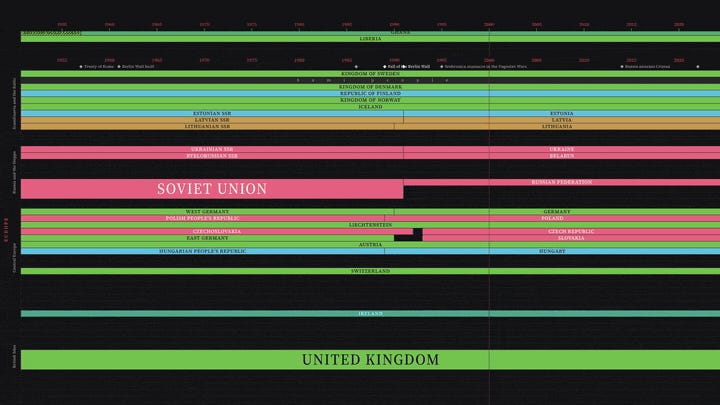
At 4:35 in the morning on November 8 I pasted a link to a photo of a poster into Claude Code and typed “make this an interactive website please make it as AAA as possible”. Around 11 that night I hit publish on a seven and a half minute film about it, 4K at 60 frames a second, with a score, narration and a new studio intro. The website had been live since breakfast, and by the time the film went up it had over two thousand rows of states, empires and peoples going back five thousand years, each one with a source you can click.
That’s about eighteen and a half hours from a photo to a published film, which I think is pretty fucking impressive, so this is how it actually went, including the bits where it went wrong, because there were a few.
You can play with the chart at entireworldhistorytimeline.com and watch the film on YouTube.
It started as somebody else’s poster #
The idea isn’t mine, SenseForMaps makes a World History Timeline poster, one giant chart with every state and people stacked in rows against time. I saw a photo of it and basically wanted that, but something you can actually zoom around in. The site credits them and so does the film’s description, and you should go look at the original.
The first version was live about forty minutes after the first prompt. I gave it the domain and it put the site up, then I told it to credit me, and what came out was a canvas chart you can zoom from the whole five thousand years down to a single dynasty, twelve regions colored by language family so you can watch Semitic or Turkic speakers spread across the page, and a static page for every row so Google has something to read.
That first version had 2,012 rows and the build spat out 2,082 pages, and not one of those rows had a source behind it yet.
Somebody asked where a row came from #
About ten hours later someone asked, very politely, where the early Dravidian row came from, the one running back to 3200 BC, and I couldn’t tell them, a model had written it, it looked right and I’d believed it, same as you’d believe anything in a nice clean table.
So I said “can you fix then”, followed by “good yeah make sure everything we state is sourced”, and it sent 21 agents through 2,367 rows and events, checking dates and descriptions against real articles and changing whatever didn’t match. Dates moved, descriptions got rewritten, some rows changed language family. Indeed it took another pass later on, it went round again until nothing was left flagged, 2,594 rows and events sourced and 3,427 links that all resolve.
Let me be clear about what that means tho, 99.7% of those sources are English Wikipedia, so this is a chart checked against Wikipedia and I’m not going to dress that up as scholarship. But click any row and you can see where it came from, and if it’s wrong you can tell me.
It put a dome on Persepolis #
Then I wanted it more cinematic. The guided tour has 15 stops, and each one got a still from GPT Image that Kling turned into one continuous shot of 22 to 27 seconds, a first clip plus a continuation from its last frame, with ElevenLabs doing the voice and the sound. We ran Kling against Seedance side by side before picking it.
One take of Persepolis revealed a dome that Persepolis never had. Looked gorgeous, complete fiction, so it got recut. You get a lot of that with these models... it hands you something beautiful and something wrong with the same straight face, and if you’re not actually looking you’ll ship the dome. The film’s description says straight up that the scenes are imagined reconstructions.
Filming a website one frame at a time #
The film is the real site, so every move you see really is the chart. Claude swapped out the browser’s clock so the chart only moves when the capture script tells it to, one exact frame at a time, which means it doesn’t matter how long each 4K frame takes to grab, the motion comes out perfect at 60fps. Then it’s all cut together in Remotion with the AI scenes, an ElevenLabs voice and a score from ElevenLabs Music. It opens on the best fact on the whole chart, Cleopatra lived closer in time to the iPhone than to the building of the Great Pyramid, and near the end it pulls all the way back and tells you that out of 2,162 rows only 301 make it to today. The final master, with the new intro in it, was 27,035 frames and took 38 minutes to render.
Before that final render I looked at our studio intro and told Claude, and I’m quoting myself here, that it looked “basic bitch af”. It binned our old electric logo reveal and wrote an actual raymarched light shader, the V of the Voidmode logo as a tear in a black wall with light pouring through the smoke, same 3.4 seconds so the edit didn’t move. Re-baking the intro in 4K takes under a minute, so we just kept going until it was right.
Once I’d uploaded the master to YouTube, Claude filled in nearly everything else through my browser, the title, the chapters, the tags, the AI disclosure, a three way title test and the end screen.
Has to be tasteful clickbait #
The first thumbnail was a plain shot of the chart, so I told it “needs much better click bait thumbnail” and what came back was the full YouTube treatment, a shocked Cleopatra, giant arrows, fat outlined text. It read fine at feed size and it was way too loud for us, so I told it “has to be tasteful clickbait”. I ended up up a different one from that batch myself, the glowing wall of history with one tiny person in front of it.
Claude then came back with a quieter dusk portrait of Cleopatra looking at a phone and told me it thought that one would beat mine. It might be right, I’ll test it against the wall once the title test finishes.
Hang on, where’s Libya #
After the film was out I was looking at the chart and asked “I wonder why Libya has no history recorded here before the Ottomans?”, which is a fair question for a place with Cyrene and Leptis Magna in it.
Turned out there’s no Libya lane on the chart at all, its three historic regions got filed under different headings, and from the year 439 to 1551 almost nothing even mentioned the place, about 1,100 years of it. I said “fix please”, and it had agents read the sources, added five new rows, fixed a link that wrongly handed Cyrene over to Roman Africa and named Libya in ten rows that had skipped it. That took about twelve minutes, and the site now counts 2,167 rows to the film’s 2,162.
And look, every audit had already passed at this point, nothing flagged, validator happy, every link resolving, and a whole country’s medieval history was barely there. Makes sense when you think about it, a checker can only check what’s on the page, it’s got no idea what isn’t. Somebody had to look at it and go, hang on, where’s Libya, and that was me at half eleven at night.
There are definitely more holes like that one, if you find one tell me and I’ll get it on the chart. That’s how the Banu Khattab of Zawila ended up on there, a dynasty that ran the Fezzan in the Sahara for about 250 years.
And if you want to have a play with it, it’s here https://entireworldhistorytimeline.com
Thanks for reading.
André