TL;DR — Key Takeaways
Humanoid robotics is progressing quickly, but impressive demonstrations do not necessarily translate into reliable, commercially viable workers.- Success depends on three interconnected layers: the body, intelligence and deployment infrastructure. - Real-world deployments from Figure, Agility Robotics and UBTech show meaningful progress, but questions remain around uptime, human intervention, maintenance and economics. China leads in manufacturing and hardware scale, while the U.S. remains strong in AI and robotics intelligence, with Europe, Japan and South Korea contributing industrial and robotics expertise.- Most humanoids still operate in bounded, controlled environments rather than achieving general-purpose physical autonomy. - The real milestone will come when customers repeatedly pay robots to perform productive work with fewer interventions and improving economics.
Watch enough robot videos and it is easy to believe the humanoid era has already arrived. Robots walk, run, dance, carry boxes and perform athletic maneuvers that would have been difficult to imagine a decade ago. Chinese manufacturers are shipping thousands of them. American startups are raising billions of dollars and signing agreements with some of the world’s largest automakers and logistics companies.
The progress is real. So is the gap between an impressive robot and a commercially useful autonomous worker.
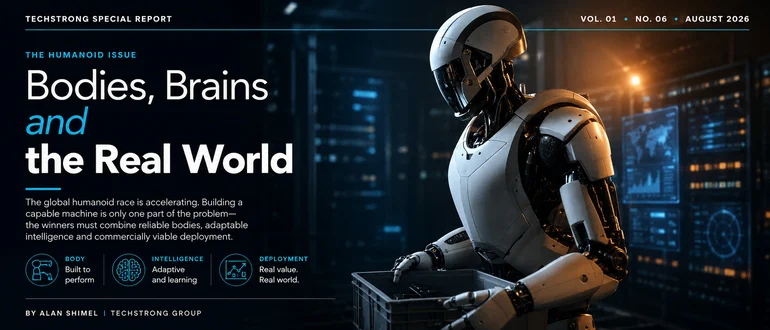
Our new Techstrong Special Report, “Bodies, Brains and the Real World: The State of AI-Powered Humanoid Robots,” examines that gap and the global competition to close it.
It Takes More Than a Body
The humanoid race is often presented as a competition to build the best physical machine. That misses two-thirds of the problem.
A commercially useful humanoid requires three systems to work together:
- The body: Actuators, hands, sensors, batteries, onboard computing, balance, durability and manufacturing.
- The intelligence: Perception, task understanding, planning, manipulation, learning and error recovery.
- The deployment system: Workflow integration, safety, maintenance, fleet management, human exception handling and sustainable economics.
The body determines what the robot can physically do. The intelligence determines what it can understand and learn. Deployment determines whether any of it creates economic value.
A robot performing a backflip demonstrates extraordinary mechanical engineering and control. It does not tell us whether that robot can move the same container hundreds of times during a production shift without breaking, stopping or asking a person for help.
Productive Work Is Beginning
There are credible signs that humanoids are moving beyond laboratory demonstrations.
At BMW’s Spartanburg, South Carolina, plant, Figure 02 accumulated approximately 1,250 operating hours and moved more than 90,000 sheet-metal components. According to BMW, the robot contributed to the production of more than 30,000 BMW X3 vehicles.
Agility Robotics says its Digit humanoid has moved more than 100,000 totes in a paid Robotics-as-a-Service deployment at a warehouse operated by GXO. The robot removes totes from autonomous mobile robots and places them onto a conveyor as part of a recurring logistics workflow. GXO describes the arrangement as a multi-year commercial deployment rather than another proof of concept.
Those are meaningful operating records. They also leave important questions unanswered. Neither case publicly discloses enough information about human interventions, uptime, maintenance costs or comparative economics to determine how close these systems are to operating like independent workers.
China provides another side of the story. UBTech reported selling 1,079 full-size humanoids and generating RMB820.6 million in related revenue during 2025. Yet a UBTech executive acknowledged that its robots currently produce only about 30%–50% as much as human workers on selected tasks.
That combination—rapid scale and limited productivity—captures the state of the market unusually well.
Download the Full Report (PDF) The Global Race Has Several Leaders
China currently leads in the body layer: components, supply chains, production capacity and aggressive pricing. Its manufacturing ecosystem can put thousands of machines into research centers, factories and developers’ hands.
The United States leads in much of the intelligence layer. NVIDIA, Google DeepMind and American robotics startups are developing foundation models and vision-language-action systems intended to make robot skills more adaptable and transferable.
Europe brings industrial integration, safety and human-centered design. Japan and South Korea retain deep expertise in robotics, electronics and automotive manufacturing.
No company or country has conclusively combined all three layers at commercial scale.
Our report also introduces the Techstrong Humanoid Autonomy Scale, ranging from direct teleoperation to general-purpose physical autonomy. Most commercially relevant systems today remain toward the lower end: They perform bounded tasks in controlled environments with human setup, supervision or exception handling.
That does not make the industry a mirage. It means we need better measures. Shipments are not deployments. Demonstrations are not productive shifts. Signed agreements are not customer renewals. And a robot that completes most of a task but frequently requires a person to rescue it may not be economical.
The humanoid era will begin when customers repeatedly pay robots to perform useful work with fewer interventions and improving economics. We are closer to that point than we have ever been. We are not there yet.
The full report examines the 50-year history of humanoid robotics, the body-intelligence-deployment equation, leading companies and deployments, the global competitive landscape, the Techstrong autonomy scale and the metrics that will separate sustainable businesses from remarkable demonstrations.
Read the full Techstrong Special Report: Bodies, Brains and the Real World: The State of AI-Powered Humanoid Robots.